All species › Passerines › Treecreepers › Short-toed treecreeper
Short-toed treecreeper | Certhia brachydactyla
Boomkruiper | Agateador europeo
On the Continent this is the treecreeper you meet first: the bird of village avenues, town parks, orchards and lowland oak and beech woods, working its way up a trunk in a tight spiral and then dropping to the foot of the next tree to start again. Britain and Ireland are the great exception — the short-toed treecreeper does not breed there at all, and a handful of records in the far south-east are national rarities. Anyone who learns their treecreepers in Britain and then crosses the Channel has to start again from scratch.

Voice
This is where the question is settled, and nowhere else. The call is a loud, full, penetrating tyoot, often repeated and sometimes running into an accelerating tyoot-tyoot-tyoot; it has real body to it and carries across a park, and more than one observer has first written it down as a great tit or a Chiffchaff. The song is short, loud and given in exactly the same rhythm every time, closing on an emphatic final note: tyoot tyoot tyoot te-roy-TIT. It lasts under two seconds and sounds cut off, as though a piece were missing. One trap is worth knowing: where the two species live side by side, some males sing the other's phrase. Call and habitat then count for more than song.
Recording: Latal — CC BY 4.0 · xeno-canto
Identification
Small and mouse-like, grey-brown above with fine white spotting and streaking that matches bark exactly, white below. The tail is long, stiff, pointed and rusty, and is braced against the bark as a third leg, so the bird jerks upward and never travels head-down. The bill is long, thin and curved like a pair of forceps, and works deep into bark crevices. The decisive detail is on the underparts and the head. Flanks and lower belly are rarely clean white but dingy to buff-brown, often with a warm wash on the rear flank. The supercilium is greyish and inconspicuous, weakest in front of the eye and not running far behind it. The pale band across the primaries is comparatively flat, with a short, barely projecting step. The bill averages longer and the hind claw shorter than in Eurasian treecreeper — measurements taken in the hand, not field marks, and every one of these characters overlaps.
Confusion species
Everything turns on Eurasian treecreeper; see its own species page, where the same difference is set out from the other side. That bird is whiter and cleaner below, warmer and more contrastingly spangled above, with a sharply defined white supercilium running well behind the eye, a shorter bill, a longer hind claw, and a pale primary band with an obvious projecting step. In dim light in a damp canopy not one of those marks is safe. Away from a calling bird, the honest course in the zone of overlap is to leave the record blank. Nuthatch is heavier built, blue-gray above with rusty flanks and a black eye-stripe, has a straight dagger bill and no propping tail, and is the only European tree-climber that also travels head-first downwards. Wren is likewise brown and barred, but round, short-tailed with the tail cocked, and it hops rather than climbs.
Habitat
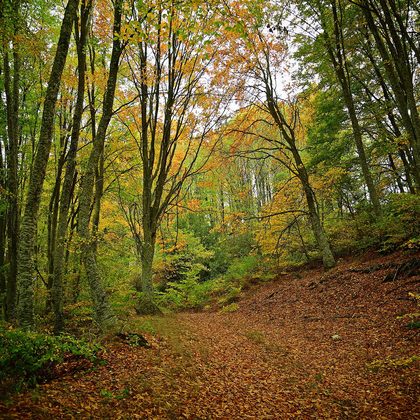
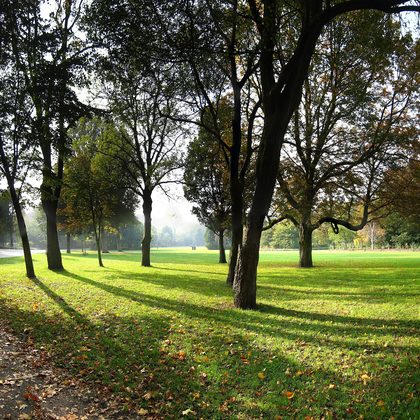
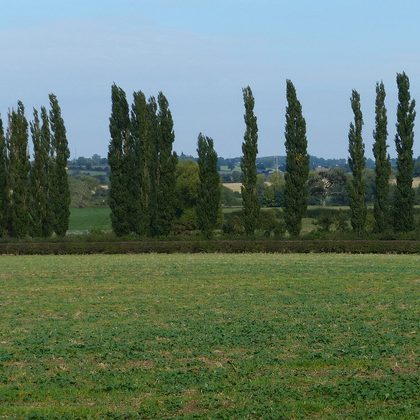
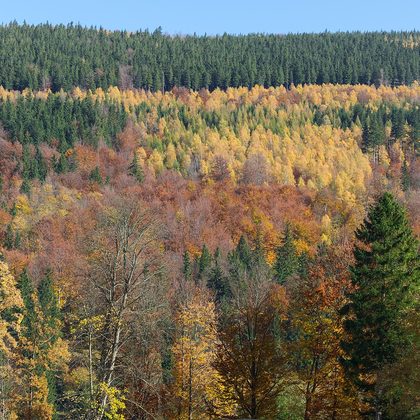
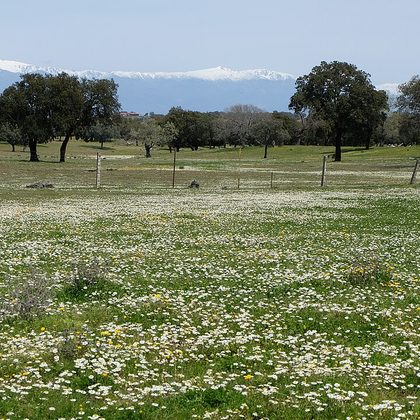
Broadleaved and mixed woodland in the lowlands, and above all half-open mature timber: beech and oak avenues, parkland, estates, cemeteries, traditional orchards, hedge banks, village edges and gardens with tall trees. What matters is rough, deeply furrowed bark and loose flaking plates; a smooth young plantation is worthless to it, an old oak or a flaking pine is a larder. The nest sits behind a hanging plate of bark, in a crevice under ivy or in a wedge-shaped treecreeper box, built as a platform of twigs carrying a cup of bark, moss and feathers. In southern Europe it also occupies cork oak woodland, dehesa and mountain forest well above a thousand metres.
Where the bird is most at home, classified with EUNIS — the European standard for habitats.
Range and movements
From Portugal and north-west Africa east to Turkey and the Caucasus, north to Denmark and the extreme south of Sweden; it occurs nowhere else in the world. Across France, the Low Countries and Germany it is the common lowland treecreeper and Eurasian treecreeper retreats to conifers and higher ground. In the Netherlands it is a widespread resident with 135,000 to 180,000 breeding pairs in 2018–2020, several times the estimate of the 1970s. Numbers have risen with maturing woodland, mature urban greenery and milder winters. It is highly sedentary: most birds spend their lives within a few hundred metres of where they hatched.
- Resident
- Breeding (summer)
- Winter
- Passage
- dark = core range, pale = thinly spread
Where and when to look
Learn the call first and the species turns up everywhere. From March to May walk an avenue of old trees between seven and ten in the morning and wait for the short, hard phrase, often delivered from a low branch or while climbing. To see the bird, do not look up: watch the base of the trunks, because a treecreeper always starts its round low down. Continental visitors from Britain should make a point of checking a bird in a lowland park in Normandy or Brabant against their memory of a British treecreeper — the dingier flanks and weaker supercilium are far easier to fix with the two impressions close together. In winter, look for roost hollows gouged into the soft fibrous bark of giant sequoias planted in parks; a bird will fly in at dusk and press itself into the pocket with its bill tucked in.
Conservation status
Not globally threatened and increasing over most of western Europe. The species gains from woodland being allowed to age, from mature planted greenery in towns and from milder winters, and is largely spared the pressures that have hit other woodland birds. Prolonged hard frost does cost it dearly, since it cannot work insects out of frozen bark, and a district can be half empty after a severe winter and full again three summers later. The one structural threat is the tidying away of old rough-barked trees, in woodland, park and street alike.