All species › Waders, gulls and terns › Sandpipers and snipes › Solitary sandpiper
Solitary sandpiper
Tringa solitaria | Amerikaanse bosruiter | Andarríos solitario
A small, dark-backed Nearctic Tringa and one of the more coveted transatlantic strays. At first glance it looks like a Green Sandpiper that has gone wrong: the same compact, dusky shape at the edge of a ditch, but with a bold white eye-ring and, the moment it flies, no white rump at all.

Voice
It almost always calls when flushed: a sharp, high, rather thin peet-weet-weet of two or three syllables, finer and more piercing than the fuller tlooee-weet-weet of Green Sandpiper and rising at the end. The tone recalls Spotted Sandpiper but is thinner and more urgent. A bird that goes up silently is a bird you will struggle with.
No freely licensed recording is available for this species yet.
Identification
Roughly Green Sandpiper size but slimmer-necked and finer-billed. Upperparts dark olive-brown, closely and neatly spotted white; breast finely streaked and cleanly cut off against a white belly. The complete white eye-ring stands out on the dark head, and the pale line runs only from bill to eye, never behind it. Legs dark olive-green, bill straight and dark with a dull green base. In flight the rump and central tail are dark; only the outer tail feathers are white with heavy black bars, and the underwing is sooty black. The feet barely clear the tail tip. Juveniles show buff rather than white spotting and are the age most likely to reach Europe.
Confusion species
Green Sandpiper is the first bird to eliminate, and the rump settles it: a solid, gleaming white block against a broad black tail band on Green Sandpiper, against a dark rump, dark tail centre and finely barred white tail sides on Solitary. Green Sandpiper is also bulkier, blacker above and more coarsely spotted, with a broken eye-ring and a short supercilium. Wood Sandpiper is the other trap: a long supercilium reaching well behind the eye, a square white rump, yellow legs and, crucially, a pale grey underwing, where Solitary and Green Sandpiper both show a blackish one. Run the three characters in order — eye-ring, rump, underwing — and together they leave nothing open.
Habitat
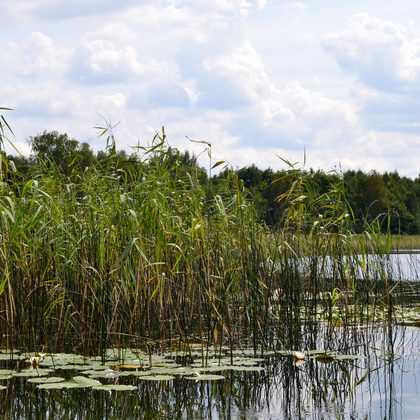
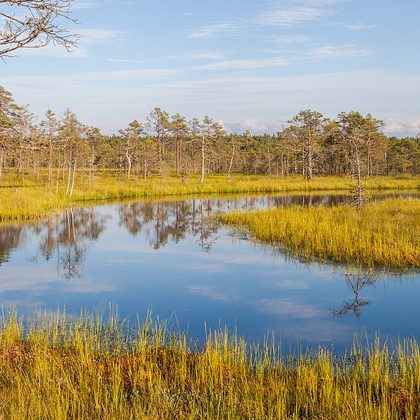
Small, sheltered fresh waters: woodland ditches, field drains, stream edges, muddy farm ponds and the overgrown corners of sewage lagoons, clay pits and reservoirs. It shuns open tidal flats. On the breeding grounds — muskeg and swamp forest across Alaska and Canada — it lays in the old tree nests of thrushes and other passerines, and the chicks drop to the ground within a day or two of hatching.
Where the bird is most at home, classified with EUNIS — the European standard for habitats.


Range and movements
Breeds right across the North American taiga and winters from Mexico to Argentina. In Europe it is a genuine rarity: a few tens of records for Britain and Ireland, a handful for the Netherlands and a scatter elsewhere, with the Azores taking the largest share of the Western Palearctic total. Most birds are juveniles displaced in late August and September, and one that makes landfall often stays for days at a single small pool.
Where and when to look
In September ignore the estuary and work the small water: an overgrown sewage lagoon, a drain behind a sea wall, a clay pit drying out among willow scrub. Walk slowly and listen, because the bird usually lifts at ten metres and calls as it goes. Watch the rump as it climbs away; two seconds is enough.
Conservation status
Least Concern, with a thinly spread but very extensive breeding range across boreal North America. Numbers are hard to monitor because it nests solitarily and stays out of sight through the breeding season. The pressures worth naming are the loss of small forest wetlands to forestry and drainage and the drying of the muddy pools and rice fields it uses in winter.