All species › Sandgrouse › Sandgrouse › Spotted sandgrouse
Spotted sandgrouse | Pterocles senegallus
Sahelzandhoen | Ganga moteada
The palest sandgrouse in this guide and the largest of the three desert species: a long-bodied, sand-coloured bird with an orange face and two fine tail streamers. On bare gravel plains it is next to invisible, and most sightings begin as sound — a flock coming in to water, low and fast, with a soft bubbling call that carries right across the flat.

Voice
The flight call is a musical, bubbling quee-too quee-too, sometimes written witt-oo witt-oo: two syllables, the second lower, with a whistled undertone. It is markedly softer and rounder than anything the Iberian sandgrouse produce. Flocks call almost continuously on the way to water, and over open ground the sound carries several hundred metres. Birds flushed at close range give a shorter, harder kwit.
No freely licensed recording is available for this species yet.
Identification
Bigger and slimmer than the other two desert sandgrouse, with elongated central tail feathers — shorter than those of pin-tailed sandgrouse, but plain to see both perched and in flight. The male is almost unmarked sandy: grey crown and nape, orange-yellow face and throat, plain pinkish-grey breast with no band at all, and a narrow dark stripe running down the centre of the belly to the vent. The female is finely spotted black over head, breast and mantle, which is where the English name comes from, and shows the same dark belly stripe. In flight the primaries look strikingly pale with a dark trailing edge, and the underwing coverts are sandy rather than white. Legs short and feathered, bill small and blue-grey.
Confusion species
At a drinking pool it often stands beside crowned sandgrouse, and that is the comparison worth learning. This bird is larger and longer-bodied, carries two fine tail streamers and has a plain orange face; the crowned sandgrouse has a short pointed tail with no streamers, and its male wears a black band running from the forehead between the eyes down to the chin. Then look underneath: a narrow dark stripe runs down the middle of the belly here, while the crowned sandgrouse is unmarked below. Lichtenstein's sandgrouse presents no problem at all — much smaller, shorter-tailed, and closely barred all over. Against the two Iberian species the underwing is the thing to fix on: sandy here, so the bird reads as evenly pale from below, rather than white with a hard dark border. And the call always settles it: a soft two-syllable bubbling, neither a dry rattle nor a low growl.
Habitat
Flat desert with little relief: sand and gravel plains, the margins of dune fields, wide expanses of hamada with scattered tussocks, and broad dry wadi beds. Of the three desert sandgrouse this is the one that tolerates the loosest sand, and it is often found exactly where erg meets reg. Food is seeds picked from the ground while walking, and flocks also feed on stubble and field edges around the oases and in Israeli farmland. Water sets the shape of the day: one to two hours after sunrise the flocks arrive at a pool, a cattle trough or a well, drink quickly and leave. The male soaks his belly feathers there; that plumage holds water, and he flies it back to the chicks, which drink it straight from the feathers.
Where the bird is most at home, classified with EUNIS — the European standard for habitats.
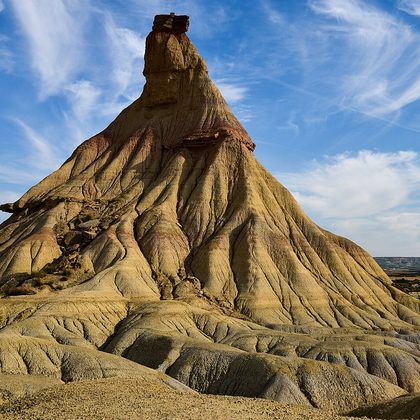
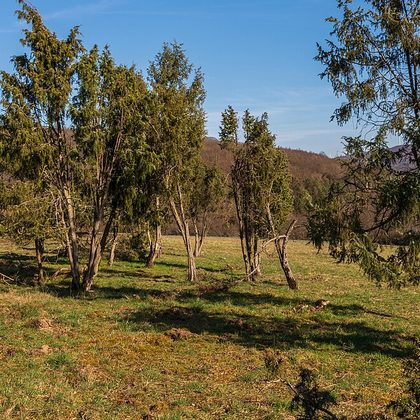
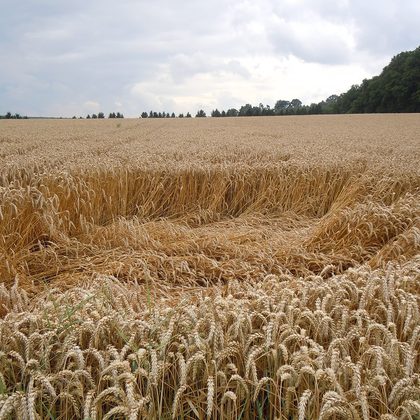
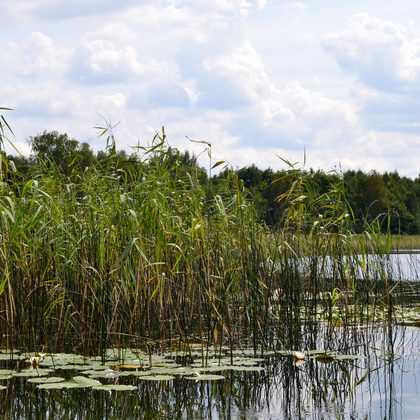
Range and movements
Two centres within the area of the maps. In Israel it is resident in the Negev and the Arava, commonest in the south. In Morocco it breeds in the pre-Sahara south of the High Atlas and Anti-Atlas: the Tafilalt around Rissani and Merzouga, the plains near Zagora, and the middle Draa. Further east and south, beyond the map, the range runs right across the Sahara and Arabia to Iran, Pakistan and north-west India. It is not a bird to look for in Europe; only scattered individuals have ever crossed the Mediterranean.
- Resident
- Winter
- Passage
- dark = core range, pale = thinly spread
Where and when to look
Go to the water and wait. In the Arava and the Negev, and at the wells and livestock troughs around Merzouga and Rissani, flocks arrive between one and two hours after sunrise — later than most desert birds, so there is no need to rush. Sit low with the sun behind you and listen: the bubbling quee-too almost always arrives before the birds do. Searching the open plain is rarely productive; when something is picked up it is usually no more than an orange head above a tussock. A scope from a fixed vantage beats driving around.
Conservation status
Not globally threatened — the species occupies an enormous desert belt from Mauritania to India — but along the northern edge of that belt the decline is steep. In Israel it is listed as endangered nationally. In the 1980s ten to fifteen thousand birds still gathered at drinking sites and two to three thousand breeding pairs were estimated; the population has since fallen by more than half over three generations, and the species has all but vanished from the Be'er Sheva valley and the north-western Negev. The reasons given are the loss of clean drinking water, the spread of arable land and greenhouses, disturbance from military training and grazing, and increased nest predation by foxes and jackals subsidised by human waste. No targeted conservation measures have been taken so far.