All species › Passerines › Bush warblers › Streaked scrub warbler
Streaked scrub warbler | Scotocerca inquieta
Maquiszanger | Prinia desértica
A mouse with feathers: eleven centimetres, a good part of it a dark tail held upright, moving through the dwarf shrubs of a stony desert slope as though it were rolling along the ground. Scrub warbler is a fair name and the scientific one, inquieta, is fairer still: this is a bird of grit, stone and dry bush that never stops moving.

Voice
The song is a short, clear, plaintive whistle of two to four notes, tsee-tsee-tsoo, the last falling away — an oddly pure sound in a landscape where nothing else sings. The female often answers at once with a dry rattle, so the pair seems to produce a single phrase. It sings all year but most from January to April, usually from the top of a low bush or a stone and at first light. Calls: a rolling prrt and a sharp tsit, and as a rule you hear these long before you see anything.
No freely licensed recording is available for this species yet.
Identification
Small, round and softly marked. Sandy grey to drab brown above, the crown finely dark-streaked and the mantle faintly so; the drier the country, the paler the bird. The head pattern settles it: a sharp dark eye-stripe with a long creamy supercilium above it. Underparts off-white, warming to pink-buff on the flanks and under the tail. The tail is long, dark and graduated with white tips to the outer feathers, and is almost always cocked or swung nervously from side to side. Bill small and fine, legs pale pink to orange and surprisingly long. Sexes alike. It flies as little as possible: low, weak, and straight into the next bush.
Confusion species
Graceful prinia also cocks a long tail but lacks the black eye-stripe and creamy supercilium, is paler and warmer, and lives in gardens, hedges and reed rather than stony desert; its song buzzes like an insect instead of whistling. Asian and African desert warblers share the ground but are plain sandy with no streaked crown, have a shorter tail, a yellow iris and yellow legs, and stay inside the bush. Larks of the same slopes walk in the open and show a long pointed wing and short tail; this bird scuttles beneath the shrubs with its tail up.
Habitat
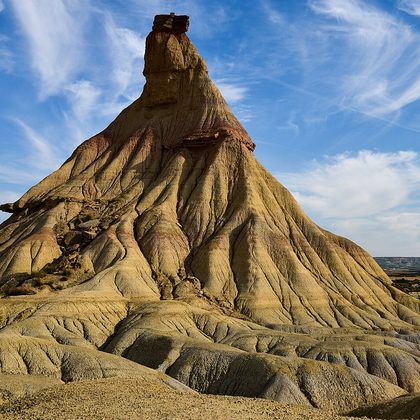
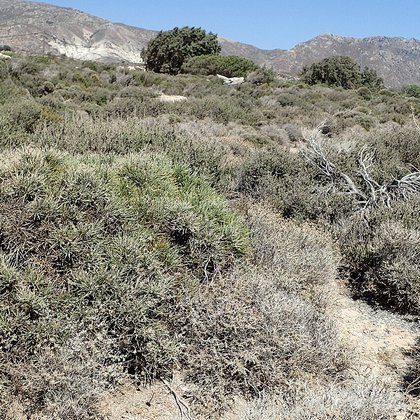
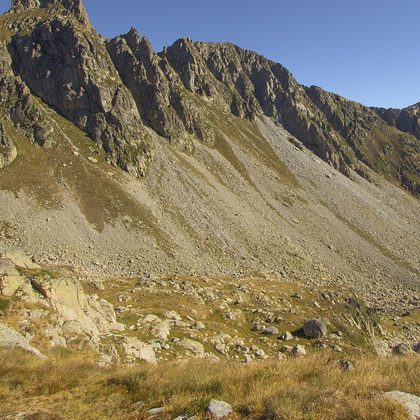
Stone and gravel desert with scattered low shrubs: wadi beds and their banks, boulder slopes, scree fans below cliffs, weathered plateaux and the dry margins of steppe, from sea level to well over two thousand metres in the Atlas. It avoids pure sand desert without bushes, and avoids buildings and irrigation just as firmly. The nest is a domed ball of grass, wool and feathers with a side entrance, hidden low in a thorny shrub; outside the breeding season families of four to eight birds move about together.
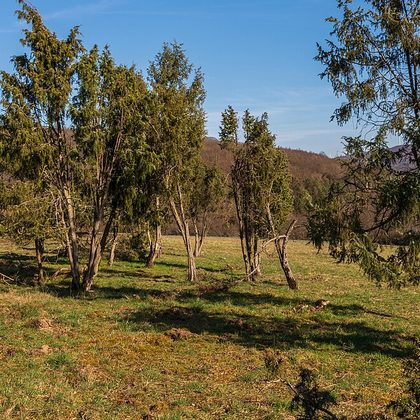
Where the bird is most at home, classified with EUNIS — the European standard for habitats.
Range and movements
From Morocco and the northern Sahara east through Tunisia, Libya and Egypt, across Sinai to the Negev, the Judaean desert and Jordan, and beyond this guide's map into Arabia, Iran and Central Asia. Within the guide it is therefore a bird of two far corners, the Maghreb and the Levant. It does not occur in Europe, and belongs to the small group of species you can only find along the desert edge.
- Resident
- Winter
- Passage
- dark = core range, pale = thinly spread
Where and when to look
The first hour after sunrise in a wadi near Sde Boker, in the Judaean desert, or on a stony slope in the Moroccan pre-Sahara. Sit still on a rock and listen for the rolling prrt; the family party will usually work past you, bush by bush. Expect to see it first as a grey ball running away, and only afterwards — when it hops onto a bush top — to get the head pattern and the cocked tail.
Conservation status
Not threatened (LC), widespread and common in its own ground. Its habitat is worthless for farming and is therefore hardly ever converted, which protects it in a way few songbirds in this guide enjoy. The damage is local: overgrazing by goats and camels that strips the low shrubs, cutting of bushes for firewood, and roads, quarries and solar plants along the desert edge. Long droughts push numbers down for a while, but the country is vast and the bird comes back.