All species › Passerines › Chats and flycatchers › Thrush nightingale
Thrush nightingale | Luscinia luscinia
Noordse nachtegaal | Ruiseñor ruso
The thrush nightingale is the eastern counterpart of the Nightingale: the same shape, the same skulking habits, but colder in tone and with a song that is louder, slower and far more insistent. It breeds from Denmark and southern Sweden east to Russia and Ukraine, and together with the Nightingale it forms the classic difficult pair of the European field guide — a pair settled in a single phrase on voice, and very often not settled at all on looks.

Voice
This is where it is decided, and the difference is wide enough to hear through an open car window. The song comes in short phrases separated by long, almost uncomfortable silences, and it is louder and lower-pitched than Nightingale's; on a still night it carries several hundred metres. The trademark is a hard, dry rattle trrrrrrr, like a wooden ratchet or a chain dragged over stone, alternating with deep clocking whistles chok-chok-chok and a shrill piercing tchee-tchee-tchee. What is missing is the famous swelling lu-lu-lu-lu-lu of Nightingale: that slow crescendo is entirely absent, and it is the one character that always separates the two. The whole delivery is also more angular, harder and less flowing — more punch than tune, with abrupt joins where Nightingale glides. Song runs from mid-May to late June, concentrated on the night and the first light of dawn. Calls are a grating krrrr, a hard tak and a whistled hweet, all three virtually identical to Nightingale's and therefore useless.
No freely licensed recording is available for this species yet.
Identification
A plain brown chat with a large dark eye, sturdy pale legs and an upright stance. The upperparts are cold greyish brown, without the warm rufous glow of Nightingale, and the tail differs hardly at all in colour from the back, so a bird dropping into cover shows no obvious rusty flash. Across the upper breast and the side of the throat lies a diffuse grey clouding — not crisp spots, more a vague mottling that shows only in good light at close range. The eyering is faint or absent. The wing is long and reaches well down over the tail base; on a sharp side view of the closed wing eight primary tips can be counted, against seven on Nightingale. Juveniles are warmly spotted and scalloped, exactly as in Nightingale.
Confusion species
It all turns on Nightingale — see its own species page, where the same difference is set out from the other side. Nightingale is warmer and redder above, has a distinctly rufous tail that flashes as the bird dives for cover, a clean unmarked off-white breast, a slightly more obvious pale eyering and a shorter wing with seven visible primary tips. Thrush nightingale is colder grey-brown, has a tail that stays close to the back in colour, a diffusely clouded upper breast and a longer wing. Be honest about what that is worth: on a photograph of a bird in shade, against the light or half behind foliage, the colour difference cannot be decided, and a thrush nightingale in low morning sun looks redder than a Nightingale at dusk. On many thrush nightingales the breast clouding is so faint that it disappears in a picture, and the wing character needs a sharp, square side view of the closed wing. Without song and without a sharp image, the wise course is to leave the bird unrecorded. Elsewhere: female Bluethroat shows a rufous tail base with a dark terminal band and a dark necklace, and young Robins are smaller, rounder and shorter-tailed.
Habitat
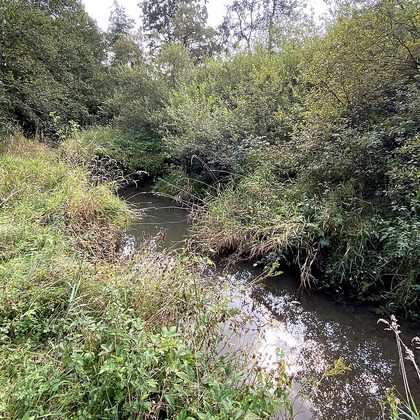
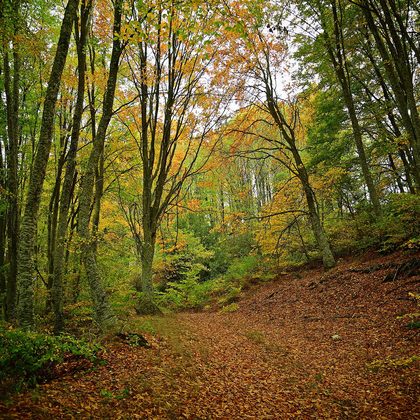
Damp, dense lowland scrub: willow and alder carr along rivers, rank floodplain thickets, hazel-rich understorey in moist deciduous woodland, old hedge banks and neglected parkland edges. Where Nightingale will also take dry dune scrub, thrush nightingale almost always wants wet ground — a closed shrub layer over bare leaf litter, usually within earshot of water. In the north of its range it breeds into town parks and along railway embankments wherever the undergrowth is thick enough.
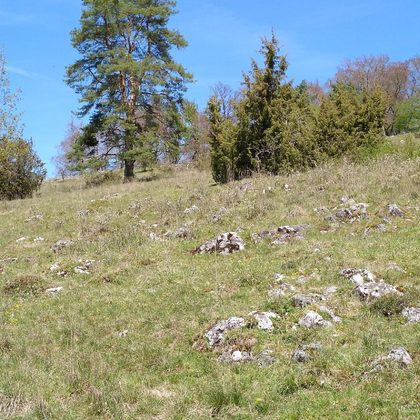
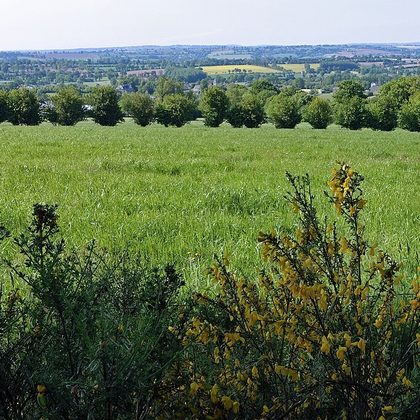
Where the bird is most at home, classified with EUNIS — the European standard for habitats.
Range and movements
Breeds from Denmark, southern Sweden and southern Finland through the Baltic States, Poland, Belarus and Ukraine far into Russia; in the south it reaches Romania, Bulgaria and the northern Caucasus. The boundary with Nightingale runs straight through central Europe, with a narrow belt where both breed and where hybrids are recorded. The entire population winters in eastern and south-eastern Africa, well outside the map area. In Britain it is a scarce but annual vagrant, chiefly on the Northern Isles and the east coast: singing males in late May and June, and skulking first-winter birds in September.
- Resident
- Breeding (summer)
- Passage
- Migration direction
- dark = core range, pale = thinly spread
Where and when to look
This is a bird you go and get on sound. The best places within the map area are the Biebrza marshes of north-east Poland and the wetlands of Estonia and Latvia, in the second half of May, between eleven at night and two in the morning. Stand on a dyke or a track through damp willow scrub and wait: on a good night three or four males will sing against each other. If you also want to see one, return to the same spot at first light and stay on the path — a bird that comes out onto a low branch of its own accord always gives more than one you have pushed into cover.
Conservation status
Not globally threatened (IUCN: Least Concern) and numerous over most of its range; in Poland and the Baltic States it is locally the commonest songster of the river valley. The western edge of the breeding range is creeping outwards, with breeding records into Denmark and northern Germany. Concerns are largely local: the canalisation of streams, the clearance of damp scrub from floodplains and the intensified use of river valleys, on top of the ordinary hazards of a migration of nearly ten thousand kilometres to East Africa.