All species › Passerines › Chats and flycatchers › White-throated robin
White-throated robin | Irania gutturalis
Perzische roodborst | Ruiseñor coliblanco
The white-throated robin is a slim, long-tailed chat of dry mountain slopes, and the male is one of the finest birds of the Middle East: slate blue, with a black mask, a white throat stripe and an orange breast. It breeds from Turkey and the Caucasus to Iran and Afghanistan and winters in East Africa.

Voice
The song is a fast, high, chattering torrent given from a bush top or in a short song flight, with plenty of imitation of local species; in tone it is thinner and more hurried than Nightingale's, and it lacks that bird's deep flute notes and long silences. The male sings mainly in the first hours after sunrise and again towards evening. The call is a sharp, disyllabic chis-it strongly recalling white wagtail, and a hard rattling trrrt in alarm.
No freely licensed recording is available for this species yet.
Identification
Larger and far slimmer than a Robin, with long legs and a strikingly long, jet-black tail that is often cocked and fanned. The male has slate-grey upperparts, a black face and black throat sides enclosing a narrow white throat stripe, a thin white supercilium, and orange-rufous breast and flanks that cut sharply against a white belly and white undertail coverts. The black tail, which shows no white when spread, is the best character in every plumage. The female is far duller: grey-brown above, off-white below with an orange wash on the flanks, a pale throat and the same long black tail. Juveniles are scalloped but already have the tail.
Confusion species
The male is unmistakable the moment face and tail are visible. The female is the difficult bird and is regularly claimed as something else in the Middle East: female and autumn redstarts have a rufous tail in constant shivering motion — the exact opposite of the plain black, more deliberately fanned tail of this species. Nightingale and thrush nightingale are shorter-legged, rounder and lack the white throat set against a dull grey face. Rock thrushes are much bulkier and heavier-billed. When in doubt, look at the tail and at the long legs, and note the upright stance on a rock or a low bush top.
Habitat
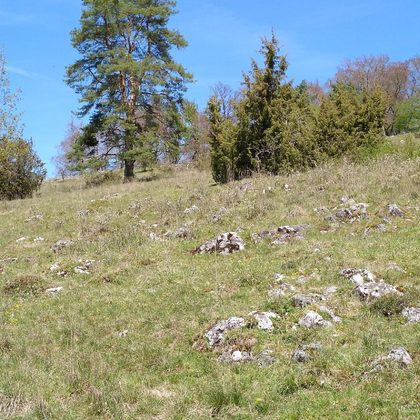
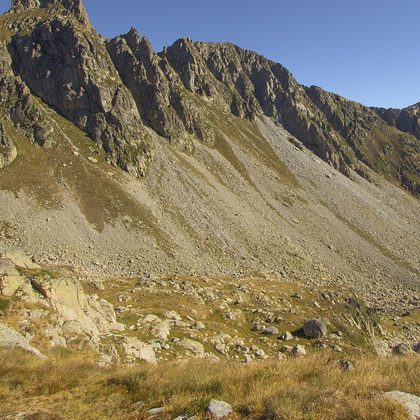
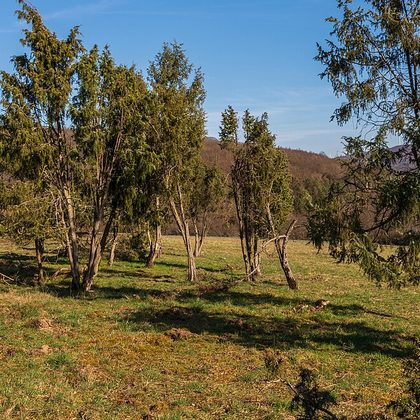
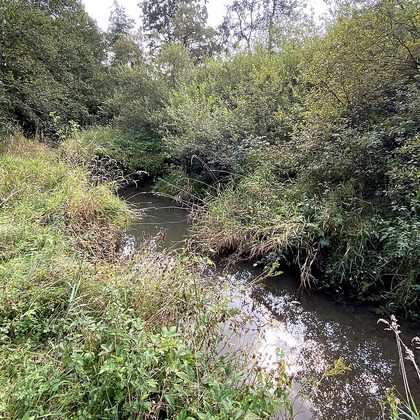
Dry, stony mountain slopes with scattered bushes: thorn scrub, almond, juniper and hawthorn on screes and rocky ground, usually between 1,000 and 2,500 metres. What matters is the mixture of bare stony ground to feed on and dense low bushes to vanish into. Where mountain streams cut through ravines it also uses the thicker scrub along the water, and in Israel and Turkey it reaches rank orchards at the foot of the hills.
Where the bird is most at home, classified with EUNIS — the European standard for habitats.
Range and movements
Breeds from western and central Turkey through the Caucasus, Armenia and Azerbaijan into Iran, Turkmenistan and Afghanistan; at its extreme west it reaches Greek islands such as Lesvos, where a few pairs breed. That entire breeding range lies inside the map area, but the winter is spent in East Africa — Ethiopia, Kenya, Tanzania — well beyond it. On passage it is numerous in Israel and Jordan. To north-west Europe it is an extreme vagrant, with a handful of records for Britain, the Netherlands and Scandinavia; the British birds are the classic Skokholm and Shetland spring overshoots.
- Breeding (summer)
- Passage
- Migration direction
- dark = core range, pale = thinly spread
Where and when to look
Look for it in May on a sunny, stony slope with scattered scrub in central or eastern Turkey, early in the morning. Walk the slope and scan the bush tops: a singing male almost always picks the highest twig of a low bush or a projecting rock. If you hear the wagtail-like chis-it, stand still and wait — the bird will work a few metres closer of its own accord and then spread that black tail. On Lesvos it pays to walk the dry slopes around Ipsilou in May.
Conservation status
Not globally threatened (IUCN: Least Concern) and locally numerous in the core of its range. The species is tied to a landscape under pressure: overgrazing that strips out the shrub layer, the grubbing of thorn scrub for arable land, and the cutting of roads and quarries into hillsides. Where scrub is left standing on stony slopes it holds up well.