All species › Passerines › Reed warblers › Western olivaceous warbler
Western olivaceous warbler | Iduna opaca
Westelijke vale spotvogel | Zarcero bereber
The olivaceous warbler of the west: a colourless grey-brown bird with not one striking feature, living in the tamarisks and oleanders along the rivers of southern Spain, Portugal and Morocco. It is never still, flicks its tail down at every hop, and gives itself away with a fast grating babble from deep inside a bush.

Voice
The song is a fast, low, grating babble kept up at length, with the lurching cadence of a Sedge Warbler but no clear whistles and no mimicry: a sustained stream of nasal, rattling notes from inside a tamarisk or a bramble. It is slower and fuller than that of Eastern Olivaceous. The call is a hard, dry tzek, running into a rattled tzrrr when the bird is agitated. Song from mid-April into July, including the heat of the afternoon.
No freely licensed recording is available for this species yet.
Identification
Plain grey-brown above and dirty white to faintly buff below, with no yellow, no streaking and no supercilium worth the name — the species is identified by the absence of marks. The bill is long, broad and straight with an entirely orange lower mandible, and the flat forehead runs straight into it, making the head look long and pointed. The primary projection is short and the tail square-ended, with narrow pale edges to the outer feathers. Legs grey to fleshy grey. Behaviour completes the picture: every movement is punctuated by a sharp downward flick of the tail. Sexes alike.
Confusion species
Icterine and Melodious Warblers are placed at once: both are clearly yellow on throat and belly and greenish above, while this bird is wholly colourless and, on top of that, dips its tail without pause. Eastern Olivaceous Warbler is the real problem — see its own species page, where the same difference is set out from the other side. That bird is smaller and shorter-billed, colder grey rather than brownish, and its song runs faster and higher. In practice geography decides: in Iberia and north-west Africa it is this species. Marsh and Reed Warblers are warmer brown, have a rounded tail and do not flick it.
Habitat
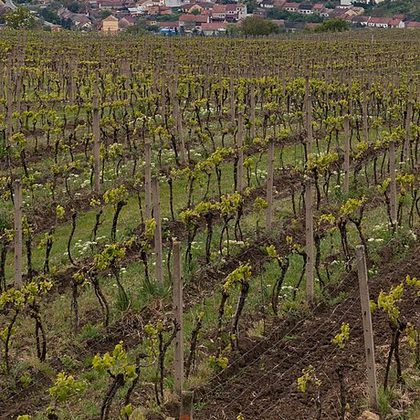
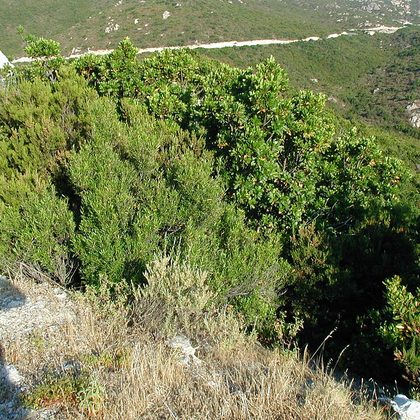
Scrub along rivers and streams: tamarisk, oleander, bramble and willow in the gallery beside the bed, including watercourses that run dry for most of the year. Also olive groves and orchards with an understorey, kitchen gardens, neglected gardens and village edges with thick hedges. It always wants dense low bushes and needs no woodland at all.
Where the bird is most at home, classified with EUNIS — the European standard for habitats.


Range and movements
Iberia south of the Ebro and the Tagus, and north-west Africa from Morocco to Tunisia. In Spain it is commonest in Andalusia and Extremadura and along the Levante coast, and it is absent from the north and north-west. It very rarely strays to north-west Europe, and there are no accepted records for the Netherlands. It winters in West Africa south of the Sahara and so spends well over half the year outside the area of this guide.
- Breeding (summer)
- Passage
- Migration direction
- dark = core range, pale = thinly spread
Where and when to look
May or June, early morning, along a southern Spanish river bed with tamarisk and oleander. Stand by the densest bush and wait for the grating babble; the bird will usually shuffle out onto an open twig for a moment afterwards. Watch for the tail flick at every hop — it is the one behavioural mark that separates it from Icterine and Melodious in a single second.
Conservation status
Not threatened and still common over most of its range. Canalising and dredging river beds, clearing tamarisk and oleander scrub and abstracting water for irrigation cost it habitat locally, and very dry summers depress breeding success. Where a river bed keeps its scrub, the bird is back within a few years.