All species › Passerines › Reed warblers › Eastern olivaceous warbler
Eastern olivaceous warbler | Iduna pallida
Oostelijke vale spotvogel | Zarcero pálido oriental
One of the commonest songbirds of the Balkans and the eastern Mediterranean, and at the same time one of the plainest to look at: small, grey-brown and without a single feature that catches the eye. It lives in riverside willows, in olive groves and in town gardens, and the first thing you notice is the hurried nasal babble and the endless downward flicking of the tail.

Voice
The song is a fast nasal babble with a bouncing cadence, closest to Sedge Warbler but with no clear whistles and no mimicry: minutes on end of short grating and chattering notes, usually from an open twig high in a tree. It runs faster and shriller than that of Western Olivaceous. The call is a hard tzek or tzrek, accelerating into a rattle when the bird is agitated. Song from late April into July, including the middle of the day.
No freely licensed recording is available for this species yet.
Identification
Small and plain, grey-brown above and dirty white below, with no yellow, no streaking and at most a faint pale supercilium in front of the eye. The bill is long and broad for the size of the bird, with an orange lower mandible, and the flat forehead makes the head look pointed. The primary projection is short and the tail square-ended and the same brown as the back, with narrow off-white edges to the outer feathers. Legs grey. The decisive mark is behavioural: almost every movement is punctuated by a short, hard downward flick of the tail. Sexes alike.
Confusion species
Icterine and Melodious Warblers are yellow on throat and belly and greenish above; this bird is colourless and, besides, dips its tail constantly. Western Olivaceous Warbler is the hard one — see its own species page, where the same difference is set out from the other side. That bird is slightly larger and longer-billed, browner in tone and slower in song; it belongs to Iberia and north-west Africa, while this species breeds from the Balkans to the Levant, so in practice geography decides. Upcher's Warbler is bigger, grey-headed, and swings a dark tail sideways. Reed Warbler is warmer brown, has a rounded tail and does not flick it.
Habitat
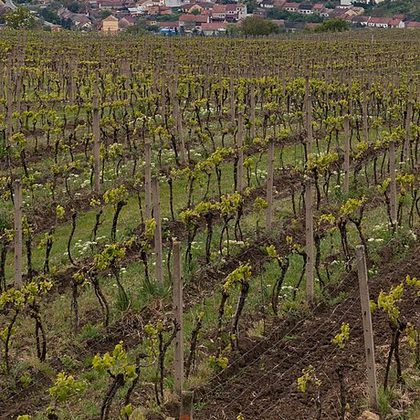
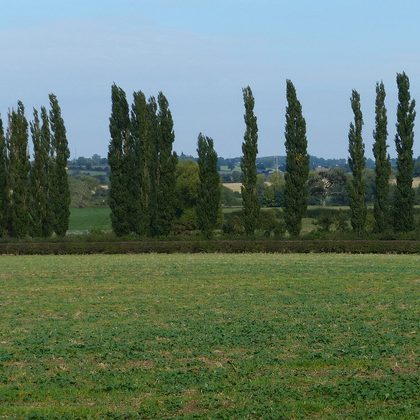
Willows, poplars and tamarisks along rivers and in floodplain woodland, olive groves and orchards, poplar lines and park woodland, and beyond that gardens, parks and village edges with big trees. Unlike Western Olivaceous it likes to be high up: it feeds in the canopy and sings from an open branch, and it avoids both closed forest and open treeless ground.
Where the bird is most at home, classified with EUNIS — the European standard for habitats.


Range and movements
Breeds in south-east Europe and the eastern Mediterranean: from Hungary, Serbia, Romania and Bulgaria through Greece, Turkey and Cyprus to Syria, Lebanon, Israel and Egypt, and on into the Caucasus and southern Russia. Along the Danube and in the Pannonian basin it has been pushing north for decades. It is therefore an ordinary breeding bird of the area covered by this guide and in no sense a vagrant, although in north-west Europe it remains a major rarity. It winters in the Sahel and eastern Africa.
- Breeding (summer)
- Passage
- Migration direction
- dark = core range, pale = thinly spread
Where and when to look
May or June, the first hours of the day, in a line of willows or poplars beside a river in Serbia, Bulgaria or northern Greece — or simply in an old town park anywhere on the Mediterranean. Work by ear: the hurried nasal babble belongs to the place like the sound of crickets. Then watch the tail: one hard downward flick at every hop turns an 'unidentified warbler' straight into this species.
Conservation status
Not globally threatened, stable to increasing in Europe and clearly expanding at the northern edge of its range. It tolerates farmland and villages well, which leaves it less exposed than most riverside songbirds, though the loss of floodplain woodland and the felling of old poplar lines hurt it locally. Since the beginning of this century it has been treated, along with Western Olivaceous Warbler, as a separate species; the 'Olivaceous Warbler' of older handbooks and of many photographs online still covers the two together.