All species › Passerines › Reed warblers › Sykes's warbler
Sykes's warbler | Iduna rama
Sykes' spotvogel | Zarcero de Sykes
The sand-coloured counterpart of the Booted Warbler: longer, colder in tone, and with a bill that looks too long for the bird carrying it. It breeds in the tamarisk, gardens and town parks of Iran and Central Asia. Until early this century it was treated as a race of the Booted Warbler; since then it has been treated as a separate species, and on the North Sea coast it is one of the hardest and rarest vagrants there is.

Voice
The call is a hard, dry tchek, often in a short burst, and a clicking tk-tk. None of it separates the bird from Booted Warbler, and on call alone a vagrant will never be accepted. The song does separate them: slower, lower and far more monotonous than Booted's — a sustained nasal, grating chatter of short, endlessly repeated phrases, closer to Eastern Olivaceous Warbler than to the hurried rattle of its smaller relative. On the breeding grounds it sings from May into July from a tamarisk or a garden tree, including through the middle of the day.
No freely licensed recording is available for this species yet.
Identification
A shade larger than Booted Warbler and much longer-looking, with a long tail and a short, blunt wing. The plumage is cold and washed out: sandy grey above, white to dirty white below, at most a faint buff wash on the flanks, and none of the Booted's warmth. The bill is the best mark: long, straight and nearly parallel-sided, the lower mandible orange-pink right to the tip — no dark tip. The face is flat and expressionless, with a short, diffuse pale supercilium that starts in front of and above the eye and barely continues behind it, and no dark lateral crown-stripe above it. The primary projection is very short, some forty to fifty per cent of the exposed tertials, with five or six primary tips, so the wing looks stubby and the tail long. That tail is slightly rounded and carries less white on the outermost feather than Booted shows, and it is pumped downwards and swung sideways almost without pause. Legs pale grey-brown to fleshy. Sexes alike.
Confusion species
Booted Warbler is the comparison that counts, and its own page sets out the same difference from the other side. It is smaller, rounder and shorter-tailed, warmer brown, with a short bill whose orange lower mandible has a dark tip, a supercilium running clearly behind the eye with a darker stripe above it, a longer primary projection and a short square-ended tail with more white — and it does not pump its tail continuously. The real trap is Eastern Olivaceous Warbler: bigger and heavier, with a longer and broader bill, but with exactly the same tail action; on size, bill breadth and wing formula that difference often cannot be settled in the field. Upcher's Warbler is larger again, with a dark, white-edged tail that it swings slowly downwards. Marsh and Blyth's Reed Warblers are warmer and more compact and lack the white in the tail.
Habitat
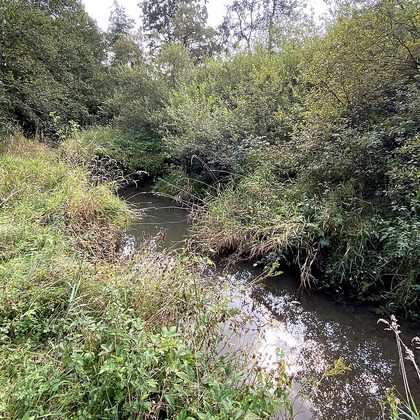
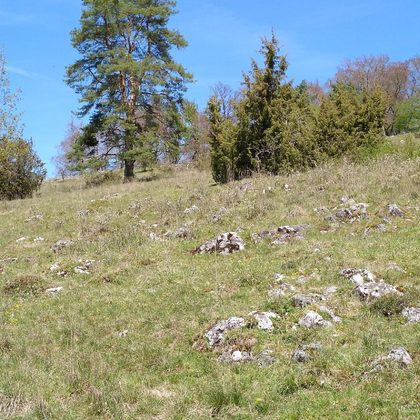
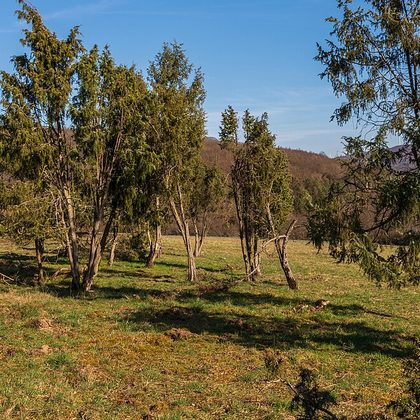
Dry, warm lowland with bushes and water not far off. The classic sites are tamarisk thickets and riverine woodland along rivers and irrigation canals, willow and oleaster along field edges, and beyond that semi-desert with scattered scrub, oases, orchards, poplar rows and town parks — most Iranian records come from parks, gardens and riverbanks in and around towns and villages. Where Booted Warbler wants the damp rank herbage of the forest-steppe, Sykes's keeps to dry, open scrub.
Where the bird is most at home, classified with EUNIS — the European standard for habitats.

Range and movements
A breeding bird of the Middle East and Central Asia: from south-east Azerbaijan and throughout Iran east through Turkmenistan, Uzbekistan, western and southern Kazakhstan and Afghanistan to Pakistan and north-west India, and north-east into western China. The western edge of that range lies inside this guide's map area: in Iran the species is recorded in numbers through May and June from Qom and Tehran to Isfahan and Khuzestan, and it is a common breeder in the Caspian lowlands of western Kazakhstan. It winters in Pakistan and India. In north-west Europe it is a very rare vagrant — a few tens of British records spread across July to October, a comparable number in Scandinavia, and no more than a handful for the Netherlands and Belgium together.
- Breeding (summer)
- Passage
- dark = core range, pale = thinly spread
Where and when to look
The odds are long, but the method is plain. In August and September, on the Northern Isles, the east coast or a Dutch Wadden island, look at every small pale Iduna and work it as a Booted Warbler. Only when the bill is strikingly long with the lower mandible orange to the tip, the face flat with the supercilium dying out behind the eye, and the long tail pumped downwards without pause, does it start to be interesting. Then photograph the spread tail, the closed wing and the bill in profile, and expect that in practice a record is rarely accepted without in-the-hand biometrics or DNA from a collected feather or a dropping. Anyone who simply wants to see the bird should stand beside a tamarisk-lined river in Iran or southern Kazakhstan in May or June.
Conservation status
Not threatened (LC). The range is large and continuous and numbers are stable; the species copes well with man-made country and breeds into orchards, gardens and town parks. Tamarisk scrub is lost locally where Central Asian rivers are drawn down and straightened, but for now that is offset by gains along irrigation systems. European vagrant records are creeping up, mainly because observers know the species better and photographs and biometrics are now routine.