All species › Passerines › Reed warblers › Booted warbler
Booted warbler | Iduna caligata
Kleine spotvogel | Zarcero escita
The smallest of the region's Hippolais-type warblers, barely bigger than a Chiffchaff and so plain that most British birders know it only from an October morning on Fair Isle or the Norfolk coast. It breeds in the rank herbage of Russia, Estonia and Finland, has been pushing west for half a century, and is now the small brown warbler an autumn crowd is most likely to be standing around.

Voice
Vagrants usually stay silent but do call. The call is a dry, hard tchek or tek, often in short bursts, along with a rattling tcherr. None of it separates the bird from Sykes's Warbler, which calls almost identically, so in autumn the call settles nothing. The song does: a fast, high, dry rattle, hurried and sharp, with short repeated motifs and squeaky notes between them, delivered from a bush top or in a brief song flight. In Sykes's the same song runs slower, lower, more nasal and far more monotonous.
No freely licensed recording is available for this species yet.
Identification
Very small and compact, shorter-tailed and rounder than any other Hippolais or Iduna: the impression is closer to Lesser Whitethroat than to a reed warbler. Upperparts grey-brown, warmed by a sandy buff wash in fresh autumn plumage; underparts white with buff flanks. The head carries most of the identification: a white supercilium that clearly continues behind the eye, bordered above by a darker lateral crown-stripe and below by a dark loral line — a face with contrast, not a blank one. The bill is short, fine and triangular, and the orange lower mandible has a dark tip; that dark tip is the single most useful mark on the bird. There is no pale wing panel; the tertials are dark with narrow pale fringes, and the primary projection is short, roughly half to two-thirds the exposed tertial length, with six or seven primary tips. The tail is short and square-ended, with a white outer web to the outermost feather and a pale tip. Legs grey-brown to fleshy. Sexes alike.
Confusion species
Sykes's Warbler is what it all turns on, and the comparison is set out from the other side on its own page. Sykes's is bigger and longer, colder and sandier grey, with a noticeably longer and straighter bill whose lower mandible is orange right to the tip, a flatter, blanker face on which the supercilium barely runs behind the eye and the dark crown-stripe is missing, a shorter primary projection, and a longer tail that it pumps downwards almost without pause. Set against that, the Booted looks rounder, warmer and busier. Marsh and Blyth's Reed Warblers are larger and longer-bodied, with longer bills lacking the dark tip and with no white in the tail. Eastern Olivaceous Warbler is clearly bigger, greyer and longer-billed, and dips its tail in the same way. Lesser Whitethroat has a dark mask and a grey head; Willow Warbler and Chiffchaff have fine pointed bills without the broad base and move in an altogether lighter fashion.
Habitat
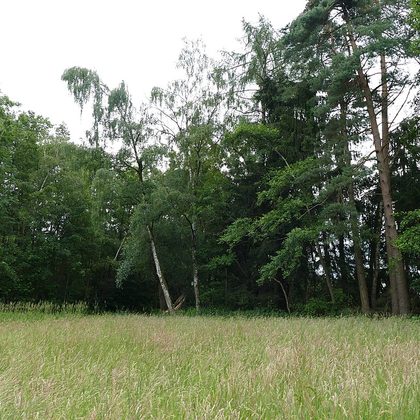
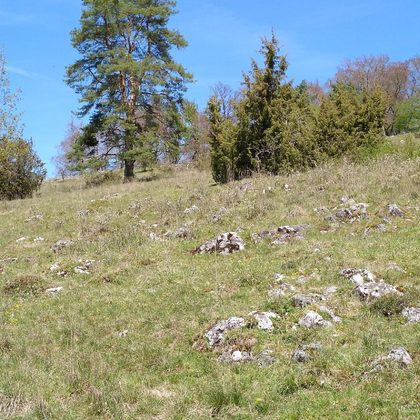
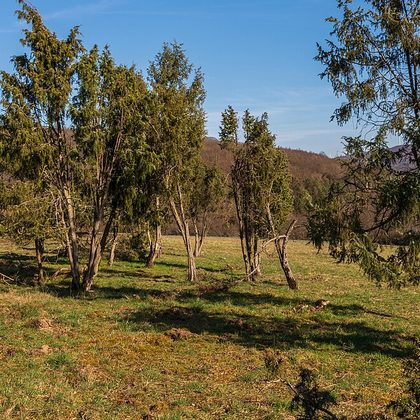
Rank herbage with bushes — not woodland and not reed. Across Russia and western Siberia it breeds in overgrown hay meadows and lupin stands, in nettle and meadowsweet, in willow scrub along rivers, on abandoned fields and along the wood edges of the forest-steppe. Northwards it takes clearings and felled ground in birch and conifer forest; southwards, steppe with scattered scrub. A single bush or tall stem as a song post is enough. The autumn vagrant ends up in sea buckthorn, elder and nettles just behind the dunes, but that is where it came down, not where it belongs.
Where the bird is most at home, classified with EUNIS — the European standard for habitats.

Range and movements
A breeding bird of north-east Europe and northern Asia: from Finland, Estonia and north-west Russia east into western and central Siberia, and south to northern Kazakhstan and northern Iran. The western edge has been moving since the 1970s; singing males are now found every spring in Sweden, Estonia and Finland and breeding is regular, with hundreds of June and July records a year from west of Russia alone. It winters in India and Sri Lanka. In Britain and Ireland, the Netherlands and Belgium it is a scarce but near-annual vagrant with a sharp peak in September and October, most often on the Northern Isles, along the North Sea coast and on the Dutch Wadden islands.
- Breeding (summer)
- Passage
- dark = core range, pale = thinly spread
Where and when to look
Mid-September to late October, on Fair Isle, Shetland, the Norfolk coast or a Dutch Wadden island, in low scrub and nettles in a dune slack or a lighthouse garden. Work in a fixed order. Bill first: short, fine, orange lower mandible with a dark tip. Then the head: does the white supercilium run behind the eye, and is there a darker stripe above it? Then the tail: short, square-ended, white along the outer edge, and not pumped downwards all the time. Then photograph the spread tail and the closed wing, because a field impression alone will not carry a record. And keep the base rate in mind: any small pale Iduna in north-west Europe is a Booted Warbler until it is shown not to be.
Conservation status
Not threatened (LC). The range is enormous and numbers are stable to increasing, with a clear spread to the north-west: in half a century Finland, Estonia and Sweden have gone from exceptional to regular breeding ground. That feeds straight into the North Sea vagrancy figures, although a fair share of the rise is simply that observers now know the bird. No threats are in view; if anything it gains from rank and abandoned farmland and from the lupins along Russian road and railway verges.