All species › Passerines › Reed warblers › Olive-tree warbler
Olive-tree warbler | Hippolais olivetorum
Griekse spotvogel | Zarcero grande
The largest tree warbler of the region and by far the heaviest-billed: a drab grey bird, almost as bulky as a Great Reed Warbler, that delivers a slow, grating phrase from the old olive groves of Greece and western Turkey. It sings high in the canopy and shows itself rarely, so the voice is the way in.

Voice
The song is a slow, deep, grating run of short phrases, as though a Great Reed Warbler were singing at half speed: a rasping chrek-chrek, then a resonant ku-chuk, then a gap. It carries a long way across a grove and has nothing of the hurried medley of the Icterine: no mimicry, no nasal de-de-roid, no pace. The call is a soft but full-bodied tok, often repeated. Song from early May to mid-July, strongest in the first hour after sunrise.
No freely licensed recording is available for this species yet.
Identification
Big, long-bodied and grey, with a strikingly long, broad bill whose lower mandible is orange-yellow right to the tip. Grey-brown above with an olive wash over rump and undertail coverts, dirty white below with a grey cast on breast and flanks. A thin white eye-ring and pale lores give the face an open look. The secondaries carry a pale wing panel and the primary projection is long. The tail is long, square-ended and dark grey with white edges to the outer feathers; the legs are heavy and blue-grey. Sexes alike.
Confusion species
Beside Icterine and Melodious Warblers it looks lumbering: a quarter bigger, with no yellow at all below, a flat pointed head and a bill so heavy it recalls a starling. Great Reed Warbler is bulkier still but warm rufous-brown, with a clear supercilium and a rounded tail. Eastern Olivaceous Warbler shares the grey plumage but is a third smaller, far finer-billed, and dips its tail downwards without pause — something the Olive-tree Warbler never does.
Habitat
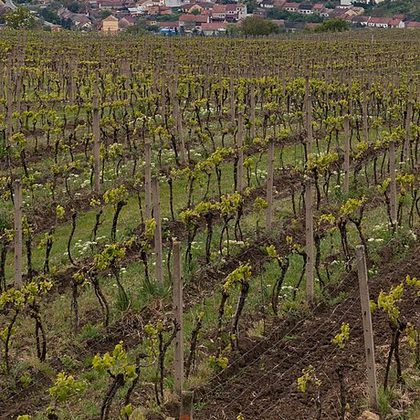
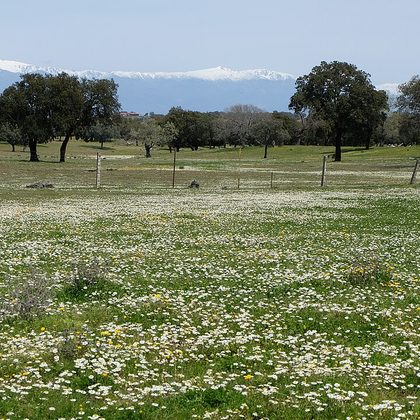
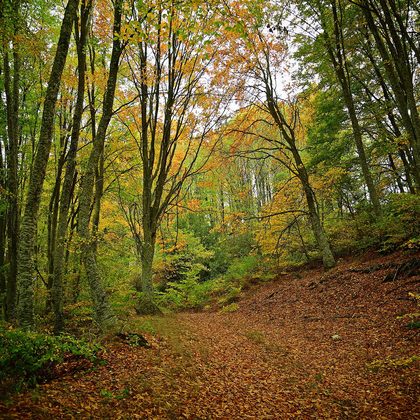
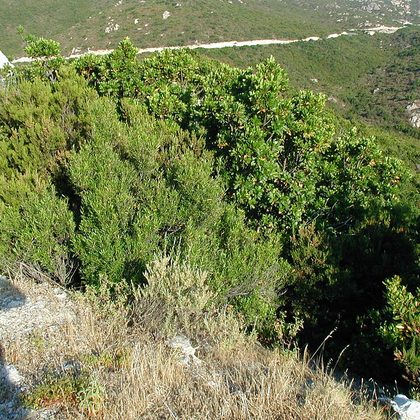
Old, tall olive groves with grass or herbs beneath, open oak woodland on slopes, almond and fruit orchards, and the edge where orchard gives way to maquis. It needs large trees to sing and feed in and avoids both closed forest and bare treeless ground. Mostly lowland, up to about eight hundred metres.
Where the bird is most at home, classified with EUNIS — the European standard for habitats.
Range and movements
Breeds in the southern Balkans and the eastern Mediterranean: Greece with the Ionian and Aegean islands, Albania, North Macedonia, southern Bulgaria, western and southern Turkey, Syria, Lebanon and Israel. Beyond that it is a major rarity, with no accepted records for the Netherlands. It winters in eastern and southern Africa, from Kenya to South Africa, and so spends half the year outside the area of this guide.
- Breeding (summer)
- Passage
- Migration direction
- dark = core range, pale = thinly spread
Where and when to look
Mid-May to mid-June, the first hour after sunrise, in an old olive grove on Lesbos, in the Peloponnese or along the Turkish west coast. Track the slow grating phrase first and only then search the canopy: a large grey bird with a long bill, usually motionless among the leaves. By mid-morning it falls silent and becomes almost impossible to find.
Conservation status
Not globally threatened, but the European population is falling and the bird depends on a landscape that is changing fast. Grubbing out old olive trees for intensive low-trained plantations removes song posts and nest trees, while abandoned groves close over into impenetrable scrub. Where old groves with an open herb layer stay in use, it holds on.