All species › Passerines › Chats and flycatchers › Whinchat
Whinchat | Saxicola rubetra
Paapje | Tarabilla norteña
The Whinchat is the bird of old-fashioned hay meadow and rough moorland edge: a small upright shape on an umbellifer or a fence wire, with a broad white stripe over the eye and an orange breast. It is the counterpart of the Stonechat — same shape, same posture, same ticking — but with an entirely different year, because it winters in the Sahel. Across lowland Britain and the near Continent it has all but gone.

Voice
The call is a soft whistled tu followed by two dry clicks: tu-tek-tek. It is gentler and less stony than Stonechat's hard chack, but the rhythm is the same and at a distance the two are treacherously alike. The song is a short, quiet, hurried phrase of scratchy and whistled notes, often with mimicry of other grassland birds worked in — Skylark, Yellow Wagtail, Redshank — given from a perch or in a brief song flight. Heard from late April into July, loudest in the first week after arrival.
No freely licensed recording is available for this species yet.
Identification
Small, slim and upright, with a short tail and notably long wings: on a perched bird the primaries reach far down over the tail base. The feature everything turns on is the broad creamy supercilium, running well behind the eye and turning the dark cheek into a mask; below it a second pale stripe runs along the throat like a whisker. The upperparts are warm brown and heavily streaked, the breast orange-buff, fading onto the belly. The second feature is on the tail: a white patch on each side of the tail base, most obvious in flight. The spring male is the sharpest version — near-black cheek, brilliant white stripe, a white wing patch — but the female, the juvenile and the drab autumn bird all show the supercilium and the white tail base too. See those two marks and the bird is named.
Confusion species
Stonechat is the only real confusion — see its own species page, where the same difference is set out from the other side. It shows no supercilium in any plumage: the male's head is wholly black, the female's plain dark brown, so the face reads as closed rather than striped. Its tail is uniformly dark with no white corners, its back is less crisply streaked, and its outline is rounder, shorter-winged and longer-tailed. Habitat separates them too: Whinchat wants tall herbs in damp, unimproved grassland and bracken-covered slopes, Stonechat dry heath, gorse and dune. And the calendar settles most of it: between November and March a chat in Britain or the Low Countries cannot be a Whinchat. Siberian stonechat, the autumn vagrant, may show a pale supercilium but lacks the white tail base and instead has a large unstreaked creamy rump. Northern wheatear is bigger and longer-legged, stands on the ground rather than on stems, and shows a broad white rump with a black inverted T in the tail.
Habitat
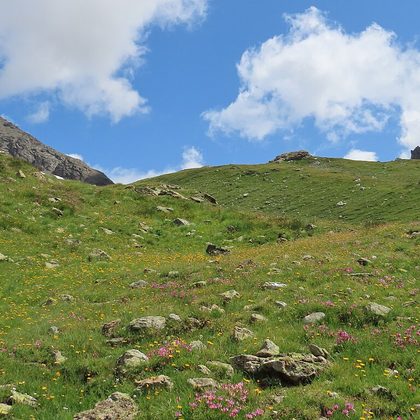
Open, herb-rich grassland with structure, cut late or not at all: unimproved hay meadows, damp and wet grassland with rushes and sorrel, rough ditch banks and field margins, bracken-covered hillsides and the edges of moor and blanket bog, and in the mountains flowery hay meadows well above the treeline. The constant requirement is a combination of tall, stiff stems to hunt from, a dense grass sward to hide the nest in, and plenty of insects. On passage it uses anything that stands proud: potato haulm, sunflowers, maize edges, fence posts and thistle heads.
Where the bird is most at home, classified with EUNIS — the European standard for habitats.
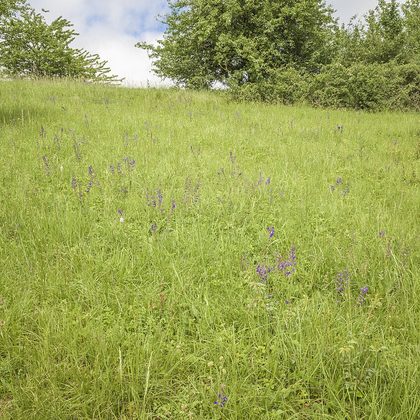
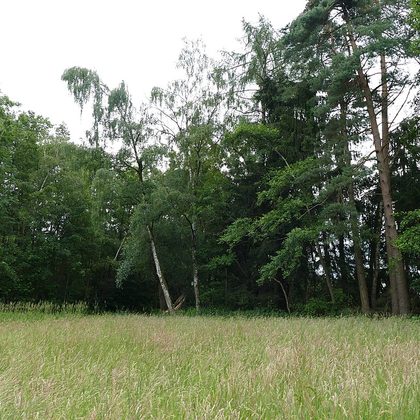
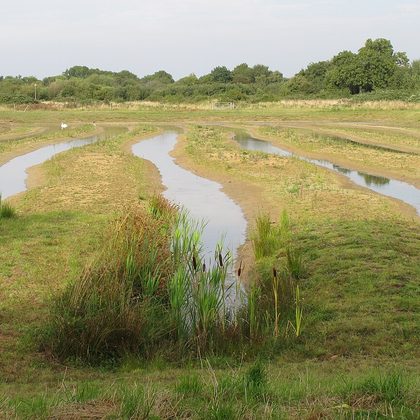
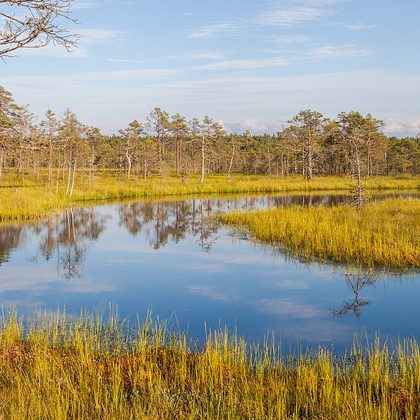
Range and movements
Breeds from Ireland and northern Portugal east beyond the Ob and from northern Scandinavia south to central Spain, central Italy and the Caucasus; every bird winters in sub-Saharan Africa, from Senegal east to Kenya and south to Zambia. In Britain it is now essentially an upland bird of Wales, the Pennines, the Southern Uplands and the Scottish glens, with some 50,000 pairs, having withdrawn almost entirely from the lowland south and east. In the Netherlands only 225 to 350 pairs remain, nearly all in the north-east. On autumn passage, by contrast, the species is still widespread and easy to find from mid-August to early October.
- Breeding (summer)
- Passage
- Migration direction
- dark = core range, pale = thinly spread
Where and when to look
For breeders, go up: a bracken-covered valley side or a rushy moorland edge in late May or early June, early in the morning. Scan the tallest stems along the fence lines and the bracken margin; the male sits still and upright and the white supercilium shows at once. For migrants, September is far easier — walk a coastal headland, a set-aside field or a rough field margin and look at every small bird sitting on top of the vegetation. Flush it and watch the tail base: two white patches settle it.
Conservation status
Not globally threatened, but one of the hardest-hit farmland and upland birds of western Europe. In Britain the Whinchat was moved to the Red List of Birds of Conservation Concern in 2015, and numbers fell by roughly two-thirds between 1995 and 2024; it has effectively vanished as a lowland breeder. In the Netherlands, where it is listed as Endangered, the population has shrunk by more than eighty per cent since the 1960s, from several thousand pairs to the 225 to 350 of today. The causes are well documented and all lead back to the grassland: hay meadows converted to heavily fertilised, species-poor silage, water tables lowered, and mowing done earlier and more often, so that nests and young are cut out in June. Add the loss of rough ditch banks, verges and odd corners — the very perches the bird lives from — and the decline of large insects, and conditions on the Sahel wintering grounds on top of that. Where wet, late-cut, herb-rich grassland has been restored it does come back, but in small numbers and only where the management is kept up year after year.