All species › Passerines › Chats and flycatchers › Siberian stonechat
Siberian stonechat | Saxicola maurus
Aziatische roodborsttapuit | Tarabilla siberiana
Siberian stonechat is the third party in the stonechat problem: an Asian bird that breeds west to the forest-steppe and river valleys of north-east European Russia and that reaches the North Sea coast in small numbers every autumn. Usually the bird in question is a pale, unstreaked youngster in the dunes, and usually it takes half a day before everyone agrees. Since the turn of the century it has been treated as a species in its own right, separate from European and African Stonechat.

Voice
The call is the standard call of the group and offers little help: a thin, plaintive hweet followed by one or two hard clicks, hweet-chack. Experienced ears hear the clicks as slightly softer and duller than in European stonechat, more a tchack than a stony chack, but the difference is too slight to build a record on, and an autumn vagrant will often stay silent for days. The song, never heard here, is a short, hurried and rather higher-pitched phrase of scratchy and whistled notes, given from a bush or in a brief song flight.
No freely licensed recording is available for this species yet.
Identification
In shape and posture a stonechat: small, round, short-tailed and always on top of the vegetation, but with a longer primary projection and so a slightly slimmer rear end. The breeding male is the clear-cut version — a jet-black hood, a broad and very clean white collar reaching high up the neck, a large white wing patch, and orange confined to the upper breast so that belly and flanks look almost white. The decisive mark is on the rump: a large, plain creamy to off-white panel with no streaking, which flashes as the bird flies off. But the birds that turn up here are rarely such males. An autumn bird is pale sandy and strikingly low in contrast: a pale unstreaked lore and supercilium, an off-white throat, a plain buff breast with no orange, unstreaked flanks, and the same big pale rump, against which the dark tail stands out sharply. If the bird can be seen in flight or preening, look at the underwing: in this species the axillaries and underwing coverts are solidly black, in European stonechat mottled grey.
Confusion species
European stonechat is the bird at issue, and the mistake nearly always runs one way: a pale, washed-out autumn Stonechat is taken for a Siberian. So look at the rump, and take your time over it. On European stonechat the rump is small, buff and clearly dark-streaked, and merges into the back without a sharp edge; here it is large, pale, unstreaked and cleanly cut off. Then look at the underparts: an autumn European stonechat has a warm orange-buff wash across the whole breast and streaked, often rusty flanks, whereas this species fades to white below the breast. The black underwing is the third point and settles the case whenever it can be seen. One character alone is never enough: a large pale rump does occur on some juvenile European stonechats, and Stejneger's Stonechat from the far east is all but inseparable on plumage, so records are now often clinched with DNA from a dropping. Whinchat is far easier to rule out: broad white supercilium running well behind the eye, heavily streaked back, white patches at the tail base and no pale rump at all.
Habitat
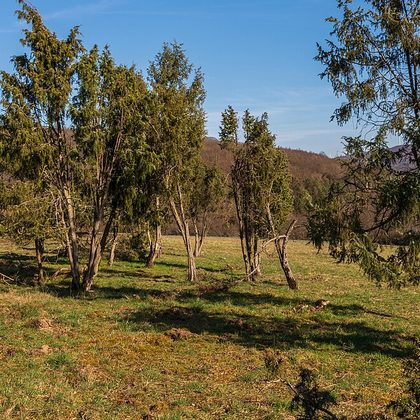
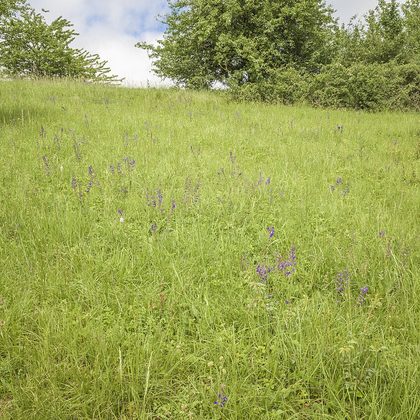
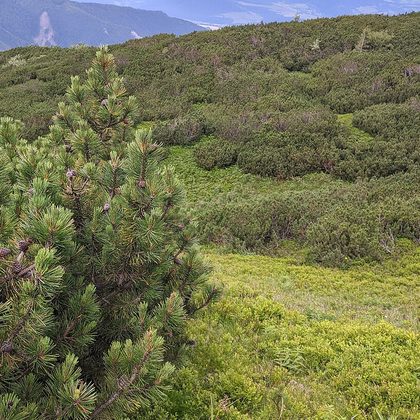
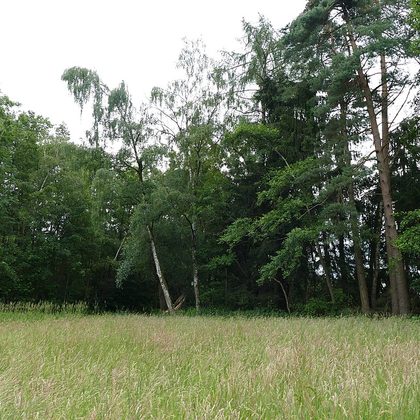
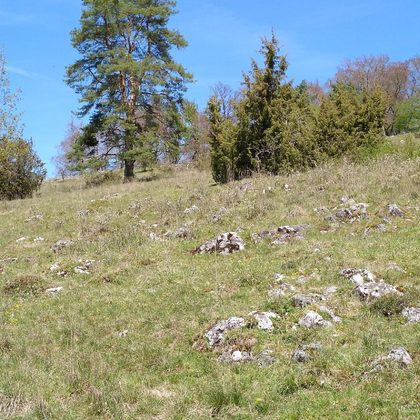
On the breeding grounds, open low ground with scattered bushes and a firm herb layer: dry steppe and forest-steppe with wormwood and scrub, damp river valleys and saline hollows, clear-fells and bog edges within the taiga, dwarf birch and willow scrub along the tundra edge, and in Central Asia montane meadows well above the treeline. In winter, in India and South-East Asia, it uses paddy fields, rank grassland and riverbanks. Birds that strand in western Europe are almost always in the outer dunes, on coastal scrub, saltmarsh or rough field margins — exactly where the resident stonechats are in the same weeks.
Where the bird is most at home, classified with EUNIS — the European standard for habitats.
Range and movements
Breeds from north-east European Russia — Arkhangelsk, Komi and the country west of the Urals — east across Siberia to Mongolia and north-east China, and south to the Caucasus, Iran and the Himalaya, so part of the range falls inside the area of this guide; breeding in Finland and the Baltic states is exceptional. The great majority of birds nevertheless winter outside the region, in India, Bangladesh and South-East Asia, with a smaller stream to the Middle East and north-east Africa. In north-west Europe it is a regular but scarce vagrant, with more than two hundred records to date; Britain and Ireland account for a good share of them, and almost all fall between late September and early November, with a thin spring showing in April and May.
- Breeding (summer)
- Winter
- Passage
- Migration direction
- dark = core range, pale = thinly spread
Where and when to look
This is a bird to look for in the last days of September and through October, at the places that also produce Yellow-browed and Pallas's Warblers: Shetland, Fair Isle, the North Sea headlands of Norfolk and Yorkshire, and the Dutch and German Wadden islands. Work the coastal scrub and the rough ground behind the dunes and check every stonechat you meet, because the vagrant sits among the local birds. If one looks too pale and too plain, wait for it to fly and watch the rump; photograph the raised wing and the underwing, since that is what will finish the record.
Conservation status
Not globally threatened. The Red List does not yet assess it separately but treats it together with European and African Stonechat under the broad species Saxicola torquatus, listed as Least Concern; the range is vast and numbers are high. In the European part of the breeding range it has, if anything, edged westwards over recent decades rather than declined, and the number of western records rises steadily — though part of that rise reflects more observers, better cameras and the habit of checking every pale stonechat.