All species › Passerines › Chats and flycatchers › Canary Islands stonechat
Canary Islands stonechat | Saxicola dacotiae
Canarische roodborsttapuit | Tarabilla canaria
The Canary Islands stonechat lives on Fuerteventura and nowhere else on earth. Not a wheatear but a stonechat: a small round bird perched on top of an aulaga bush, with a broad white supercilium its familiar relative never shows. Perhaps fifteen hundred remain, spread through the barrancos of a single island, which makes it one of the rarest birds in Europe.

Voice
The call is the one the whole group shares and is what gives the bird away first: a hard dry chack-chack like knocked pebbles, almost always preceded by a thin plaintive hweet. It keeps it up for as long as you stand in the territory. The song is a short, high, hurried twitter of a couple of seconds, thinner and quieter than that of European stonechat, with squeaky and rustling notes mixed through it, delivered from the top of a bush or in a brief fluttering song flight. Heard most from January into May, early in the morning before the wind gets up.
No freely licensed recording is available for this species yet.
Identification
Smaller and finer than European stonechat, with a short tail and a big head, and like it always perched on top of a bush, bolt upright and flicking its tail. The male has a dark brown to blackish-brown head with a broad, pure white supercilium running well behind the eye — the character everything turns on. The throat is white, there is a white patch on each side of the neck, and the breast is warm orange-buff, fading to off-white on the belly. The mantle is brown with dark streaks, there is a small white patch on the wing, and the rump is buff-white and streaked. The tail is dark with narrow pale edges. The female is the same bird in softer brown: the head brown rather than blackish, the supercilium buff rather than white, the neck patches faint and the breast a paler orange. Juveniles are buff-fringed and scaled all over but already carry the pale supercilium.
Confusion species
On Fuerteventura itself the risk is small, since it is the only breeding chat on the island. Even so, small numbers of European stonechats reach the Canaries in winter, and then the supercilium decides: the male European stonechat has an entirely black head and throat with no supercilium at all, and a deeper red-orange breast. Between the females it is harder, but the Canary bird stays paler and finer, with a more sharply marked white throat and a more obvious supercilium. Whinchat, which passes over the islands in small numbers in September and October, also shows a broad pale supercilium, but it is slimmer and longer-winged, far more heavily streaked on the back, and on taking off it shows white patches on either side of the tail base, which the Canary Islands stonechat does not. Elsewhere on the islands: northern wheatear is bigger and longer-legged, stands on the ground rather than in a bush, and shows a broad white rump in flight.
Habitat
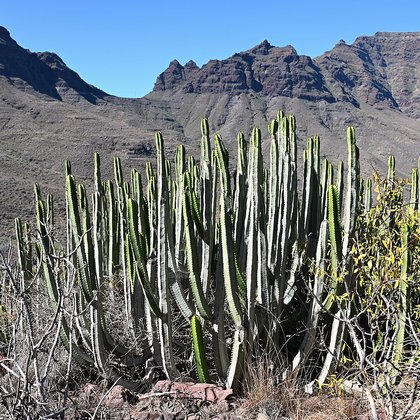
Dry barrancos and stony slopes with open, low scrub: aulaga, boxthorn, saltwort and scattered palms, with thirty to fifty per cent bare ground between the bushes. That mixture is what matters — dense cover is as useless to it as a wholly bare plain. It likes the rim of a barranco or the line of an old terrace wall, and the nest is on the ground under a bush or in a crevice in a dry-stone wall. From sea level to the highest ground on the island, but densities are highest in the rough, dissected country of the north and centre.
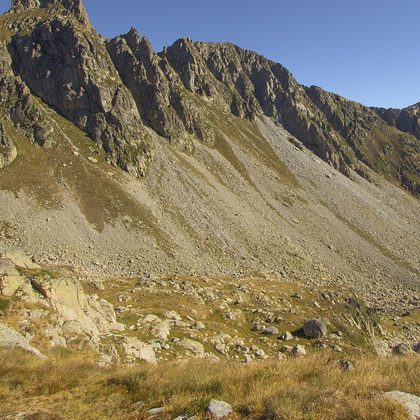
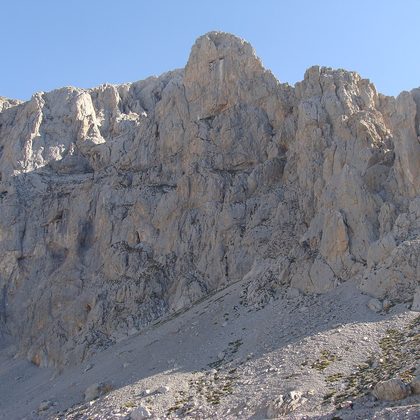
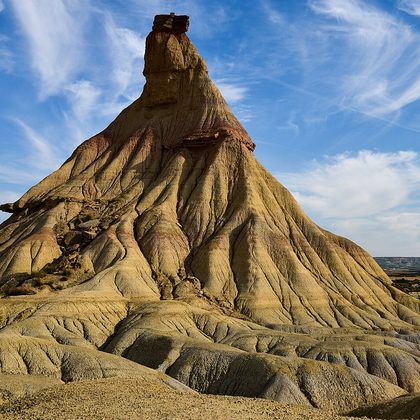
Where the bird is most at home, classified with EUNIS — the European standard for habitats.
Range and movements
Fuerteventura alone, with a few birds on the neighbouring islet of Lobos. The birds of the Chinijo islets off Lanzarote have been gone since the early twentieth century and have not been found there since. The core of the present population lies in the Betancuria massif, around Vega de Río Palmas, in the barrancos of the central and northern parts of the island and on the Jandía peninsula. The flat, heavily grazed plains of the south and east and the built-up coastal strips are largely empty. It does not leave the island: there are no vagrants of this species.
- Resident
Where and when to look
Early morning in the Barranco de la Torre, at Vega de Río Palmas or along the road through the Betancuria massif. Drive into a barranco with scattered aulaga bushes, get out and listen: you will hear the ticking before you see anything. Stand still and scan the tops of the bushes, because the bird comes up of its own accord to see who is about. From January to April the males sing and territories are easiest to find. Keep to the paths and tracks: pairs nest on the ground under a bush, and a walker cutting straight through the scrub costs the island birds in the most literal sense.
Conservation status
Listed globally as Near Threatened, and among the birds in this guide one of those with the smallest margin. The entire world population sits on one island and is put at thirteen hundred to seventeen hundred mature birds, spread over a few hundred territories almost all of which lie in barrancos; in Spain itself it is placed in a more severe category than on the world list, which with one island and numbers like these is no surprise. The pressure comes from several directions at once. Building for tourism and housing and the clearing of scrub take habitat away, above all along the coast and on Jandía. Goats stripping the scrub, falling water tables and long droughts leave the barrancos barer than the bird can stand. And feral cats and black rats take eggs and young from nests on the ground, which on an island with a population of this size tells immediately. There is better news too: much of the habitat lies within protected areas, the population is counted and followed, and cat and rat control in the core areas works. But one dry run of years, or one badly placed development in the wrong barranco, weighs heavily at once when the population is this small.