All species › Passerines › Chats and flycatchers › European stonechat
European stonechat | Saxicola rubicola
Roodborsttapuit | Tarabilla europea
Of all the small birds of heath and dune the Stonechat is the easiest, because it always sits on top: on the tip of a bush, on a barbed wire, on a tussock, bolt upright and flicking its tail. And it gives itself away at once, for the moment you enter its territory it starts ticking chack-chack and does not stop. In Britain it is one of the real winners of the last thirty years.

Voice
The call explains the name of the whole group: a hard, dry chack or chack-chack, like two pebbles knocked together, almost always preceded by a thin, plaintive hweet — together hweet-chack-chack. It keeps it up for as long as you stand in the territory, and that is usually the first clue the bird is there. The song is a short, hurried, slightly scratchy phrase of a second or two, close to Dunnock in pace and tone, delivered from the top of a bush or in a small fluttering song flight. Heard from mid-February into July, most persistently in March and April.
No freely licensed recording is available for this species yet.
Identification
Small, round and big-headed, with a short tail and short wings, and always upright. The summer male has an entirely black head and throat with no supercilium at all, and behind it a broad white half-collar on each side of the neck that does not meet across the nape. The mantle is blackish-brown and streaked, there is a bold white patch on the wing coverts, and the breast is orange-red, fading to off-white on the belly. The rump is buff-white with dark streaks — a vague pale area, never a large clean white panel. The tail is uniformly dark, with no white. The female is the same bird in brown: the head dark but not black, with a pale throat, the collar duller, the breast warm orange. Autumn birds and juveniles are warmly buff-fringed all over and the head looks brown; the dark unmarked tail and the streaked rump are then what to rely on.
Confusion species
Everything turns on Whinchat — see its own species page, where the same difference is set out from the other side. In every plumage Whinchat shows a broad creamy supercilium running well behind the eye, which turns the dark cheek into a mask; Stonechat never shows that stripe, not even the female. Flush the bird and watch the tail: Whinchat has a white patch on each side of the tail base, Stonechat's tail is plain dark. Whinchat also looks slimmer, longer-winged and shorter-tailed, and perches on tall herbs more often than on bushes. Season and site settle most cases: a chat on a damp hay meadow in May is likely a Whinchat, one on a winter moor is always a Stonechat, since Whinchat is then in Africa. Siberian stonechat makes it a trio in autumn — paler, with a large unstreaked creamy rump, much whiter belly and flanks and blackish underwing coverts; it too has its own page. Robin stays in the undergrowth, lacks the white wing patch and has long thin legs; northern wheatear is bigger and longer-legged and shows a broad white rump with a black inverted T in the tail.
Habitat
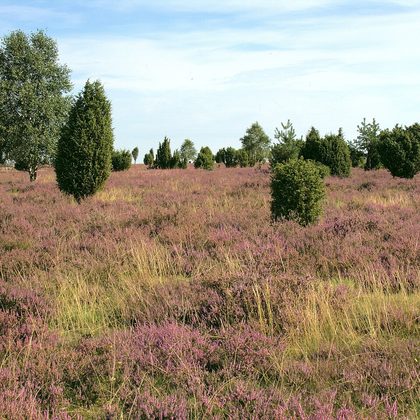
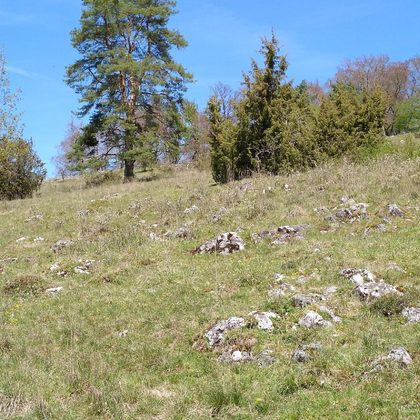
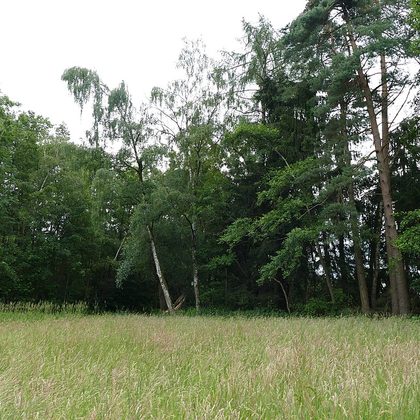
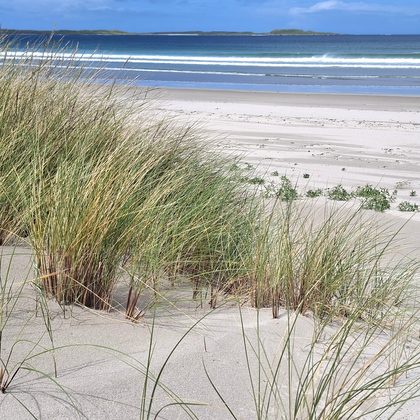
Open, low, dry ground with bushes to perch on and a dense herb layer to nest in: dry and wet heath with gorse, heather and bog myrtle, dune scrub and dune slacks, young forestry and clear-fell, rough road and railway verges, sea walls, saltmarsh edges and neglected field margins. The nest is on the ground under a tussock, always within a few metres of a lookout perch. Where verges are cut short every year the bird disappears; where cutting is late or done in rotation it comes back.
Where the bird is most at home, classified with EUNIS — the European standard for habitats.

Range and movements
From Ireland and Britain east to Ukraine and Turkey and south to north-west Africa; northern birds move to south-west Europe and the Maghreb, southern ones stay put. Britain and Ireland hold some 65,000 pairs, concentrated in the western and southern uplands, on coastal heaths and increasingly on inland lowland heath and young plantation. In the Netherlands it is now a numerous breeder of the sandy soils and the whole coastal strip. In Iberia it is a widespread and common resident of matorral, field edges and woodland margins, from sea level well into the mountains.
- Resident
- Breeding (summer)
- Winter
- Passage
- dark = core range, pale = thinly spread
Where and when to look
Walk a heath or a dune slack in late March or early April on a sunny, windless morning and look at the tops of the bushes and along the wire fences. The male will use the same few perches for hours, in full summer plumage, and often allows an approach to ten metres. If you hear the ticking but see nothing, stand still: the bird will come up of its own accord to see who is in its territory. In winter the best odds are on coastal heath and the outer dunes, where a single pair will sit on the same bush all season.
Conservation status
Not globally threatened, and in Britain one of the clearest recoveries of recent decades: numbers have risen steeply since the mid-1990s and the species was moved from the amber to the green list of Birds of Conservation Concern. The gains have come from a run of mild winters — this is a short-distance migrant, and a severe winter costs it a large share of the population at once — together with heathland restoration and gorse management. What still costs birds is the cutting of verges and rough margins in the middle of the breeding season, the tidying of scrub along field edges and ditches, and, at the other extreme, heath left to grow into closed woodland.