All species › Passerines › Chats and flycatchers › Hooded wheatear
Hooded wheatear | Oenanthe monacha
Monnikstapuit | Collalba monje
The hooded wheatear does not behave like a wheatear. Instead of standing upright on a clod in open country it sits halfway up a rock face and takes its insects on the wing, in long swerving sallies that carry it tens of metres from its perch and back again. Within this guide it belongs only to the hot gorges around the Gulf of Aqaba, the Arava and the Dead Sea, and it is thinly spread everywhere.

Voice
A silent bird; look for it, do not listen for it. The song is rarely heard and is quiet and hesitant — a hurried babble of scratchy and squeaky notes with a few clear whistles among them, given from a ledge or in a short flight along the rock wall, mostly in the early morning from March to May. The calls are a thin rising hweet and a soft ticking chek, far less hard than the pebble-tap of northern wheatear and barely audible at any distance.
No freely licensed recording is available for this species yet.
Identification
A large, slim wheatear with a strikingly long tail and a long, heavy black bill. The male has a jet-black head, throat and upper breast running unbroken into a black mantle and black wings, with a pure white crown set on it like a cap; everything from the lower breast down is clean white. The tail settles it: it is largely white, with black confined to the central pair of feathers, and there is no terminal band at all. A bird taking off therefore shows a long white tail with a black central stripe rather than the inverted T of most wheatears. The female looks like a different bird altogether: plain pale sandy grey above, cream to light buff below, without mask, supercilium or any contrast, but with the same slim build, the same long bill, the same long tail and the same tail pattern in muted grey-brown.
Confusion species
Look at the tail before anything else. Of the black-and-white wheatears of the Levant and Sinai, the hooded is one of only two without a black terminal band; the other is white-crowned wheatear. Separate those two on the underparts: white-crowned is black from chin to undertail coverts, hooded is white from the lower breast down. White-crowned is also bulkier, shorter-tailed and much shorter-billed. Pied wheatear and Finsch's wheatear share the combination of white crown, black throat and black mantle, but on both a broad black band closes off the tail across its full width; so does mourning wheatear, which in addition has orange-buff undertail coverts. On females and immatures the plumage is little help and the decision falls to structure and behaviour: the long bill, the long tail, the wholly featureless pale plumage without a supercilium, and the habit of hawking insects in the air from a rock face rather than dropping to the ground from a stone. Female northern and Isabelline wheatears keep to open ground, are shorter in bill and tail, and always show the broad black terminal band.
Habitat
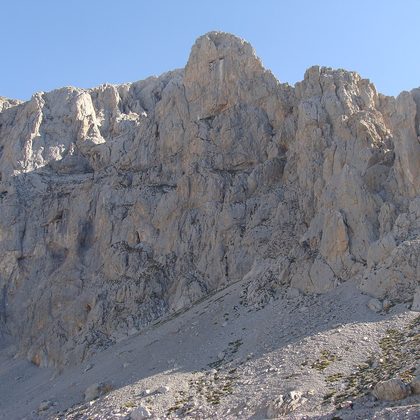
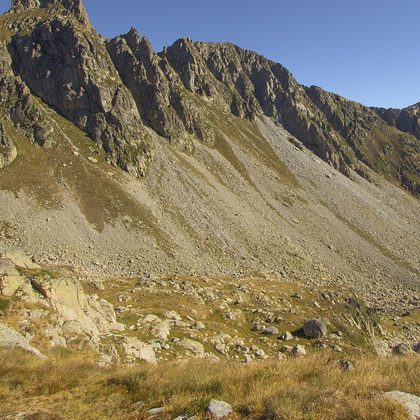
Vertical desert: steep wadis with rock walls, narrow gorges, erosion gullies and screes, and the granite and sandstone massifs of the Red Sea mountains. A plain without a cliff is empty ground to this bird — it needs a rock face to hunt from and crevices and cavities in that face to nest in. From more than two hundred metres below sea level at the Dead Sea up to about a thousand metres. Outside the breeding season it also turns up around desert settlements, date gardens and the watered hotel margins of Eilat and the Arava.
Where the bird is most at home, classified with EUNIS — the European standard for habitats.


Range and movements
Within the area of this guide it is confined to the south-eastern edge: the Negev, the Arava and the mountains behind Eilat in Israel, the gorges of Wadi Rum, Dana and Petra in Jordan, and Sinai and the Eastern Desert in Egypt. Beyond it the range runs on across Arabia and Iran to Afghanistan and Pakistan. It is resident but wanders widely outside the breeding season; in Israel it is recorded in all twelve months, most often in winter and early spring, which is also when most observers are there. Nowhere does it breed densely — a single pair to a wadi is normal. It reaches Turkey, Cyprus and Greece only as a great rarity.
- Resident
- Winter
- Passage
- dark = core range, pale = thinly spread
Where and when to look
December to March in the mountains behind Eilat: Amram's Pillars, the Timna valley and Nahal Shlomo. Walk or drive into a wadi until the walls rise on both sides, then stand still and look up rather than down, because this bird is not on the ground. Watch for a black-and-white bird that drops off a ledge, snatches something in mid-air and curves back; the long pale tail and the tumbling, almost butterfly-like flight give it away before any plumage detail is visible. Wadi Rum in Jordan works just as well in the first hour of light.
Conservation status
Not threatened globally. The species has an enormous but thinly populated range and there is no evidence of decline; there are also no good population figures, because little counting is done in desert mountains. Such pressure as exists is local: roads and quarries pushed into wadis, growing recreational use of the best-known gorges, and the disturbance that comes with it in the breeding season. At the edge of the range, in Israel and Jordan, the totals run to a few hundred pairs, which makes local losses weigh more heavily than the global assessment suggests.