All species › Passerines › Chats and flycatchers › Desert wheatear
Desert wheatear | Oenanthe deserti
Woestijntapuit | Collalba desértica
Desert wheatear turns the familiar wheatear picture inside out: the tail is not white with black but almost wholly black, and the black of the throat runs on across the side of the neck onto the shoulder. It belongs on the sand and gravel plains of North Africa and Central Asia, but in November one sometimes stands on a groyne on a North Sea beach.

Voice
The song is a short, thin, plaintive phrase of two to five drawn-out whistles that fall away at the end, chew-chew-chewww, given from a stone or a bush and sometimes in a brief fluttering flight. The sound is strikingly mournful and carries a long way over bare ground. The call is a soft chek and a thin rising hweet, with a rattling chrrr in agitation. Sung from February into June, and in North Africa early in the year.
No freely licensed recording is available for this species yet.
Identification
A small, pale wheatear of about 15 cm. The male is sandy above and creamy below, with a black face and a black throat that runs unbroken across the side of the neck to the black shoulder — that continuous black is the best character. A pale supercilium sits above the eye, and the wings are blackish-brown with broad pale fringes. The tail is almost entirely black with white only at the extreme base: in flight you see a pale rump giving way abruptly to a solid black tail, with no inverted T. The female lacks the black throat, is greyer brown above and buff below, but has exactly the same black tail.
Confusion species
The rule of thumb is short: any wheatear with an all-black tail is a desert wheatear. Northern wheatear has a broad white tail panel with a black inverted T; Western and eastern black-eared wheatear in their black-throated form also show a black throat, but the tail is largely white with a narrow terminal band and the black throat does not reach the shoulder. Pied wheatear has a black mantle and white underparts. Isabelline wheatear is bigger, longer-legged and uniformly sandy with no black on the head at all, and shows a white tail base with a broad black terminal band. Females and autumn birds of all of these look much alike; then look at nothing but the tail and how far the white reaches.
Habitat
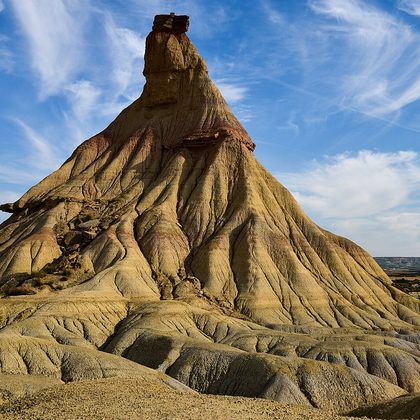
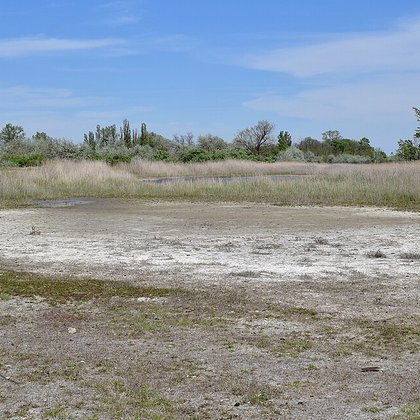
Sand and stone desert, semi-desert and barren plains: hamada, gravel flats, dried-up watercourses, saltpans and chotts, low dunes with scattered bushes, and in Asia also steppe and stony plateaux up to 3,500 m. It needs no rock face and nests in a hollow under a bush tussock, in a rodent burrow or under a stone. In winter it stands on flat bare sand with a few clumps of vegetation.
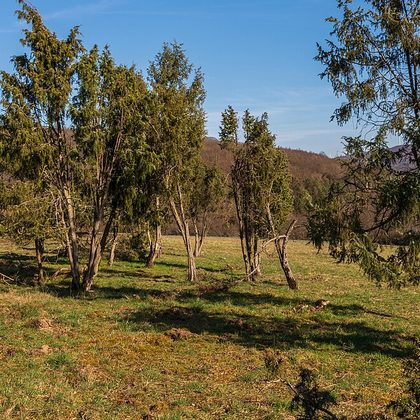
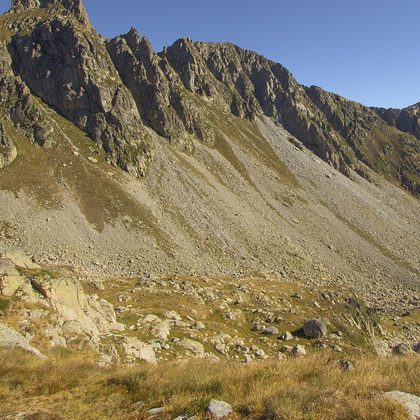
Where the bird is most at home, classified with EUNIS — the European standard for habitats.
Range and movements
Two widely separated parts. Western birds breed in North Africa, from Morocco and Western Sahara through Algeria, Tunisia and Libya to Egypt west of the Nile, and are largely resident there. Eastern birds breed from Sinai and Arabia through Iran, Afghanistan and Central Asia to Mongolia and north-western China, and move out to north-east Africa, the Arabian Peninsula, Iraq, Pakistan and north-west India. To north-west Europe it comes as a vagrant, and very characteristically late in the autumn: most British and Dutch records fall between mid-October and December, almost always on the coast.
- Resident
- Breeding (summer)
- Winter
- Passage
- Migration direction
- dark = core range, pale = thinly spread
Where and when to look
For anyone travelling in North Africa: the chotts and gravel plains of southern Tunisia or the country around Merzouga in March, when the males are in song. For anyone staying at home: November and December on the coast, on a beach, a sea wall or a bare dune foot. A vagrant is usually extraordinarily tame and stays for days within the same hundred metres, so flush it once and look properly at the tail — if there is no white in it, you are done.
Conservation status
Not threatened. The species has an enormous range and a large population, and desert and semi-desert are under less pressure than most other habitats. Overgrazing around wells and settlements matters locally, as does the ploughing of steppe in Central Asia, but across the range as a whole there is no evidence of decline.