All species › Passerines › Chats and flycatchers › Western black-eared wheatear
Western black-eared wheatear | Oenanthe hispanica
Westelijke blonde tapuit | Collalba rubia occidental
The wheatear of hot, stony southern hillsides: a slim bird with a black mask and a creamy-ochre back that hunts insects from a stone, a thistle or a low almond tree and returns to the same perch after every sally. Across Spain, Portugal and the Maghreb it is a common summer bird of dry open country. Since the world lists changed in 2018 and 2020 it has been treated as a species separate from eastern black-eared wheatear.

Voice
The song is a short, hurried phrase of scratchy and squeaky notes with a few clear whistles among them and some mimicry of neighbours, delivered from a stone, a wire or in a brief bouncing song flight in which the bird climbs on fluttering wings and parachutes down. The call is a hard, dry chak, like two pebbles knocked together, often paired with a thin rising pseet. Heard from late March into June, strongest in the first hours after sunrise.
No freely licensed recording is available for this species yet.
Identification
Smaller, slimmer and longer-tailed than northern wheatear, and far paler. The breeding male has a creamy to warm ochre crown, nape and mantle — never pure white — a black mask running from the base of the bill across the lores and ear coverts, jet-black wings and white underparts washed buff across the breast. Two morphs occur: one with a white throat, one with a black throat continuous with the mask. They breed side by side and are not subspecies; in Iberia the white-throated morph predominates. The tail is the second character: almost entirely white, with a narrow black terminal band and a thin black central stripe, so far less black than on northern wheatear. The female is warm sandy brown with a faint dark mask, but shows exactly the same tail. In autumn broad creamy fringes cover all the black and every bird looks brown and featureless.
Confusion species
This is the hardest corner of the family, and here the map counts for as much as the binoculars. Eastern black-eared wheatear — see its own page, where the same difference is set out from the other side — is the real problem, although the ranges barely meet: everything west of the Adriatic, Italy and Sicily included, is Western; from the Balkans eastward everything is Eastern. On a singing spring male there are three things to do. First the colour of crown and mantle: creamy to warm ochre on Western, cool creamy-white to white on Eastern, so that Eastern reads black-and-white where Western reads black-and-buff. Second the mask: on Western the forehead stays pale right to the bill, on Eastern the black crosses the base of the bill and stands higher above the eye, making the mask look larger and heavier. Third, on the black-throated morph, the side of the neck: on Eastern the black of the throat runs broadly on to the dark shoulder, on Western the black throat is smaller and cut off sharply against the buff breast. On females, first-years and all autumn birds it stops there. Away from the breeding range they cannot be named, and that is how they should be recorded. Male pied wheatear has a black mantle and back contrasting sharply with a white crown and nape, and on it the black of the throat runs unbroken down the side of the neck into that black mantle, whereas on both black-eared wheatears the mantle stays pale and a pale wedge is left between throat and shoulder; it also carries more black in the tail. Cyprus wheatear, which breeds only on Cyprus, resembles pied wheatear but is smaller and shorter-winged, has a cream rather than white crown, a distinct orange-buff wash across breast and belly, and a song of buzzing, insect-like bursts. Northern wheatear is bigger, greyer and more solidly built, lacks the ochre tones on crown and mantle and has far more black in the tail: a broad terminal band with a clear central stripe, together forming an inverted T. Further south: Black wheatear is entirely black with a white rump, white-crowned wheatear black with a white crown and an almost wholly white tail, desert wheatear has a black throat running on to the shoulder and a nearly all-black tail without white sides, and Isabelline wheatear is larger, plain sandy and long-legged with no black at all on head or back. Whinchat, finally, shows a broad pale supercilium, a streaked back and white patches at the tail base instead of a white rump panel.
Habitat
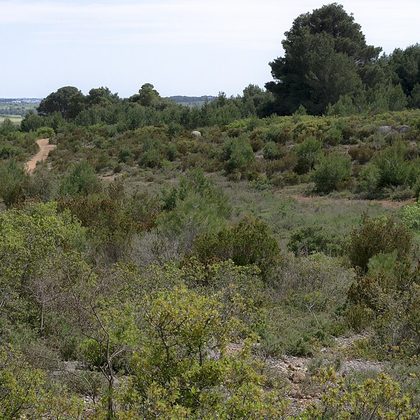
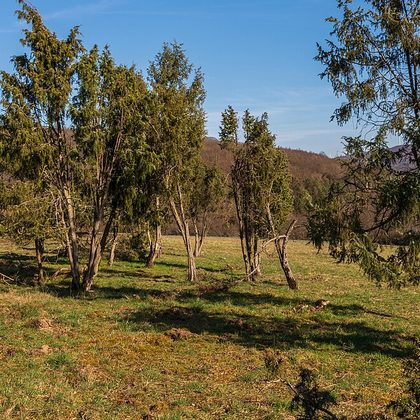
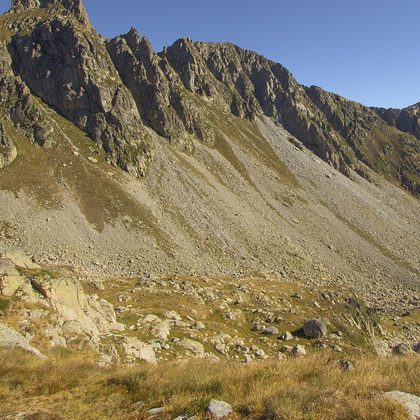
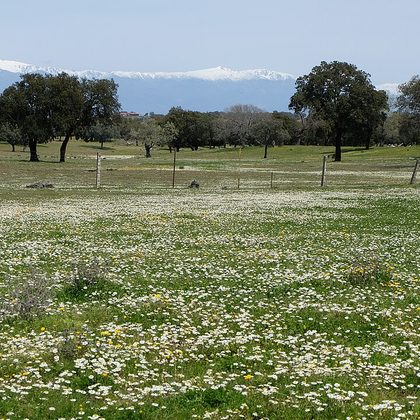
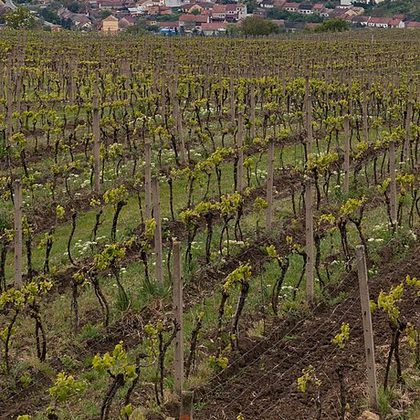
Dry, open, stony ground with bare earth and scattered bushes: garrigue, abandoned terraces, eroded slopes and badlands, almond and olive groves with unworked ground, vineyards, juniper steppe and sunny boulder-strewn hillsides. It always needs two things: low perches to hunt from, and cavities under stones or in dry-stone walls to nest in. From sea level to about 1,500 m, higher in north-west Africa.
Where the bird is most at home, classified with EUNIS — the European standard for habitats.
Range and movements
Breeds in Portugal and Spain, southern France, Italy with Sicily and Sardinia, and in Morocco, Algeria and Tunisia. All birds winter in the western Sahel, from Mauritania and Senegal to Niger, well outside the area of this guide. Spain holds by far the largest share: the last full national estimate gave 513,000 to 620,000 pairs, densest in the eastern half of the country, with Galicia, the Cantabrian strip and the Pyrenees left empty. France retains only 146 to 289 pairs as of 2022, almost all in Provence, the Aude and the Pyrénées-Orientales. In Britain and the Low Countries any black-eared wheatear is a major rarity, and many records stay under the joint name because the two species cannot always be separated in the field.
- Breeding (summer)
- Winter
- Passage
- Migration direction
- dark = core range, pale = thinly spread
Where and when to look
April and May shortly after sunrise, on a dry stony slope with scattered scrub: the páramos of Aragón, the badlands of Almería, the vine hills of La Mancha or the garrigue of the Corbières. Look for a bird that drops from a low stone or a fence post to the ground and returns at once to the same perch. Flush it and watch the tail: the almost wholly white panel with its narrow black edge rules out Northern, Isabelline and desert wheatear in one move. Only then look at the throat, because black-throated and white-throated are the same bird.
Conservation status
Not threatened globally, but in Spain the species is listed as Near Threatened nationally and has been declining since the 1960s. The causes are well understood: abandoned farmland growing over or being planted with trees, the switch from dry to irrigated agriculture, the loss of insects to pesticides, and increasing aridity in the south. As a trans-Saharan migrant it also carries the cost of drought in the Sahel. In France the fall has been steepest: a few hundred pairs remain and the species counts as critically endangered there. Where extensive grazing, bare stony ground and old dry-stone walls survive, it holds on.