All species › Passerines › Chats and flycatchers › Pied wheatear
Pied wheatear | Oenanthe pleschanka
Bonte tapuit | Collalba pía
The wheatear of the steppe and the sea cliffs around the Black Sea: a black-and-white male with a white cap and a jet-black back that rises over the slope in a slow, butterfly-like song flight. Along the western edge of its range, from Bulgaria to northern Iran, it breeds among eastern black-eared wheatears and the two interbreed on a large scale — there every intermediate stands on the rocks together. In north-west Europe it is an autumn vagrant.

Voice
The song is fuller and more musical than that of the black-eared wheatears: a varied run of short whistled and scratchy phrases with a great deal of mimicry, usually given in a conspicuous song flight in which the bird climbs above the slope on slow, butterfly-like wingbeats and parachutes back down still singing. The call is a hard, dry chak, often in series, and a rougher drawn-out zrrrt. Heard from April into July, mostly in the early morning.
No freely licensed recording is available for this species yet.
Identification
Slim and long-tailed, a little smaller and finer than northern wheatear. The breeding male is unmistakable: pure white crown and nape, jet-black face, throat and breast sides, and an equally black mantle and back, so that the black runs unbroken from chin to rump. The underparts are clean white, without orange or buff. The tail carries more black than on the black-eared wheatears: a broad black terminal band with the black also climbing well up the outer feather. In fresh autumn plumage the picture vanishes entirely: broad buff and cream fringes cover crown and mantle and the bird looks brown and scaly — which is exactly the plumage in which most western European vagrants turn up. The female is dark grey-brown with a dusky head, a pale throat and the same tail.
Confusion species
Everything starts with the mantle. On pied wheatear it is black and set hard against the white crown; on eastern black-eared wheatear — see its own page — the mantle stays pale. The second point is the side of the neck: here throat, neck side and mantle form one unbroken black area, whereas on the black-eared wheatears a pale wedge is left between throat and shoulder. The third is the tail, in which pied wheatear clearly carries more black. All of that holds only outside the hybrid zone: on the western shore of the Black Sea, in the Caucasus and in the Alborz mountains of northern Iran the two breed together and intermediates are so frequent that a proportion of birds cannot be named on plumage at all. Standing there, the wise course is to record 'pied or black-eared wheatear'. Song is no rescue either: both species sing varied phrases full of mimicry, and in the mixed populations the songs run together as well. Cyprus wheatear is the closest bird to this species and sits close to it taxonomically, but it breeds only on Cyprus, where pied wheatear occurs solely on passage. It is smaller and shorter-winged, its crown is cream rather than pure white, breast and belly carry an obvious orange-buff wash where pied wheatear is clean white, there is more black on back and tail, and it sings from trees five to ten metres up — a height no other wheatear uses. Its song, too, is not a phrase but a series of buzzing, insect-like bursts. Northern wheatear is bigger, greyer-backed and shows the familiar inverted T in the tail. Brown autumn pied wheatears in western Europe are confused mainly with northern wheatear: watch for the longer tail, the finer bill, the darker ear coverts and the broader black in the tail. Black wheatear is much larger, wholly black with a white rump; white-crowned wheatear has a white crown but an all-black body and an almost entirely white tail; desert wheatear has a sandy back and a nearly all-black tail. Stonechat and Whinchat are smaller, shorter-tailed and lack the white rump panel.
Habitat
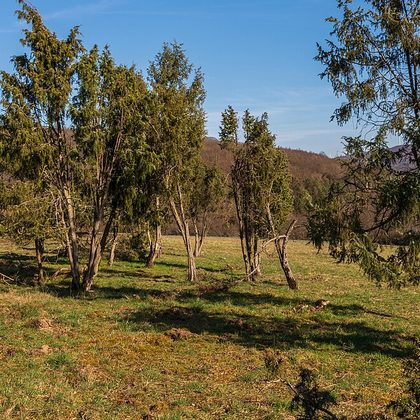
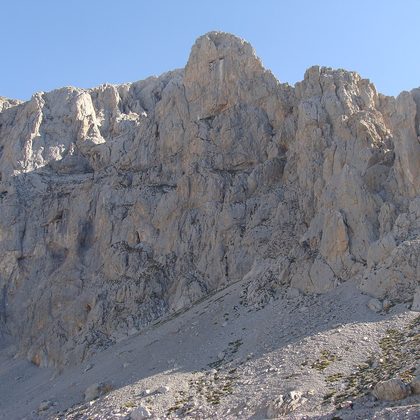
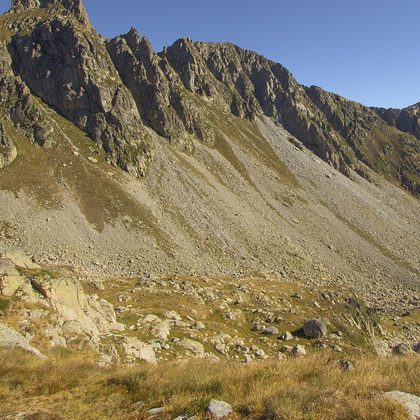
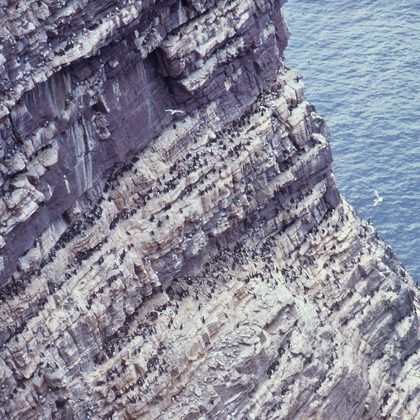
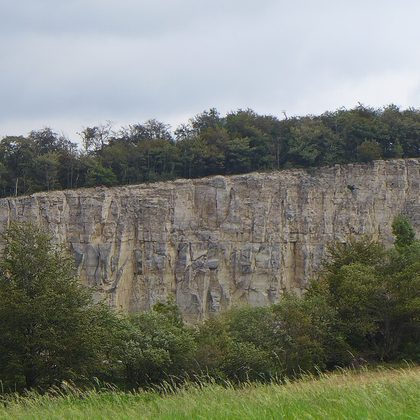
Open, dry, stony country: steppe with bare patches and scattered stones, ravines and erosion gullies, rocky mountainsides and escarpments, and along the Black Sea the limestone sea cliffs of the coast. Also quarries, ruins and derelict buildings, where it nests in niches and crevices. Always with bare ground to hunt over, stone perches, and a cavity to put the nest in.
Where the bird is most at home, classified with EUNIS — the European standard for habitats.
Range and movements
Breeds from the Black Sea steppes — the Dobrogea in Romania, the Bulgarian coast around Cape Kaliakra, southern Ukraine and Crimea — eastward through southern Russia, the Caucasus, Iran and Central Asia to Mongolia and northern China. The European population is put at roughly 47,500 to 215,000 adult birds, a small fraction of the world total. All birds winter in north-east Africa, from Sudan and Ethiopia to Kenya and Somalia, well outside the area of this guide. In Britain it is a rare but almost annual autumn vagrant, and in the Netherlands 35 records have been accepted, with a marked peak in October and November.
- Breeding (summer)
- Winter
- Passage
- Migration direction
- dark = core range, pale = thinly spread
Where and when to look
Late April or May on the Bulgarian Black Sea coast, at Cape Kaliakra or Cape Emine: the males sing from the limestone cliffs there and the butterfly song flight over the drop is the finest thing the species has to offer. Look carefully while you are there, because this is the middle of the hybrid zone and the same slope holds pied wheatears, eastern black-eared wheatears and everything in between. In north-west Europe autumn is the moment: mid-October to late November on a groyne, a sea wall or a saltmarsh, and then it is a brown bird that only the tail, the proportions and a lot of patience will settle.
Conservation status
Not threatened globally; the range is enormous and its centre of gravity lies in Central Asia, where numbers appear stable. Along the European western edge the picture is less calm: the coastal populations of Bulgaria and Romania are small and tied to a narrow strip of steppe and cliff under heavy pressure from coastal building, wind farms and tourism, and the conversion of steppe to arable has been shrinking that range for centuries. In the Caucasus and Iran the species is numerous. Quarries, ruins and abandoned stock buildings supply nest sites in many places that supplement the natural rock.