All species › Passerines › Chats and flycatchers › Eastern black-eared wheatear
Eastern black-eared wheatear | Oenanthe melanoleuca
Oostelijke blonde tapuit | Collalba rubia oriental
The black-eared wheatear of the eastern Mediterranean: on any Greek phrygana slope, any Turkish stony pasture and any ruin in the Levant there will be one singing from a rock in April. It reads black-and-white where its western counterpart reads black-and-buff, and since 2018 and 2020 it has carried its own name on the world lists. Genetically it sits closer to Pied and Cyprus wheatear than to western black-eared wheatear — and with pied wheatear it also interbreeds.

Voice
The song is a short, hurried phrase of scratchy and whistled notes, usually with a few clear rising whistles and a good deal of mimicry of local species, delivered from a boulder, a wall or a telephone wire and often in a brief song flight on fluttering wings. The call is a hard chak, sometimes doubled, and a thin rising pseet. Heard from mid-March into June, and on Lesbos or the south Turkish coast it is effectively the soundtrack of every dry hillside.
No freely licensed recording is available for this species yet.
Identification
Slim, long-tailed and sharply marked. The breeding male has a creamy-white to almost pure white crown, nape and mantle, a heavy black mask that crosses the base of the bill and rises well above the eye, jet-black wings and white underparts with at most a faint buff wash on the breast. Two morphs occur here too, white-throated and black-throated. On the black-throated morph the black of the throat runs broadly down the side of the neck to the black shoulder, and it is exactly that which makes the bird look so pied. The tail is almost wholly white with a narrow black terminal band and a thin central stripe. The female is grey-brown — colder than on the western bird — with dark lores and ear coverts and the same tail. In autumn the contrast disappears under broad buff fringes.
Confusion species
Western black-eared wheatear is the direct counterpart; see its own page, where the same difference is set out from the other side. The dividing line runs roughly along the Adriatic: Italy and Sicily western, the Balkans and everything beyond eastern. On a spring male three points are usable. Crown and mantle here are creamy-white to white and cool in tone, on the western bird creamy to warm ochre. The mask here is heavier: the black crosses the base of the bill and stands higher above the eye, whereas on the western bird the forehead stays pale right to the bill. And on the black-throated morph the black here runs broadly on to the shoulder, where on the western bird it remains a smaller, sharply bounded throat patch. Females, first-years and autumn birds cannot be separated; away from the breeding range, leave such a bird as 'black-eared wheatear'. Pied wheatear is the second problem, and a harder one, because in Bulgaria, Romania, the Caucasus and northern Iran the two breed together and hybridise extensively: every intermediate occurs there and a proportion of birds simply cannot be named on plumage. Outside those districts the mantle decides: black on pied wheatear and sharply set off against the white crown, pale here. Look also at the side of the neck — on pied wheatear throat, neck side and mantle form one continuous black area, here a pale wedge is left between throat and shoulder — and at the tail, which on pied wheatear carries more black, with a broader terminal band and black climbing further up the outer feather. Cyprus wheatear breeds only on Cyprus and resembles pied wheatear: smaller and shorter-winged than either, with a cream rather than white crown, a warm orange-buff wash over breast and belly, more black on back and tail, and an unmistakable song of buzzing, insect-like bursts delivered from a tree. On Cyprus this species occurs only on passage, so there the location does help. Northern wheatear is larger and greyer, with a broad black terminal band and central stripe in the tail — an inverted T rather than a thin edge. Further into the Middle East: Desert wheatear with its black throat running on to the shoulder and its nearly all-black tail, Isabelline wheatear, larger, plain sandy and long-legged with no black on the head, black wheatear, entirely black with a white rump, and white-crowned wheatear with its white crown and almost wholly white tail. Whinchat has a broad pale supercilium and a streaked back.
Habitat
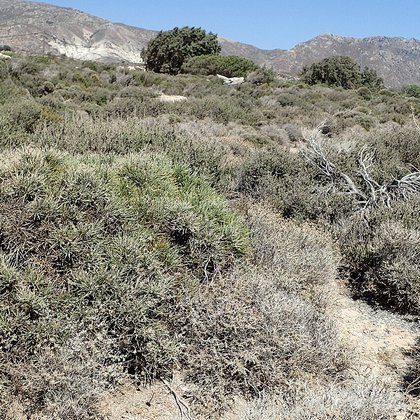
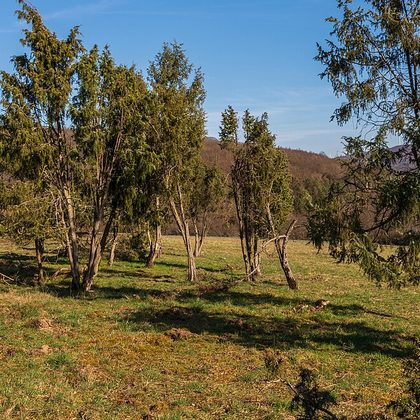
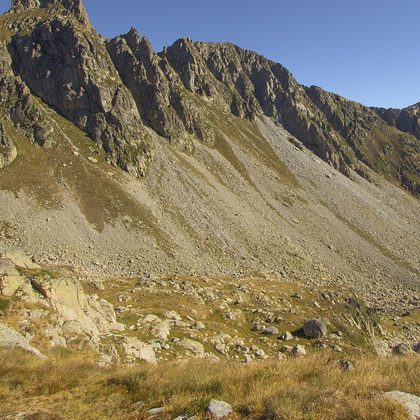
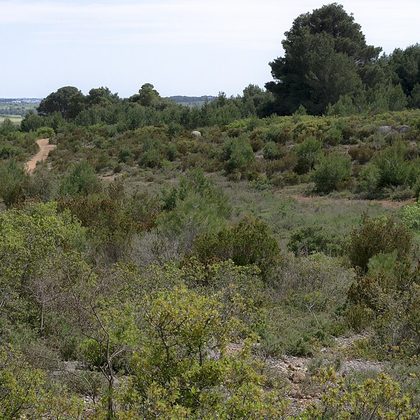
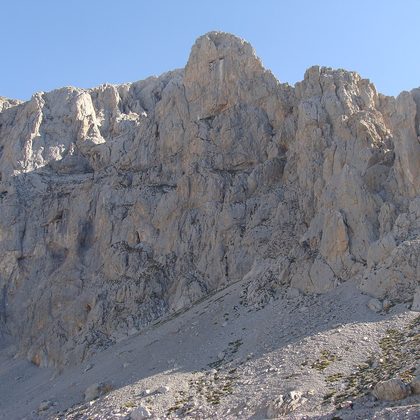
Open, dry, stony ground with low cover: phrygana and garrigue, bare stony pasture, rocky mountainsides, hill terraces with olives and almonds, quarries, and the surroundings of ruins and old castles. It goes higher than the western bird, reaching well above 2,000 m in Turkey and Iran, but always where the ground is bare and stony and there are low perches and cavities.
Where the bird is most at home, classified with EUNIS — the European standard for habitats.
Range and movements
Breeds from Croatia, Albania and Greece across Bulgaria and Turkey to the Levant, the Caucasus and Iran, with an arm down the Red Sea to Ethiopia; in Greece and Turkey it is one of the commonest songbirds of hot open country. Every bird leaves for the Sahel and Sudan, far outside the area of this guide, so the region knows it only as a breeder and migrant. In Bulgaria, Romania, the Caucasus and northern Iran it overlaps with pied wheatear and the two interbreed on a large scale. In north-west Europe it is a major rarity, and most records there remain undecided between this species and the western one.
- Breeding (summer)
- Passage
- Migration direction
- dark = core range, pale = thinly spread
Where and when to look
The second half of April on Lesbos, in the Peloponnese or along the south coast of Turkey. Find a dry slope with scattered boulders and low thorn scrub and wait for a male to take the highest stone. Photograph or sketch the head: it is the combination of the white crown, the black crossing the base of the bill and the pale mantle that fixes the species. Then check the back — if it stays pale, it is not a pied wheatear — and the tail, where the black should be no more than a narrow edge.
Conservation status
Not threatened. The Red List still keeps it within the broad species Oenanthe hispanica, which also covers western black-eared wheatear and is listed as Least Concern; the world lists have carried it under a name of its own only since 2018 and 2020. This is an abundant bird with a very large range, from the Adriatic coast to Iran, present on almost every dry slope in Greece and Turkey. The pressures are those of Mediterranean dry country generally: abandoned grazing land growing over, stony pasture converted to irrigated arable and orchard, and large fires. Where goats and sheep keep the ground short, it remains numerous.