All species › Passerines › Chats and flycatchers › Cyprus wheatear
Cyprus wheatear | Oenanthe cypriaca
Cyprustapuit | Collalba chipriota
Cyprus wheatear breeds nowhere in the world but Cyprus, and from March to October it is everywhere on the island: on the coastal hills, among the old terraces behind the villages and right up in the pines of Troodos. It is the most arboreal wheatear in the region — it perches on a branch rather than a stone — and its song sounds less like a bird than like a cicada.

Voice
The song is unmistakable and hardly sounds like a bird at all: a dry whirring buzz like a cricket or a cicada, zrrrrrrrrr, held for five to ten seconds and usually closed with a few clear high piping notes. It is delivered from a pine top, a telephone wire or a boulder, from late March into July, and carries on through the heat of the day when everything else has fallen silent. The call is a hard tsak-tsak like pebbles knocked together, often preceded by a whistled hweet.
No freely licensed recording is available for this species yet.
Identification
A small, sharply pied wheatear. The male has a cream-white to off-white crown and nape, a jet-black face, throat and upper breast running unbroken into a black mantle and black wings, and warm buff to apricot underparts. The tail is white at the base with a broad black terminal band and a long black centre, so there is more black in it than in most wheatears. The female closely resembles the male but is duller and brown-black rather than jet-black; that the sexes differ so little is itself a character. In autumn broad pale fringes give the bird a scaled look and the crown appears buff.
Confusion species
It all turns on pied wheatear; Cyprus wheatear has been treated as a full species since 1982 and before that as its island form. Pied wheatear is larger and longer-winged, the male has a pure white crown and nape rather than cream-white, clean white underparts without the buff or apricot wash, and less black in the tail — the terminal band is narrower and the white runs further back. In pied wheatear the female is brown above and so plainly different from the male, whereas here the sexes are nearly alike. The surest character is the song: a cicada-like buzz in Cyprus wheatear, a scratchy warble full of mimicry in pied wheatear. Western and eastern black-eared wheatear in their black-throated form also show a black throat, but the crown and mantle are sandy rather than black and the tail is largely white. Northern wheatear has a grey mantle, only a black mask, and the familiar black inverted T.
Habitat
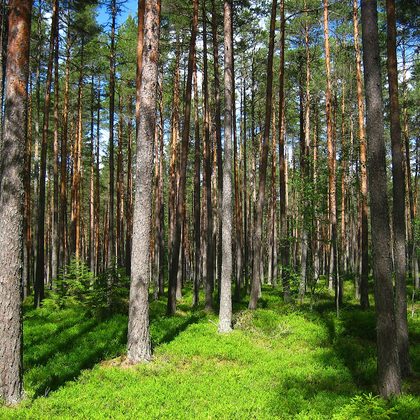
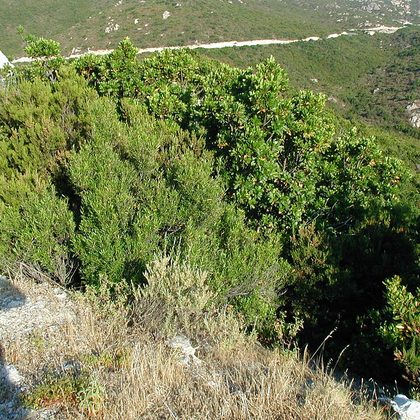
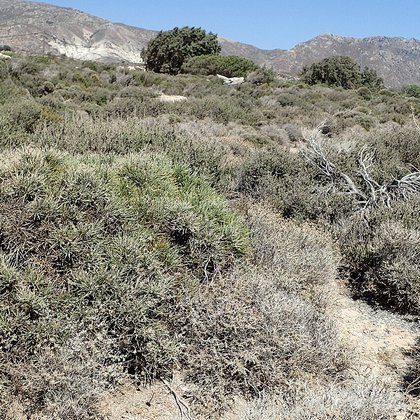
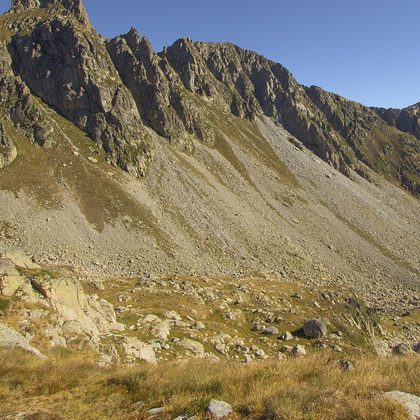
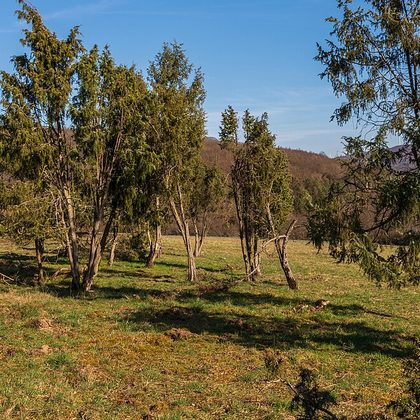
Open Calabrian pine forest and woodland edges with clearings, maquis and phrygana on stony slopes with scattered trees, old farming terraces, vineyards and orchards, and the edges of hill villages; from the coastal cliffs to the summit ridge of Troodos at over 1,900 m. Unlike most wheatears it hunts from branches, flying out after an insect in the air and returning to the same perch. The nest goes in a cavity in an earth bank, in a dry-stone wall or under a flat stone.
Where the bird is most at home, classified with EUNIS — the European standard for habitats.
Range and movements
A breeding bird of Cyprus and of nowhere else on earth. The first birds arrive in late February and March, the last leave in October and November. Geolocator work has shown that the whole population winters in one small area on the borders of Sudan, South Sudan, Eritrea and Ethiopia, roughly between 7 and 19 degrees north — a journey of some 2,200 km with a stopover on the Red Sea coast. On passage it is rarely reported from Israel, Egypt and Greece; as a vagrant it has reached Heligoland. On Cyprus itself it is among the commonest breeding birds, from sea level to the highest ground.
- Breeding (summer)
- Passage
- dark = core range, pale = thinly spread
Where and when to look
April and May, anywhere among the pines on the southern flank of Troodos or out on the Akamas peninsula. Do not look for a bird on the ground; look for one on a branch or a wire, and let your ears do the work — the cicada buzz carries a long way and at thirty degrees it is often the only sound there is. Around coastal hotels and tavernas the bird comes onto the terrace tiles, and there you can see the buff of the breast and the amount of black in the tail at close range.
Conservation status
Not threatened, with a large and stable population, but the entire world population breeds on one island of a little over nine thousand square kilometres, and that makes the species vulnerable by definition. Forest fires in Troodos, the clearing of maquis and old terracing for building and tourism, and the loss of insects to pesticides are the long-term worries. To these must be added the illegal trapping with limesticks and mist nets in the south-east of the island: it falls mainly on migrant songbirds, but it takes island breeders too.