All species › Tubenoses › Southern storm petrels › Wilson's storm-petrel
Wilson's storm-petrel
Oceanites oceanicus | Wilsons stormvogeltje | Paíño de Wilson
Wilson's Storm-petrel breeds on the shores of Antarctica and reaches European waters in the northern summer, while the Southern Ocean lies in darkness. Off Portugal and Galicia and in the Bay of Biscay it is a regular sight from June onwards; on the North Sea it remains a great rarity.

Voice
All but silent at sea, though within a feeding flock behind a boat a thin, squeaky peeping can sometimes be heard. At the colony it is noisy at night: a nasal, grating aark aark from birds on the ground, and from the male in the crevice a monotonous chatter, aark-uh-ah-ah-uh-uh, kept up for minutes at a time. None of this can be heard in European waters, where the bird gives nothing away.
No freely licensed recording is available for this species yet.
Identification
Small and compact, blackish brown, with short, broad, rounded wings whose leading edge is almost straight, giving a blunt, paddle-shaped outline quite unlike the pointed wing of Leach's. The tail is square, and the long legs project beyond it; with practice that projection is visible at surprising distances and is the single most useful mark. The webs are yellow, though a boat and good light are needed to see them. The white rump is large and wraps well down onto the flanks and the sides of the undertail, and a pale greyish-buff band runs across the greater coverts of the upperwing, broader and warmer than the dull bar of the Band-rumped. The flight is direct and gliding on stiff, slightly raised wings; when feeding, the bird hangs above the surface with the wings held up in a shallow V and dances on the water with its long legs.
Confusion species
European Storm-petrel is the usual confusion in northern waters: it is shorter-legged with no foot projection at all, flutters rather than glides, and shows a white bar along the underwing that Wilson's never has. Leach's Storm-petrel is larger and longer-winged, with a kinked, pointed wing, a forked tail, a narrower V-shaped rump patch often split down the middle, and a veering, bounding flight. Band-rumped Storm-petrel is longer-winged and glides more evenly, with a narrow, sharp-edged rump band, a duller upperwing bar and no projecting feet. White-faced Storm-petrel is white below and cannot be confused. The rule at sea is to read the foot projection and the wing shape before the rump.
Habitat
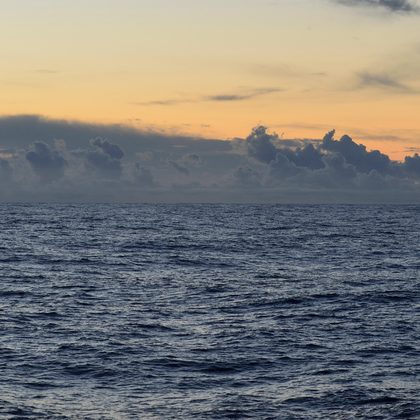
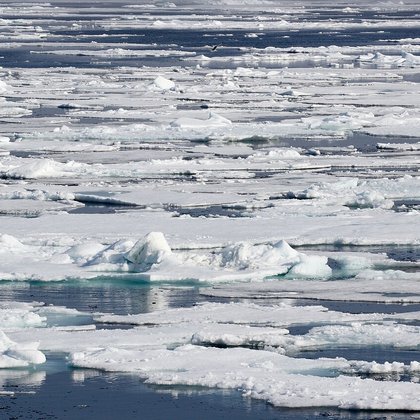
Wholly pelagic in our area, over the shelf edge and deep water, following trawlers and gathering readily at slicks of fish oil. It feeds by pattering and dipping with the wings raised, taking crustaceans, small fish and floating fat from the surface. In the southern summer it breeds in rock crevices and scree on the Antarctic coast and the islands around it, and forages in cold water along the edge of the pack ice, which is where the bulk of the world population spends the breeding season.
Where the bird is most at home, classified with EUNIS — the European standard for habitats.
Range and movements
Breeds around Antarctica, on the South Shetlands, South Georgia, the Falklands, Kerguelen and the islands near Cape Horn, from November to March. Afterwards it moves north; in the northern summer it is numerous in the North Atlantic and reaches European waters, where it is regular off Portugal and Galicia and in the Bay of Biscay from June to September, scarcer in the Strait of Gibraltar and around the Canaries and Madeira, and rare north of Ireland. It has no breeding population anywhere within the area of this guide.
- Breeding (summer)
- Passage
- Migration direction
- dark = core range, pale = thinly spread
Where and when to look
Book a pelagic. Off Galicia, and from the Bay of Biscay ferries, the species is close to expected in July and August, and a chum slick will hold birds in view for minutes at a time — the only way to see the yellow webs properly. From land the odds are poor everywhere; if you seawatch for it, do so from a southern Atlantic headland in high summer rather than during autumn gales, which is when the two commoner storm-petrels turn up. Compare it directly with European Storm-petrels in the same slick if you can: the difference in wing shape is far clearer side by side.
Conservation status
Not globally threatened (IUCN: Least Concern); this is among the most numerous seabirds in the world, with a population running into millions of pairs. The colonies lie far from human settlement, and the long-term concerns are changes in the krill stocks of the Southern Ocean, predation by skuas, and introduced mammals at a few subantarctic sites. In European waters the bird is only a visitor, so the numbers seen here follow what happens in the Antarctic rather than anything that can be managed locally.