All species › Passerines › Cisticolas › Zitting cisticola
Zitting cisticola
Cisticola juncidis | Graszanger | Buitrón
A tiny, streaked warbler of damp grassland and rice fields, ubiquitous in southern Europe but always noticed first by the monotonous dzip falling out of the sky like a metronome. The species has been pushing north for decades and now breeds in the Netherlands too.

Voice
The song is not musical but unmistakable: a sharp, short, metallic dzip … dzip … dzip, roughly twice a second, each note punched out at the top of an undulating song flight, so the sound bounces to and fro across the field. The bird loops in wide arcs ten to thirty metres up, from March into September, including the middle of the day and in full sun. The call is a short nasal tsip or a dry tchek from within the vegetation, often just before it launches again.
Recording: Jochem Verweij — CC BY-SA 4.0 · Wikimedia Commons
Identification
Minute, smaller than a Wren, with a short, broad, rounded tail that is fanned to reveal a black band with white tips underneath. Upperparts rufous-brown and heavily black-streaked, including the crown, which pointedly lacks a pale central stripe. The rump is unstreaked and warm rusty brown. Underparts plain creamy white without streaking, bill fine and pointed, legs pink. In flight small, light and bouncing, always with that short, conspicuously banded tail.
Confusion species
In north-west Europe a juvenile Sedge Warbler is the classic error: clearly larger, with a long rounded tail without white tips, a broad pale crown stripe between two dark bands, a long creamy supercilium and an unstreaked rusty rump, and it sits in reed rather than grass. Cetti's Warbler is much darker, wholly unstreaked and explosively loud. Grasshopper Warbler and Savi's Warbler are longer and slimmer, with a strongly graduated tail and long undertail coverts, and reel rather than tick. Meadow Pipit is bigger, slimmer and longer-tailed and lacks the streaked crown with rusty rump.
Habitat
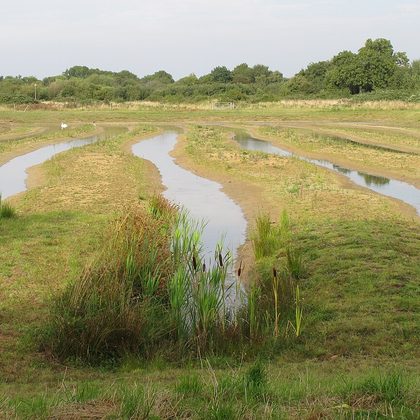
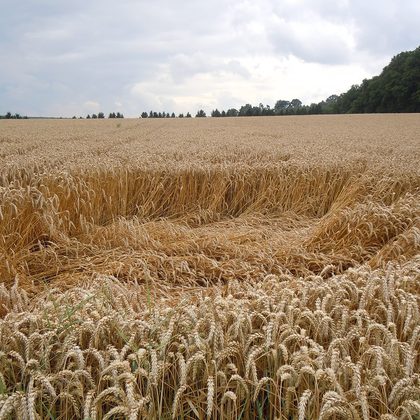
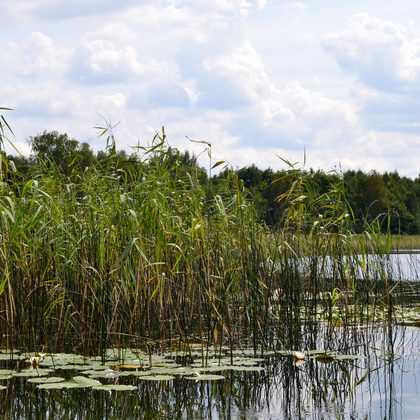
Low, damp, dense grass: coastal grazing marsh, rice fields, lucerne and cereal, rough field margins, dykes, saltmarsh edges, irrigation canal banks and lagoon fringes. The nest is a beautiful pear-shaped weave of grass blades and spider silk, literally stitched to living stems. It stays in the same kind of ground all year and does not migrate.
Where the bird is most at home, classified with EUNIS — the European standard for habitats.

Range and movements
Southern Europe, Africa and southern Asia; in Europe mainly around the Mediterranean and along the Atlantic seaboard. In Spain it is numerous in almost all low-lying open country, from the rice fields of the Ebro Delta and the Albufera to the Guadalquivir marismas and the steppes of Extremadura. The species has been moving north since the 1970s and now breeds in small numbers in Zeeland, South Holland and along the big rivers, crashing back after every hard winter.
- Resident
- Breeding (summer)
- Winter
- Passage
- dark = core range, pale = thinly spread
Where and when to look
In Spain: any spring morning over a rice field or a damp meadow; follow the dzip upwards with binoculars and you have the bird in its undulating song flight. In the Netherlands: May to July in the brackish grasslands of Zeeland and South Holland and on the Delta dykes, again with your ears as the best instrument. When it drops, keep waiting: it often perches briefly on a grass stem or barbed wire and fans the tail.
Conservation status
Not threatened (LC) and hugely numerous worldwide. Its European northern limit is shifting with the climate and it benefits from rice growing and mild winters, but the small populations at that frontier are wiped out by a severe winter and have to be replenished from the south. Drying of damp grassland, early and total mowing of dykes and field margins, and the switch from lucerne to intensive crops all cost nests.