All species › Tubenoses › Albatrosses › Antipodean Albatross
Antipodean Albatross | Diomedea antipodensis
Antipodenalbatros | Albatros de las antípodas
The Antipodean Albatross is one of the two great albatrosses that belong to New Zealand waters: a bird of nearly three metres' span, with a heavy pink bill and a plumage that runs from chocolate brown to almost white, depending on age, sex and island of origin. It breeds nowhere but on New Zealand's subantarctic islands, and its numbers are falling faster than those of any other albatross in this guide.

Voice
At sea it is all but silent; only a raw, guttural growl escapes when birds squabble over scraps behind a ship. The real voice belongs to the colony: courting birds scream and roar, clapping the bill loudly with the wings held wide. Chicks beg with a high squeaky call and squeal as they start to exercise their wings on the nest.
No freely licensed recording has been found for this species yet; what to listen for is described below.
Identification
About 110 cm long, with a span of some three metres and a weight of 4.5 to 8.5 kg. The bill is heavy and pink, without a black cutting edge. The plumage is both the problem and the story: young birds are chocolate brown with a white face and a white underwing, and males whiten with the years — first finely vermiculated on back and breast, later white with black over the outer two-thirds of the upperwing. Females stay largely brown for life, with only that white face mask. Birds from the Auckland Islands (subspecies gibsoni) are paler at every stage than those from Antipodes Island. The underwing is always white, with a narrow dark trailing edge and a dark tip.
Confusion species
Snowy Albatross (Diomedea exulans) is the hard case, and honesty is called for: a fair share of birds seen at sea cannot be named with confidence. Exulans averages larger (around 120 cm), has a heavier bill and whitens far further — old males are nearly all white, including much of the upperwing, and often carry a peach smudge behind the ear. An Antipodean never reaches that stage. Watch what the same plumage means, too: a brown bird with a white face is an adult female here, while the same dress on exulans is a young bird. Distribution helps: in the Tasman Sea and off eastern Australia the Antipodean is by far the commoner of the two. Southern Royal Albatross (Diomedea epomophora) is as large but never has a brown body and carries a black cutting edge along the upper mandible. All the mollymawks — Shy Albatross (Thalassarche cauta), Black-browed Albatross (Thalassarche melanophris), Buller's Albatross (Thalassarche bulleri) and their kin — are a good thirty centimetres shorter, always have a dark upperwing and a dark bill with yellow stripes.
Habitat
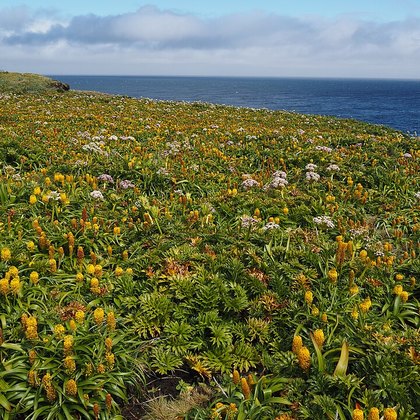
Open ocean: subtropical and subantarctic water, the shelf edge and the fronts where water temperature turns over and food gathers. It lives chiefly on squid, much of it taken at the surface at night, with fish and carrion besides. To breed it comes ashore on the tussock slopes and herbfields of the subantarctic islands, where the nest is a low cone of earth and plant matter, open to the wind.
Where the bird is most often found, arranged by main group and formation.


Range and movements
Breeds only on New Zealand's subantarctic islands: the nominate form on Antipodes Island, subspecies gibsoni on the Auckland Islands, where about 95 per cent of pairs sit on Adams Island. A handful of pairs nest on Campbell, Pitt and the Chathams. At sea it fills nearly the whole map window: the Tasman Sea, the waters around New Zealand and the shelf and slope off New South Wales, Victoria and Tasmania, where it is seen on pelagic trips mainly in the winter half of the year.
- Resident
- Winter
- dark = core range, pale = thinly spread
Where and when to look
Take a pelagic out of Wollongong or Sydney, out of Eaglehawk Neck in Tasmania or out of Port Fairy in Victoria, preferably between May and September; off Kaikoura on the South Island it can be had from the boat year-round. Look at the bill first: pink and heavy means Diomedea, and that one glance separates the two great albatrosses from every mollymawk. Then photograph both the upperwing and the underwing — without both, the plumage stage cannot be settled afterwards, and it is the stage that decides whether an identification will hold.
Conservation
Endangered (EN). Numbers have fallen steeply since 2004: breeding success runs at about a quarter, and annual adult survival has slipped to roughly 80 per cent in females and 88 per cent in males. Because females forage further north, in the zone worked by surface longliners after swordfish, more females than males are killed and the sex ratio has skewed: unpaired males now stand about the colony. Add a warming Tasman Sea with less prey, and on Auckland Island feral pigs and cats that take eggs and chicks.
Scientific name
Diomedea antipodensis | Robertson & Warham, 1992
Robertson and Warham introduced the form in 1992 as the subspecies Diomedea exulans antipodensis; in 1998 it was recognised as a full species. Because the genus did not change, authors and year carry no parentheses. antipodensis means 'of the Antipodes' and points to Antipodes Island, the type locality. The genus Diomedea was introduced by Linnaeus in 1758 and is named for Diomedes, the Greek hero whose companions were said to have been turned into seabirds.