All species › Penguins › Penguins › Gentoo Penguin
Gentoo Penguin | Pygoscelis papua
Ezelspinguïn | Pingüino papúa
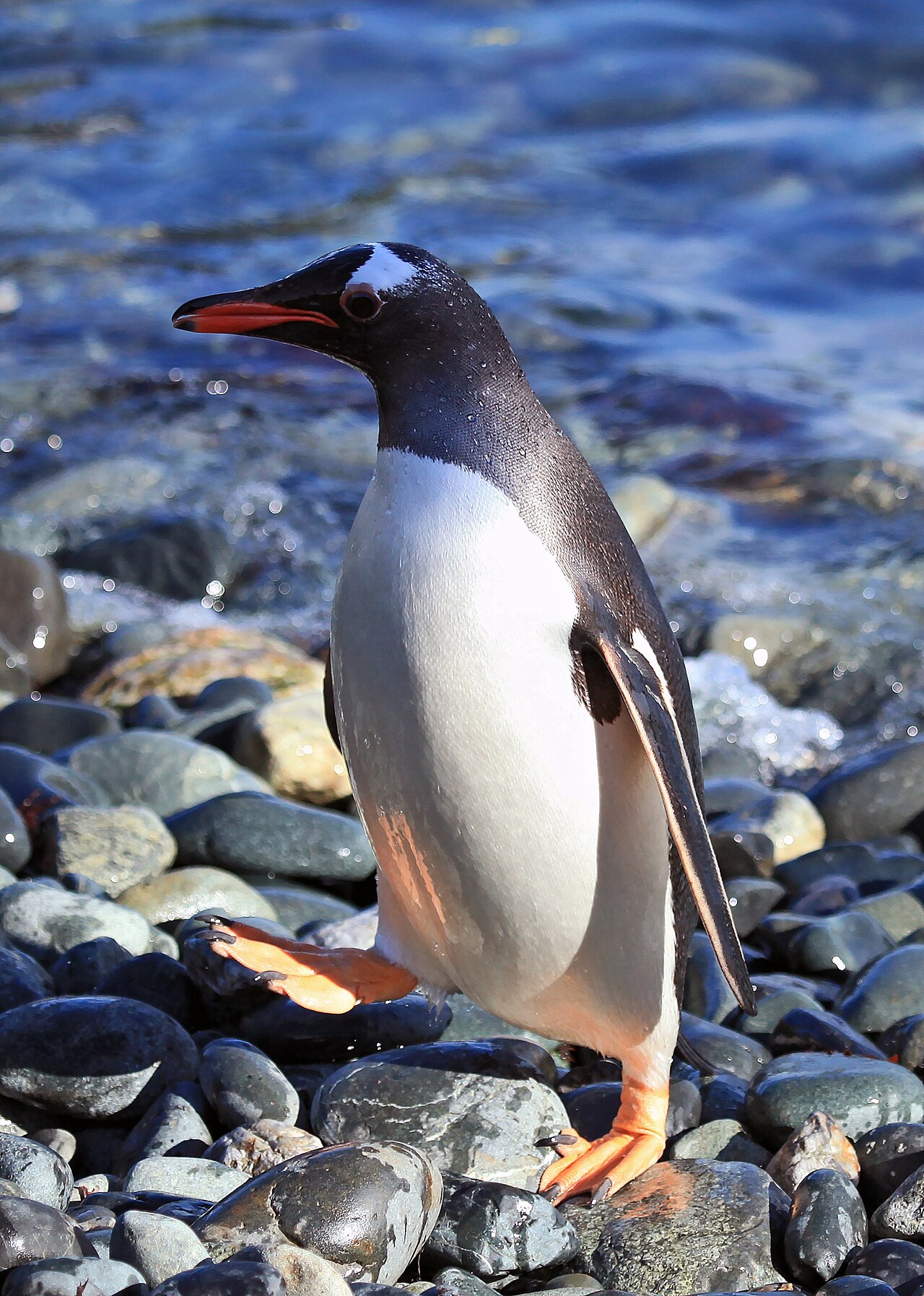
The Gentoo Penguin is the third largest of all penguins: a solid dark grey bird with a broad white band running like a bonnet across the crown from eye to eye, and a bright orange bill. It is the fastest swimmer of all penguins, reaching thirty-six kilometres an hour underwater.
Voice
At the colony comes a loud crowing ah, a-ha, a-ha, a-ha, eh delivered with the bill straight up and the flippers spread — the sound that earns the bird its Dutch name of 'donkey penguin'. At sea and on landing it gives a short hard caw as a contact call. Chicks beg with a persistent piping chatter that carries above the noise of the colony.
Recording: Meena Haribal — CC BY-NC-SA 4.0 · Volunteer Point, Falkland Islands, United Kingdom · xeno-canto
Identification
A large penguin of about eighty centimetres, dark blue-grey on head, neck and back and white below, with as its fixed character a white triangle over each eye joined by a narrow white band across the crown. The bill is orange-red with a black tip and black upper ridge, the feet orange. The tail is strikingly long and sweeps the ground as the bird walks, longer than in any other penguin. Young birds have a duller bill and a broken, blotchy white head band.
Confusion species
Within this map window it meets King Penguin (Aptenodytes patagonicus) on Macquarie Island, far larger, grey-backed and with orange ear patches instead of a white crown band, and Royal Penguin (Eudyptes schlegeli), smaller and carrying orange-yellow crest plumes on the forehead. No other penguin here combines a white crown band, an orange-red bill and a long trailing tail. At range and at sea the orange bill is the character that comes through the binoculars first.
Habitat
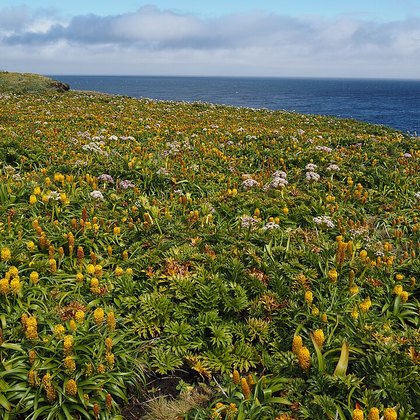
Subantarctic sea and the shallow water around the breeding islands, where it stays closer to home than most penguins and dives mainly for krill, small fish and squid. Colonies are on flat open ground behind the beach: on gravel, boulder fields, old moraine ridges and among poa tussock (grassland of loose, tall clump-forming grasses, especially in New Zealand), where the nest is a low ring of pebbles and feather scraps. Unlike most species it shifts its colony to cleaner ground from time to time.
Where the bird is most often found, arranged by main group and formation.


Range and movements
Within this map window it breeds only on Macquarie Island, administered from Tasmania; beyond it the species holds colonies on South Georgia, the Falklands, Kerguelen, Heard and the Antarctic Peninsula. On the New Zealand mainland it is a vagrant with six records between 1970 and 2011, and it turns up now and then on Campbell Island and the Snares. In Australian waters away from Macquarie it is not to be expected.
- Breeding (summer)
- dark = core range, pale = thinly spread
Where and when to look
In this area it can be seen only from an expedition ship to Macquarie Island, and then at once: in the tangle of penguins on the beach look for the bird with the orange bill and the white bonnet — among hundreds of thousands of yellow-crested Royal Penguins it stands out immediately. Watch the tail too: a penguin sweeping a track through the gravel is this one.
Conservation
Least Concern (LC), with something of the order of three hundred thousand breeding pairs worldwide and numbers that swing sharply from year to year, but no sign of a sustained decline. On Macquarie Island rabbits, rats, mice and cats have all been eradicated — the island was declared pest-free in 2014 — so the colonies there no longer suffer land predators. What does weigh is the sea: shifts in krill and fish and the warmth of the surface water decide how many chicks a colony raises.
Scientific name
Pygoscelis papua | (Forster, 1781)
Johann Reinhold Forster described the species in 1781 as Aptenodytes papua; because it later moved to another genus, author and year stand in parentheses. The epithet papua is a mistake that has stuck: Forster believed the bird belonged near New Guinea, whereas the nearest colony lies thousands of kilometres away and the type material came from the Falkland Islands. Wagler introduced the genus Pygoscelis in 1832, from Greek puge, 'rump', and skelos, 'leg' — after the legs set far back on the body. The Dutch name, 'donkey penguin', refers to the braying voice of the colony; the English name 'gentoo' is of uncertain origin, possibly from an old Anglo-Indian word.