All species › Penguins › Penguins › Yellow-eyed Penguin
Yellow-eyed Penguin | Megadyptes antipodes
Geeloogpinguïn | Pingüino ojigualdo
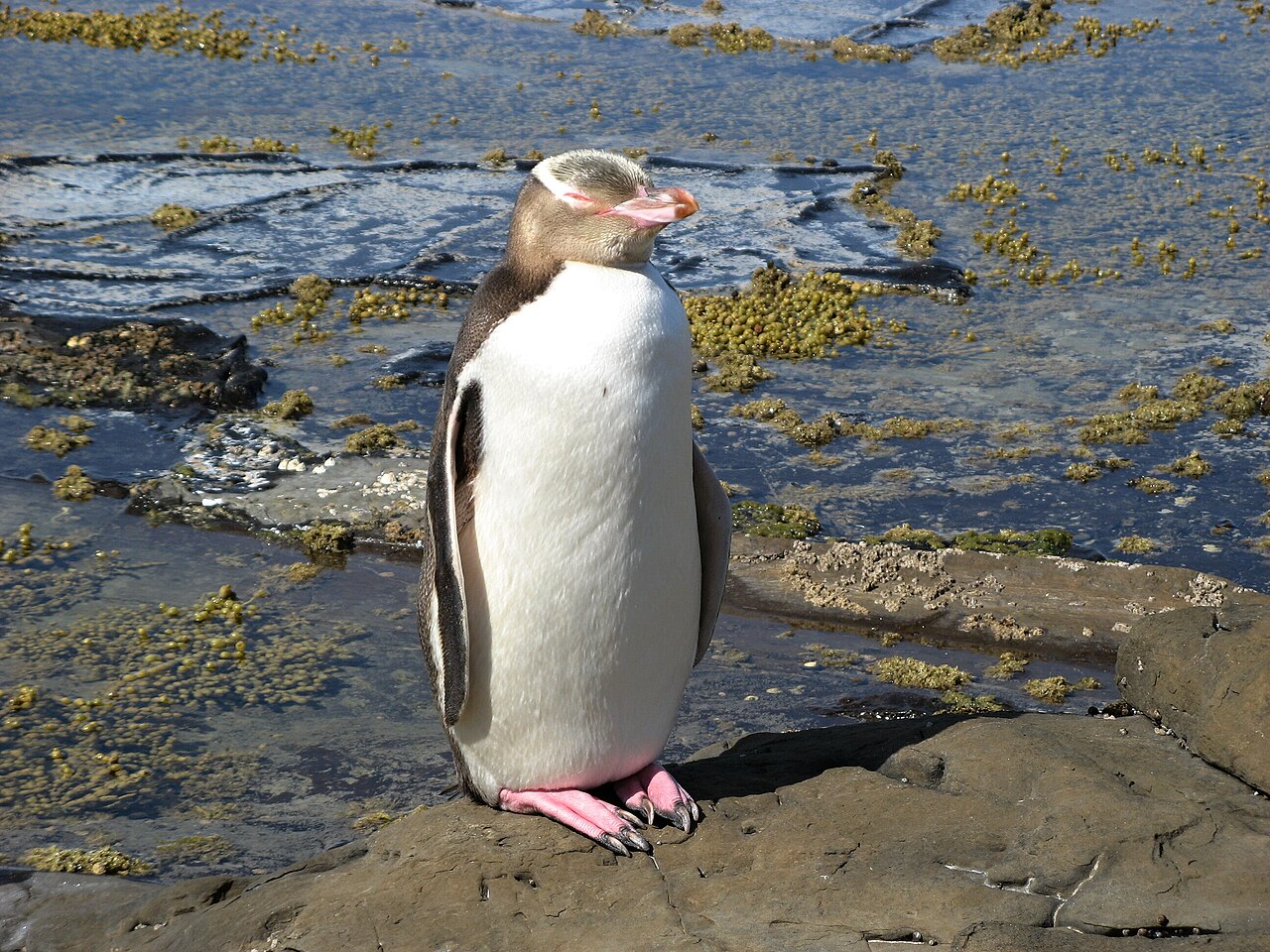
The Yellow-eyed Penguin is the largest penguin breeding on the New Zealand mainland and the only one with a pale yellow band running from the eye around the back of the head. It nests not in colonies but pair by pair, out of sight of its neighbours, which makes it both hard to count and easy to disturb.
Voice
At the nest it gives a loud, shrill bray recalling the crested penguins but higher and more tremulous: a rising eee-aaa that a pair performs in duet with heads thrown back. Birds meeting on the beach add a short barking contact note. At sea they are silent, and everything heard comes from land in the hour around sunset.
No freely licensed recording has been found for this species yet; what to listen for is described below.
Identification
A tall, upright penguin with slate-blue upperparts, white underparts and a pale yellow band running back from each yellow eye around the nape. The crown is pale yellow with fine black shaft streaks, the bill red-brown with pale horn, the feet pink and black. Young birds lack the yellow band, show a grey rather than yellow eye and a much duller, off-white head. On the water it rides high and thick-necked.
Confusion species
Fiordland Penguin (Eudyptes pachyrhynchus) breeds along the same southwestern coasts and has a yellow eyebrow with loose plumes, a redder eye and a heavier bill — no band around the nape. Little Penguin (Eudyptula minor) is half the size and entirely blue-grey and white. Young Yellow-eyed are the hard ones: look for the faint beginnings of the nape band and the paler head.
Habitat
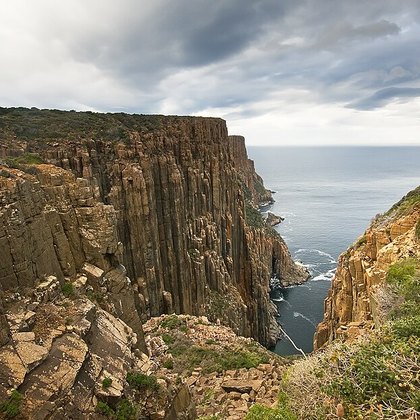
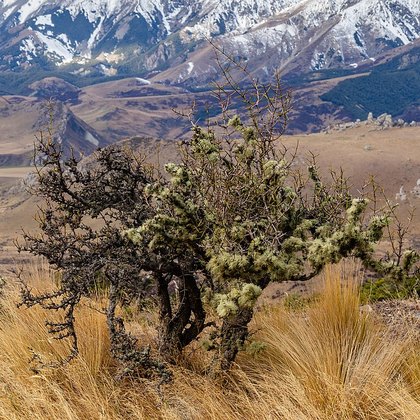
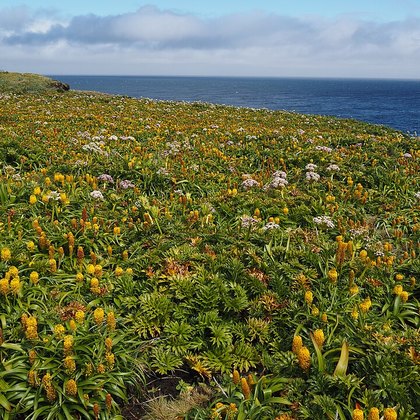
Nest sites lie on rocky coast and sea cliff and in the cover behind them: old coastal forest, regrowth of manuka and matagouri, flax stands and farm shelterbelts. Foraging is done on the continental shelf, diving to the bottom among kelp and over rocky ground, usually within twenty kilometres of the coast and by day. On the Auckland and Campbell Islands it sits in poa tussock above the subantarctic sea.
Where the bird is most often found, arranged by main group and formation.



Range and movements
Four mainland districts on the South Island — the Catlins, Otago Peninsula, North Otago and Banks Peninsula — plus Stewart Island with its near islands, and beyond them the Auckland and Campbell Islands. The centre of gravity lies in the subantarctic islands; the mainland now holds fewer than two hundred and fifty breeding pairs. The mainland population has fallen steeply since the 1990s and the breeding range has contracted at its northern edge.
- Resident
- dark = core range, pale = thinly spread
Where and when to look
Watch from a lookout or hide in the last hour before dark, when the birds come ashore after a day at sea. Stay off the beach and keep the skyline clear: a Yellow-eyed Penguin that sees people waits out in the surf and loses the time it needs to feed its chick.
Conservation
Endangered (EN), with some two thousand six hundred to three thousand mature birds worldwide and a mainland population reduced to a fraction within thirty years. On land stoats, ferrets, cats and roaming dogs take chicks and sitting adults; at sea birds are lost in set nets and trawls, and in warm sea surface conditions survival and breeding success fall as the bottom prey thins out. Outbreaks of diphtheritic stomatitis and respiratory disease come on top of that.
Scientific name
Megadyptes antipodes | (Hombron & Jacquinot, 1841)
Hombron and Jacquinot described the bird in 1841 as Catarrhactes antipodes; because it was later placed in a genus of its own, author and year stand in parentheses. The genus Megadyptes was introduced by Milne-Edwards in 1880, from Greek megas, 'large', and dyptes, 'diver'. antipodes means 'of the antipodes', the term used from Europe for the far south. The type material came from the Auckland Islands; the Maori name hoiho refers to the shrill call at the nest.