All species › Passerines › Fantails › Arafura Fantail
Arafura Fantail | Rhipidura dryas
Arafurawaaierstaart | Abanico de Arafura
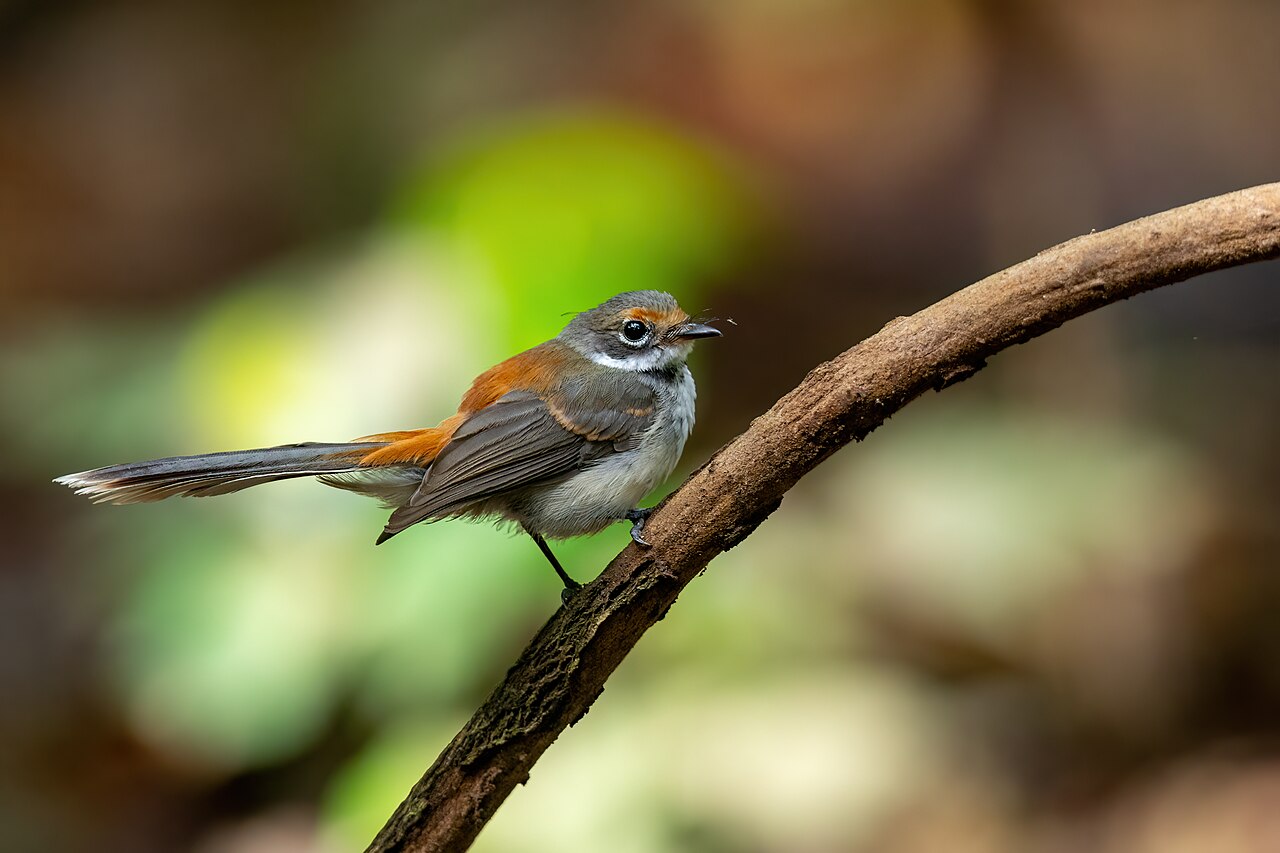
The Arafura Fantail is the tropical northern counterpart of the Australian Rufous Fantail: a small, restless bird with a rufous rump and a dark breast band that stays all year in the monsoon forest, the vine thicket and the mangrove edge of northern Australia. It was long treated as the northern form of the Rufous Fantail and has only recently been split off as a species of its own — which at once explains why older guides do not mention it and why the Red List has not yet assessed it separately.
Voice
A thin, high and delicate voice which, as in all fantails, squeaks rather than sings: a rapid series of reedy notes rising in pitch and often breaking off abruptly, preceded or interrupted by a sharp dry 'chik'. The whole is weaker and carries less far than the voices of most other songbirds of the same forest, so one has to be close to it. Anyone who knows the pattern of the Australian Rufous Fantail will recognise the same structure here; the differences between the two are subtle and hard to pin down without a recording.
No freely licensed recording has been found for this species yet; what to listen for is described below.
Identification
A small bird of fifteen centimetres with the characteristic fantail carriage: the long tail is constantly spread and swung from side to side as the bird flutters through the undergrowth. Upperparts grey-brown with a warm rufous rump and rufous tail base, conspicuous when the tail is fanned; the rest of the tail is dark with pale tips. Forehead and brow are rufous, the throat is white, and a band of dark crescent-shaped spots crosses the breast. The belly is white to pale cream. Male and female are alike. The whole bird is in motion: it rarely sits still for more than a few seconds.
Confusion species
The chief candidate is Australian Rufous Fantail (Rhipidura rufifrons), from which this species was until recently not separated. The differences are small: the Arafura Fantail is generally paler and whiter below, with a narrower and less sharply marked dark breast band, and the rufous of the rump extends further onto the base of the tail. Range and season help most: the Arafura Fantail is present all year in the tropical north, whereas the Australian Rufous Fantail appears there only in winter, when it moves north from the south-east — during the overlap season great care is needed and a bird without a photograph often cannot be named with certainty. Grey Fantail (Rhipidura albiscapa) and Mangrove Fantail (Rhipidura phasiana) lack rufous entirely and are plain grey-brown on rump and tail base. Northern Fantail (Rhipidura rufiventris) is larger, heavier and darker grey, without rufous and with a far less mobile tail.
Habitat
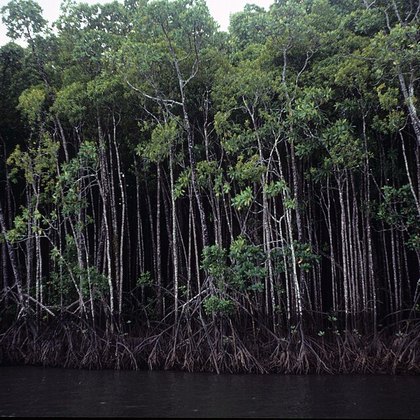
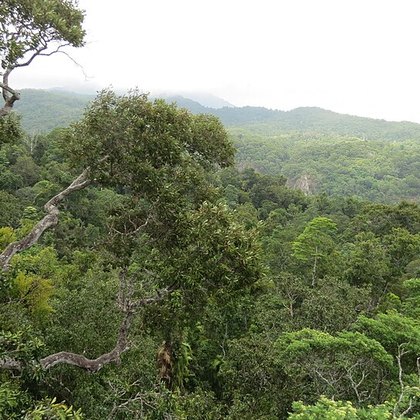
Dense, closed vegetation in the tropical north: monsoon forest and vine thicket, the edges and interior of mangrove, gallery forest along creeks and rivers, and the moist parts of lowland rainforest. The bird keeps almost always to the undergrowth and lower shrub layer, where it takes insects on the wing or flushes them from foliage by flashing its spread tail and wings. Open woodland and dry savanna are avoided; what matters is shade, moisture and a closed canopy.
Where the bird is most often found, arranged by main group and formation.


Range and movements
In Australia confined to the tropical northern rim: the Kimberley in Western Australia, the Top End of the Northern Territory with its islands, and Cape York Peninsula with the coastal strip of the Gulf of Carpentaria. Beyond that the species extends to the islands north and north-west of Australia, in the Lesser Sundas and the Moluccas — a distribution that the name Arafura, after the sea between Australia and New Guinea, captures well. The Australian birds are residents; there is no long-distance migration, though some shift within their district between mangrove and hinterland.
- Resident
- dark = core range, pale = thinly spread
Where and when to look
Look for it low down in dense monsoon forest, along the shaded margin of a mangrove stand or in the scrub beside a tropical creek, and check the rump first: warm rufous, and among the fantails of the north that is otherwise true only of the winter visitors from the south. Move quietly and stand still a while — the bird is inquisitive and often comes closer of its own accord. Always note the date: in the dry season the question remains open whether you are not looking at a wintering Australian Rufous Fantail.
Conservation
Not evaluated (NE) as a separate species. The reason is purely taxonomic: the species was split from the Rufous Fantail group only recently and the Red List has not yet followed that split, so it has formally no status of its own. The wider complex counts as unthreatened, and there is no sign that this bird is faring badly: it is common in suitable forest and occupies a habitat that remains largely intact across much of tropical Australia. That habitat is vulnerable in the long run, however, for monsoon forest and vine thicket lie as small isolated patches in the landscape and suffer from too-frequent fire and from trampling by cattle and pigs.
Scientific name
Rhipidura dryas | Gould, 1843
John Gould described the species in 1843 from a bird taken at Port Essington on the north coast of Australia. The genus Rhipidura was introduced in 1827 by Nicholas Vigors and Thomas Horsfield and combines Ancient Greek rhipis ('fan') with oura ('tail') — the fanned tail on which the English and Dutch names also rest. The epithet dryas is Greek for a tree nymph, a spirit of the woods: a reference to the closed forest the bird inhabits. The English name Arafura Fantail and the Dutch Arafurawaaierstaart both take the Arafura Sea, the water between northern Australia and New Guinea around which the range lies; the Spanish abanico de Arafura follows them.