All species › Passerines › Fantails › New Zealand Fantail
New Zealand Fantail | Rhipidura fuliginosa
Maoriwaaierstaart | Abanico maorí
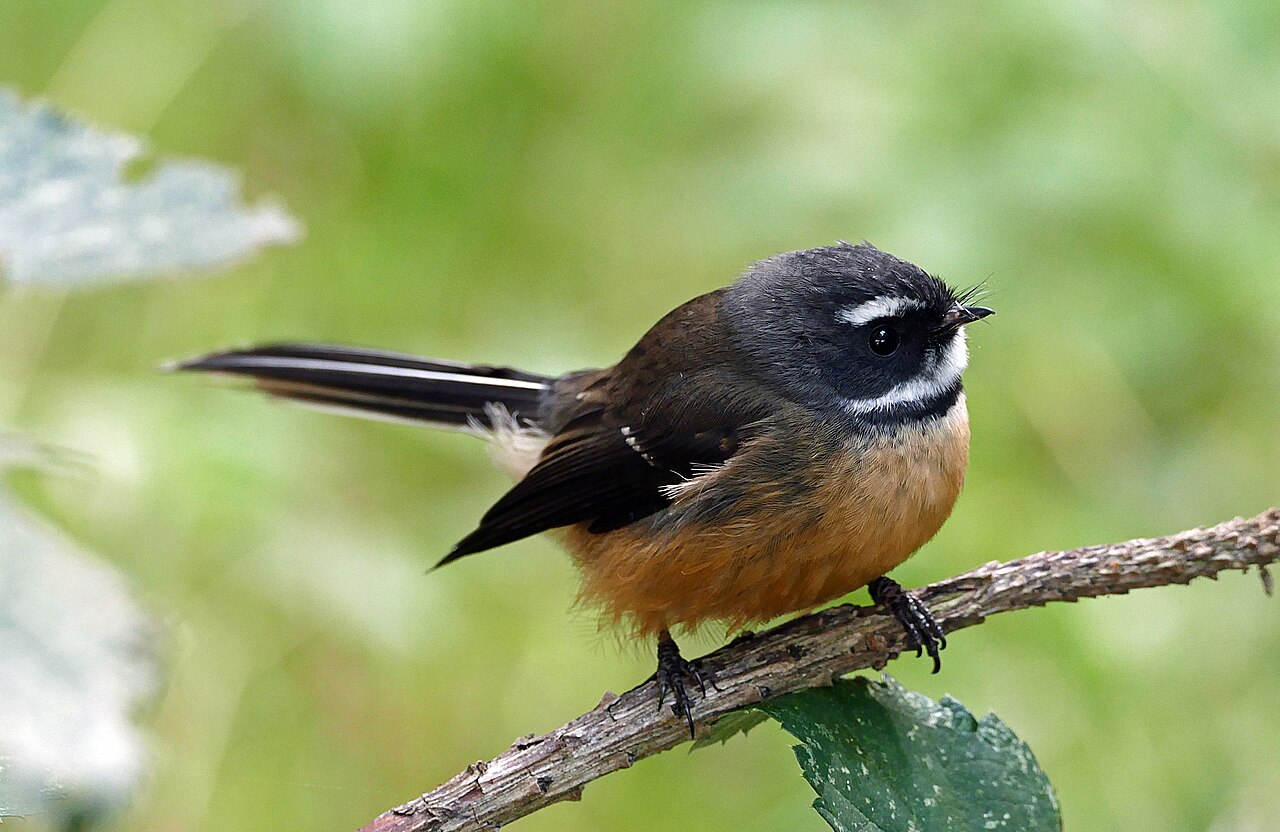
The New Zealand Fantail or pīwakawaka is the best-known small bird in New Zealand: a feather-light creature of eight grams with a tail making up about half its length, spread like a fan at every turn. It is strikingly unwary and follows walkers through the bush to catch the insects they put up. The species occurs in two sharply different colour forms — a normal one and a rare black one — and that confuses anyone who does not know it.
Voice
Two sounds every visitor to New Zealand soon learns. The call is a loud, sharp, high 'cheet', often repeated in short series and surprisingly powerful for so small an animal; it sounds like a squeaking door hinge and is used continually while the bird hunts. The song is a rhythmic, rapid, metallic chatter of similar notes, often in a falling or undulating pattern, best described as an excited rattle. The bird sings all year, including in midwinter.
No freely licensed recording has been found for this species yet; what to listen for is described below.
Identification
A bird of sixteen centimetres, half of which is tail. The normal colour form has a grey-brown head with a white brow and a white crescent behind the eye, a white throat, below it a narrow black breast band, and otherwise warm ochre-yellow to cream underparts. The tail is dark in the centre with creamy white outer feathers, giving a conspicuously pale pattern when spread. Alongside this exists a black form, almost entirely sooty black, without the white brow and without the ochre belly, sometimes keeping only a small pale spot behind the eye. These are not two species, and not a sex or age difference: it is one species with two forms, which interbreed and produce mixed broods. The black form is not rare on the South Island — a few per cent of birds — and on the North Island is very scarce to virtually absent. Male and female otherwise look alike.
Confusion species
Within New Zealand there is in practice no confusion: no other native bird combines this size with this tail and this behaviour. The only real candidate is the Australian Grey Fantail (Rhipidura albiscapa), from which this species was until recently not kept apart and which reaches New Zealand as a rare vagrant; it is paler and colder grey below, without the warm ochre, and has clearer white wingbars. More important, the black form is fairly regularly taken for something else: for a young bird, for a separate species, or for a black robin. Tail shape, tail movement and voice are then decisive, for those are exactly the same in both forms. The Chatham Islands hold their own slightly darker and heavier subspecies, not another species.
Habitat
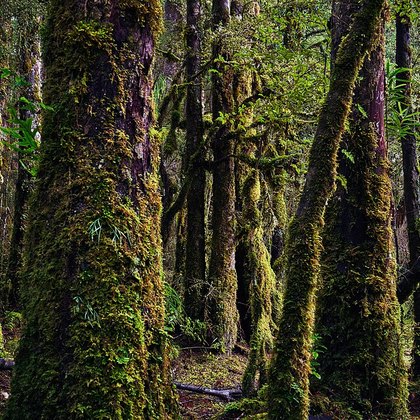
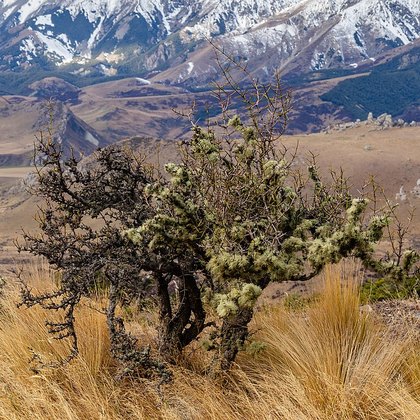
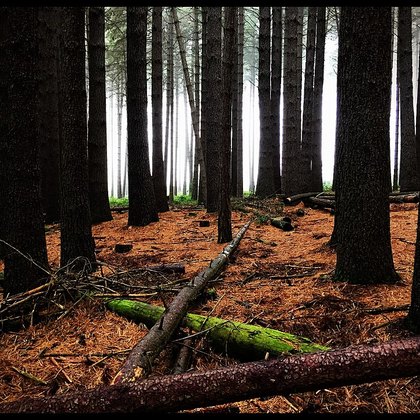
Almost any landscape with woody vegetation. The bird is equally at home in native beech forest and podocarp-broadleaf forest, in manuka and matagouri scrub, in planted conifer forest, in shelterbelts along pasture, and in town gardens and parks. It hunts on the wing in short twisting sallies from a perch, using its spread tail to flush insects from foliage. Characteristically it follows large animals — formerly the native birds and now people, dogs and stock — to profit from the insects they put up out of the vegetation.
Where the bird is most often found, arranged by main group and formation.


Range and movements
Widespread throughout the country: North Island, South Island, Stewart Island and countless smaller islands, plus its own subspecies on the Chathams. From the coast up to the treeline, in untouched forest as much as in wholly man-made country. The birds are residents but not fixed to the metre: after hard winters or in autumn they shift locally to lower and more sheltered ground. The species is one of the few native New Zealand songbirds that has stayed common in the landscape people have reshaped.
- Resident
- dark = core range, pale = thinly spread
Where and when to look
You need do nothing but stand still and wait: walk onto a bush track and stop, and within a few minutes the bird will come of its own accord to within a few metres, because your footsteps are putting up insects. Watch the tail and forget the plumage for a moment; once the flicking, fanning tail movement is familiar, the black form is recognised without hesitation too. On the South Island it pays to check every party for a black individual — there the chance is real, on the North Island it is not.
Conservation
Least Concern (LC), and ranked as Not Threatened within New Zealand's own system as well. That is remarkable, for most of New Zealand's native land birds have declined sharply under introduced predators. Nests of this species are certainly robbed, above all by ship rats, but the bird offsets that with exceptionally high productivity: a pair can raise several broods in one season, so a population recovers quickly from a bad year. The heaviest mortality comes not from predators but from the weather — hard, wet winters kill many birds in cold districts, after which numbers build up again in one or two summers.
Scientific name
Rhipidura fuliginosa | (Sparrman, 1787)
Anders Sparrman described the species in 1787 as Muscicapa fuliginosa. A famous error attaches to that description: Sparrman gave an African desert as the locality, whereas the animal in fact came from the South Island of New Zealand. The epithet fuliginosa is Latin for 'sooty' and was almost certainly chosen from a bird of the black form — a name, therefore, resting on the minority morph. The genus Rhipidura was introduced in 1827 by Nicholas Vigors and Thomas Horsfield, from Ancient Greek rhipis ('fan') and oura ('tail'). The Māori name pīwakawaka is in general use in New Zealand, English included; in the tradition surrounding Māui the bird plays a leading part, and its laughter is there the reason humankind stayed mortal. The Dutch Maoriwaaierstaart and the Spanish abanico maorí follow that cultural link, the English New Zealand Fantail the country.