All species › Passerines › Fantails › Willie Wagtail
Willie Wagtail | Rhipidura leucophrys
Tuinwaaierstaart | Abanico lavandera
The Willie Wagtail is the best known small bird in Australia: black with a white belly and a white brow, never still, and bold enough to drive Wedge-tailed Eagles and crows off its patch. It follows stock to snap up the flies they put up, dances across a lawn with its tail swinging, and sings half the night through when the moon is up.

Voice
The alarm is a fast rattling chit-chit-chit-chit, likened to a child's rattle or the cogwheels of a small mill, and it starts the moment anyone comes near the nest. Beyond that a cheerful, skipping five-note phrase that generations of Australians have heard as sweet pretty little creature. In the breeding season males sing at night as well, and the more moonlight there is the harder they go.
Recording: Rob Nicholson — CC BY 4.0 · Goondiwindi Botanic Gardens, Goondiwindi, Queensland, Australia · xeno-canto
Identification
A slim black and white bird of 18 to 22 centimetres, ten or eleven of them tail. Head, throat, breast, back, wings and tail are glossy black, the belly and undertail coverts clean white. A clear white brow stands above the eye and white whisker marks cross the cheek; when the bird is worked up those white marks are flared wider. Bill, legs and eye are dark. The sexes are alike; young birds are duller, browner and show only a faint brow.
Confusion species
Hooded Robin (Melanodryas cucullata) is shorter-tailed, shows a white wing stripe and has no white brow. White-winged Triller (Lalage tricolor) is greyer on the rump, has a white wing stripe and a white brow that runs further back, and keeps high in trees rather than low. Restless Flycatcher (Myiagra inquieta) has a white throat instead of a black breast and quivers its tail rather than swinging it sideways.
Habitat
Almost any open country with a few trees: eucalypt woodland and savanna, pasture and grazing land, creek and swamp margins, and beyond that gardens, parks, sports grounds and town edges. It avoids dense wet forest and rainforest. It needs open ground to hunt over and a low perch to work from; a shed, a fence or a grazing cow serves as well as a tree.
Where the bird is most often found, arranged by main group and formation.
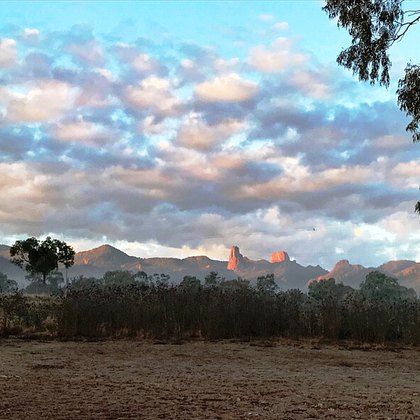
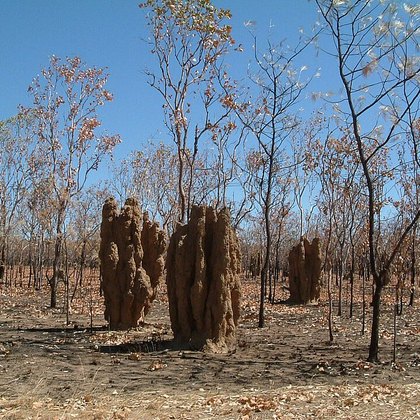
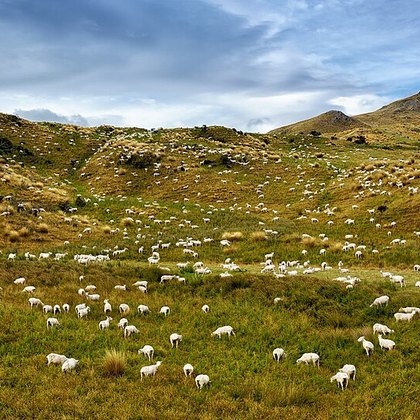


Range and movements
The whole Australian mainland, plus New Guinea, the Solomon Islands, the Bismarck Archipelago and the eastern Moluccas. On Tasmania it is a vagrant, as on Lord Howe; in 2002 it even turned up once on the Chatham Islands. In the southeast it is resident, but in northeastern New South Wales and southeastern Queensland numbers are swelled by winter visitors in June and July.
- Resident
- dark = core range, pale = thinly spread
Where and when to look
There is no need to look for it; it comes to you. Stand by a horse paddock or a picnic area and wait for it to land on a fence post and start swinging its tail. Anyone who hears the rattle can follow it to a raptor or a snake, because the Willie Wagtail attacks everything larger than itself. On summer evenings with a full moon it is still audible at midnight.
Conservation
Least Concern (LC) and one of the most numerous birds on the continent. Clearing for pasture, lawns and playing fields has helped rather than hurt it, and it breeds into the heart of large cities. Cuckoos lay on it readily, but it is good at spotting a foreign egg. Feral cats, rats and currawongs take young; none of that shows in the numbers.
Scientific name
Rhipidura leucophrys | (Latham, 1801)
Latham described the bird in 1801 as Turdus leucophrys, among the thrushes; because it later moved to another genus, author and year stand in parentheses. The genus Rhipidura was introduced by Vigors and Horsfield in 1827, from Greek rhipis, rhipidos, fan, and oura, tail. leucophrys means white-browed, from leukos, white, and ophrys, eyebrow. Aboriginal languages name it after the rattle: djididjidi among the Noongar, tjintir-tjintir among the Pitjantjatjara.