All species › Passerines › Fantails › Mangrove Fantail
Mangrove Fantail | Rhipidura phasiana
Mangrovewaaierstaart | Abanico de manglar
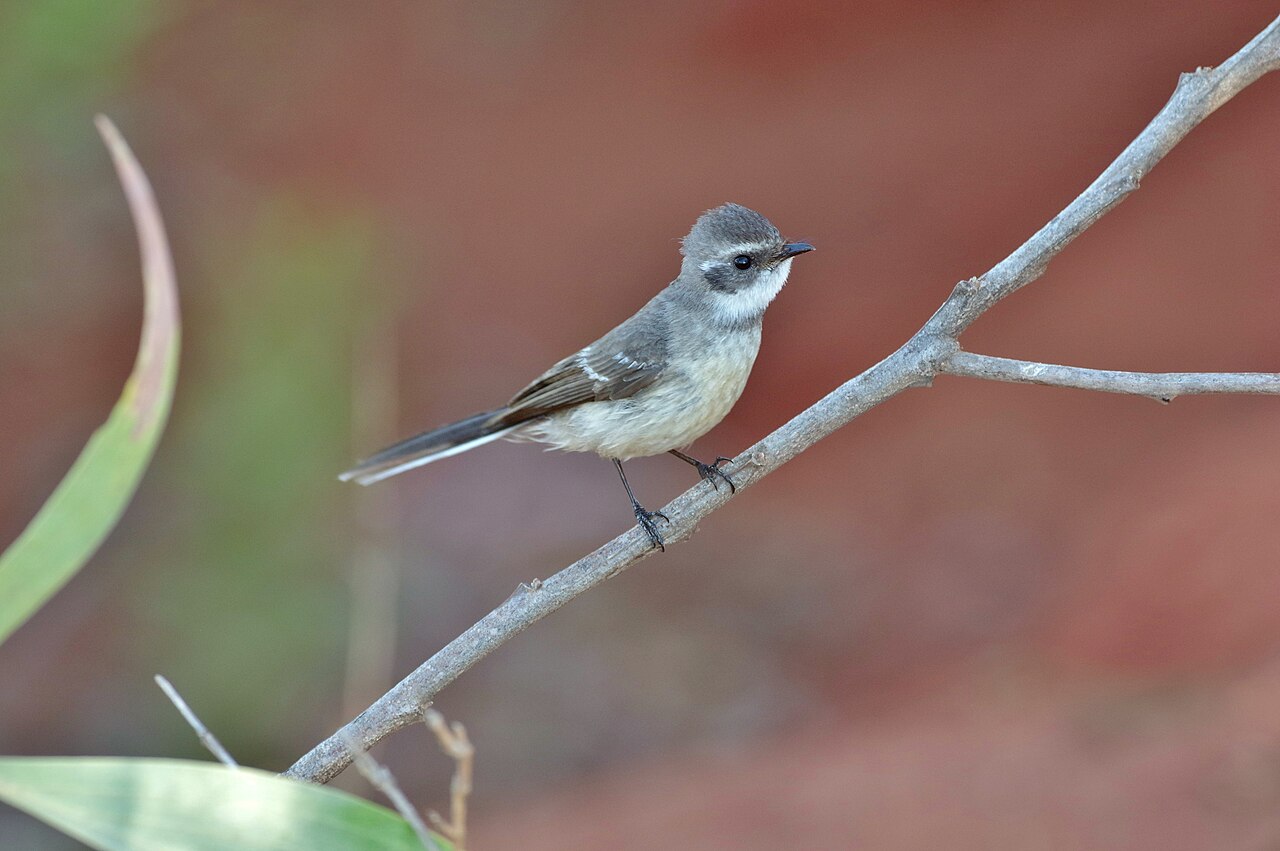
The Mangrove Fantail is Australia's smallest fantail and at the same time its most tied: it occurs practically only in mangrove, along the whole tropical north coast from Shark Bay to the Gulf of Carpentaria. Anyone who wants to see it must first get their feet wet. It closely resembles the widespread Grey Fantail, of which it was long treated as a subspecies, but it is smaller, paler and thinner-voiced — and it hardly ever leaves the mangrove.
Voice
An extremely high, thin voice, reedier still than that of the Grey Fantail: a short series of tinkling, almost glassy notes, often slightly rising, which carries in the stillness of a mangrove stand but is lost at any distance. The call is a fine sharp 'tsip'. To an ear used to the stronger voice of Grey Fantail, the difference in volume and pitch usually registers sooner than the difference in pattern, though without experience that distinction is hard to pin down.
No freely licensed recording has been found for this species yet; what to listen for is described below.
Identification
A tiny bird of fourteen to fifteen centimetres and barely seven grams, with a tail long for its size that it constantly spreads and swings sideways. The upperparts are pale grey-brown, with no rufous on rump or tail base. The throat is white, above it a narrow white brow runs back past the eye, and below it lies a faint grey breast band much weaker than in related species. The belly is pale creamy white. The tail is dark with broad white tips to the outer feathers, which light up as a white edge when it is fanned. Two fine pale wingbars show in good light. Male and female are alike.
Confusion species
The only serious candidate is Grey Fantail (Rhipidura albiscapa), from which this species was until recently not separated and which can penetrate coastal mangrove in winter. That species is larger and heavier, warmer and more buff on the belly, and has a broader, more sharply marked dark breast band; its voice is fuller and carries further. Habitat is the best handle: outside mangrove almost every small grey-brown fantail is Grey Fantail, and where the two share mangrove the difference in size and tone is visible in direct comparison but not always on a lone bird. Arafura Fantail (Rhipidura dryas) and Australian Rufous Fantail (Rhipidura rufifrons) both have a conspicuous rufous rump and tail base, a character this species lacks entirely. Northern Fantail (Rhipidura rufiventris) shares the mangrove but is much larger and darker and perches upright with a far quieter tail.
Habitat
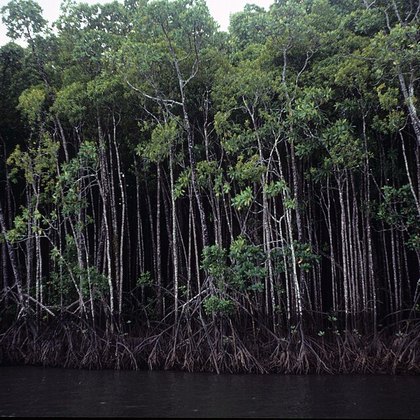
Mangrove forest, and virtually nothing else. The bird keeps to the middle and lower storeys of the mangrove, among the dense leathery leaves and the stilt roots, plucking insects and other small invertebrates from the air or flushing them from leaf and twig with the familiar flash of tail and wings. It uses both the seaward fringe and the inner, taller mangrove belt. Only rarely, and then over short distances, does it venture into the adjoining saltmarsh or the coastal scrub just behind the mangrove.
Where the bird is most often found, arranged by main group and formation.
Range and movements
A long but very narrow strip along the Australian north coast: from Shark Bay in Western Australia north along the Pilbara and Kimberley coasts, across the Top End of the Northern Territory with its islands, to the Gulf of Carpentaria and the western side of Cape York Peninsula. Outside Australia the species occurs in the Trans-Fly lowlands of southern New Guinea. The birds are residents and stay all year in the same mangrove; the range is in effect as fragmented as the mangrove itself.
- Resident
- dark = core range, pale = thinly spread
Where and when to look
At low tide take a mangrove boardwalk or track and stand still: this bird reacts strongly to a presence and often comes within a few metres to look. Check first for what is not there — no rufous on the rump — and then for the pale, faint breast band and the strikingly small size. Early morning is best, before the heat drives the mosquitoes and the bird into the depths of the stand; at midday a mangrove forest is often silent.
Conservation
Least Concern (LC). The species is common within its narrow habitat and its total range is long, so there is no acute risk. Its fate, however, hangs entirely on one vegetation type: where the mangrove goes, the bird goes with it, for it has nowhere to move to. That makes it sensitive to port development, aquaculture, roads through coastal swamp, and to the large-scale mangrove dieback that occurred along the Gulf of Carpentaria in 2015 and 2016 after a coincidence of heat and an exceptionally low sea level. At the same time mangrove is expanding landward in other places along the north coast, so the picture differs from district to district.
Scientific name
Rhipidura phasiana | De Vis, 1885
Charles Walter De Vis described the species in 1885 from material at the mouth of the Norman River in north-western Queensland. The genus Rhipidura was introduced in 1827 by Nicholas Vigors and Thomas Horsfield and combines Ancient Greek rhipis ('fan') with oura ('tail'). The epithet phasiana derives from Phasianus, the pheasant, and means 'pheasant-like': a reference to the tail's length relative to the body, not to colour or size. The English name Mangrove Fantail, the Dutch Mangrovewaaierstaart and the Spanish abanico de manglar all three take the same and most useful character, the habitat to which the bird is wholly bound.