All species › Waders, gulls and terns › Skimmers, noddies, terns and gulls › Arctic Tern
Arctic Tern | Sterna paradisaea
Noordse stern | Charrán artico
The Arctic Tern makes the longest migration on earth: it breeds on the tundra and the Arctic islands and spends the northern winter in the pack ice of Antarctica, some seventy thousand kilometres there and back each year. Australia and New Zealand lie on that route, which is why you nearly always meet it here over open water, in non-breeding or first-year plumage. It comes ashore mostly when a south-westerly has put it on the beach.
Voice
In this region it is usually silent; the voice belongs to the colony, and the colony is ten thousand kilometres north. Where it breeds it gives a sharp, nasal kee-yah that rises at the end, shorter and harsher than the Common Tern's, and a rattling kt-kt-kt-kt at an intruder. At sea you may hear no more than a short high keep as two birds pass over a patch of feed. In a mixed flock that difference from the Common Tern's fuller, lower voice is often more use than the plumage.
No freely licensed recording has been found for this species yet; what to listen for is described below.
Identification
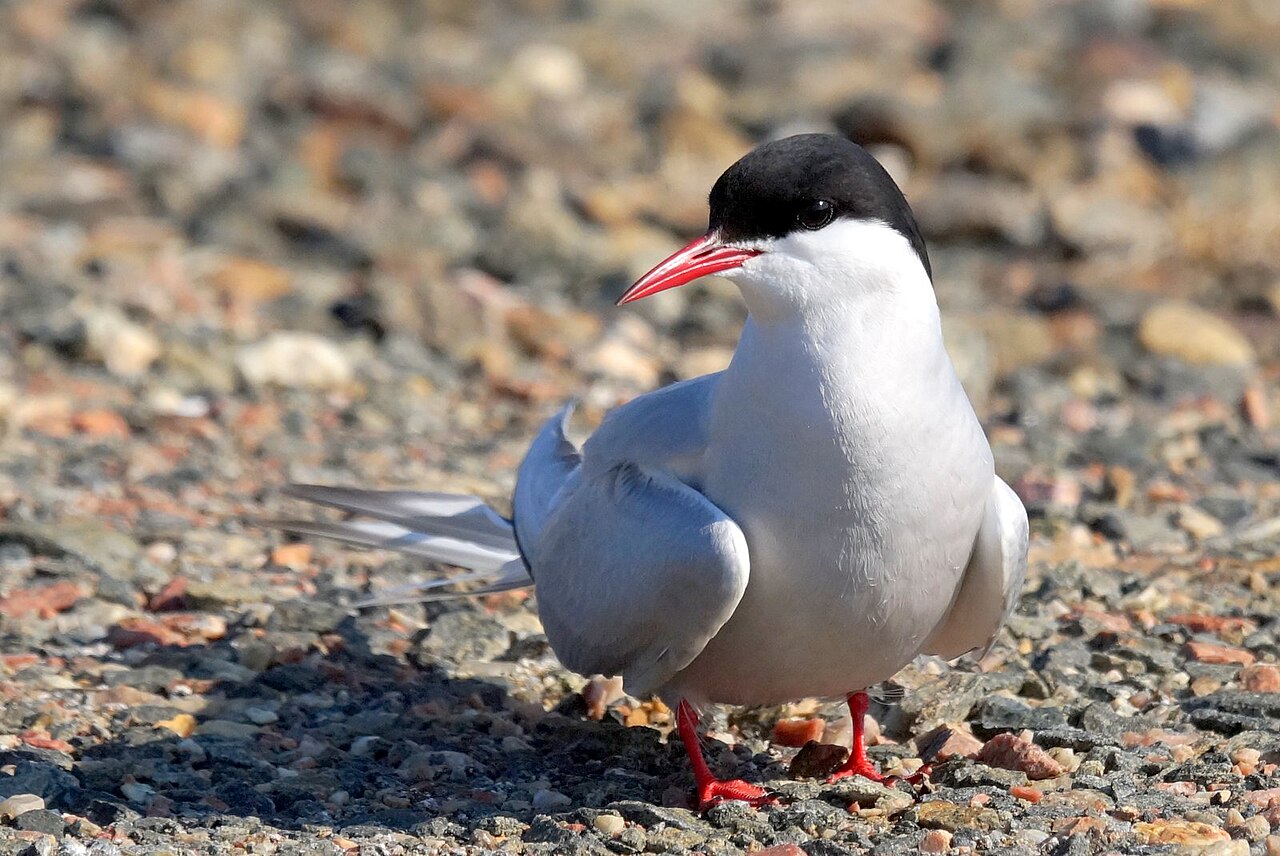
A slim tern with narrow wings, a short neck and a rounded head, and with tail streamers that pass the wingtips on a perched bird. The decisive character is at the bottom: the tarsus measures only 16 mm, so a standing Arctic Tern sits so low that its belly all but touches the ground. From below the hand is translucent, with a narrow, razor-sharp black trailing edge to the primaries — not the soft dark wedge of the Common Tern. In the plumage it usually shows here the bill and legs are black, the forehead white, and there is no dark carpal bar. Young birds have finely scaled upperparts, a short tail and strikingly white inner wings.
Confusion species
Antarctic Tern (Sterna vittata) is the main trap in these waters, and moult is the easiest way to separate them: in the southern summer the Antarctic Tern is in full breeding dress with a blood-red bill, red legs and a solid black cap, while the Arctic Tern is then in non-breeding plumage or in moult, with a white forehead and a black bill. The Antarctic Tern is also stockier, greyer below, heavier (139 against 110 g) and shorter in the streamers. Common Tern (S. hirundo) has longer legs, a dark carpal bar and that broad soft wedge in the wingtip. White-fronted Tern (S. striata) is larger and whiter with a long black bill, and Roseate Tern (S. dougallii) has still longer white streamers above an almost uniformly pale wing.
Habitat
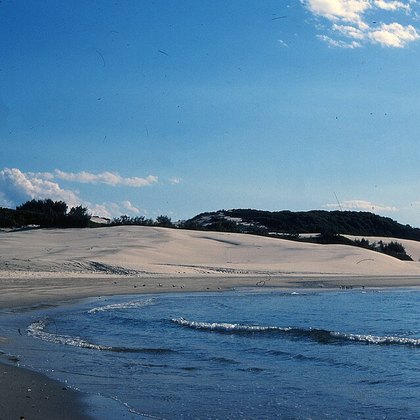
Open sea and continental shelf, and in the south the cold water around the subantarctic islands and the edge of the pack ice. It feeds over shoals of small fish and krill, often in company with storm-petrels and prions, and rests on driftwood, on buoys or on the water itself. It appears on the coast mainly under duress: on sandy beaches and spits after prolonged gales.
Where the bird is most often found, arranged by main group and formation.


Range and movements
Inside the map window it is above all a bird of the sea south of the mainland: the south coast of Western Australia, the Great Australian Bight, Victoria, Tasmania and New Zealand's subantarctic waters, between November and April. It is nowhere numerous — over ten years a few hundred records in Australia and a few dozen in New Zealand — and many reports concern beach-wrecked or exhausted birds after a heavy south-westerly. It does not breed here.
- Resident
- Winter
- Passage
- dark = core range, pale = thinly spread
Where and when to look
After a long south-westerly blow in December or January, walk a sandy beach in Victoria or Tasmania and look at the leg length of every tern: a bird that seems to lie on its belly while standing is one to look at harder. On a pelagic trip in the Southern Ocean, the narrow sharp black trailing edge of the translucent hand is the character that survives distance. Note the moult as well: a tern in full breeding plumage here in January is more likely an Antarctic Tern.
Conservation
Least Concern (LC), with a world population in the millions, but the picture is not uniformly good: whole seasons have failed in North Atlantic colonies as sandeels collapsed, and the Arctic breeding grounds are changing fast. Inside this map window there is no colony to protect; what counts here is a clean, fish-rich Southern Ocean and quiet on the beaches where exhausted birds recover after a storm.
Scientific name
Sterna paradisaea | Pontoppidan, 1763
Erik Pontoppidan described the species in 1763 as Sterna paradisaea, and since the genus has not changed author and year carry no parentheses. Sterna comes from Old English stearn, 'tern'. paradisaea goes back to Late Latin paradisus, 'paradise', probably for the long streaming tail feathers that recall a bird-of-paradise. Pontoppidan gave no type locality; it was later fixed on Christiansø near Bornholm, Denmark. The Dutch and English names both point north, to where the bird breeds.