All species › Gannets and cormorants › Cormorants and shags › Auckland Shag
Auckland Shag | Leucocarbo colensoi
Aucklandaalscholver | Comorán de las Auckland
The Auckland Shag is the blue-eyed shag of the Auckland Islands and breeds there and nowhere else, five hundred kilometres south of New Zealand. It is black and white with a metallic green gloss over head and neck, carries a tall black crest and a magenta-pink eye ring when breeding, and — unlike several of its relatives — has no warty knobs above the base of the bill.

Voice
At sea it is silent. At the colony the male gives a run of barking and ticking notes in display, a dry ark-ark followed by a rattling tk-tk-tk, while the female answers with soft purring or a puffing blow. At nest changeover both birds stretch the neck and a dull groan follows; chicks beg shrilly and without let-up.
No freely licensed recording has been found for this species yet; what to listen for is described below.
Identification
A stocky marine shag of a little over sixty centimetres and some two kilos, black on head, neck, back and wings with a metallic green to blue sheen, white on throat, breast and belly; a white bar crosses the wing and stays visible as a stripe on a perched bird. In breeding dress a tall black crest rises on the forehead, the eye ring turns magenta-pink and the throat pouch orange-red, with the red facial markings at their brightest. The feet are pale pink. There are no knobs or caruncles above the bill base — a key difference from several relatives. Young birds are dull brown where the adults are black, with pale facial skin.
Confusion species
Campbell Shag (Leucocarbo campbelli) is the nearest double, but breeds six hundred kilometres away on Campbell Island and is slightly lighter built, with a yellow line above the gape grading to red below. Bounty Shag (Leucocarbo ranfurlyi) is larger, with orange-yellow facial skin. Imperial Shag (Leucocarbo atriceps) on Macquarie and New Zealand King Shag (Leucocarbo carunculatus) in the Marlborough Sounds do carry orange caruncles above the bill base; Otago Shag (Leucocarbo chalconotus) also has a bronze morph that does not occur here. In short: in this group the island settles the species, and the face comes second. The gap to Pitt Shag (Phalacrocorax featherstoni) is wide: that bird is grey, slim, half the weight and belongs in a different genus altogether.
Habitat
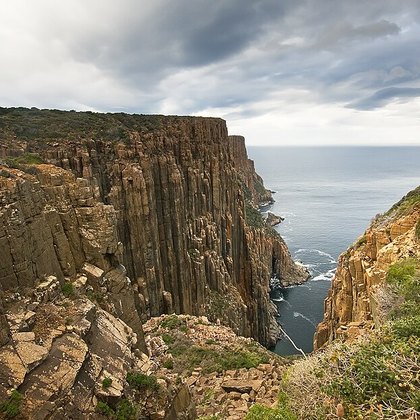
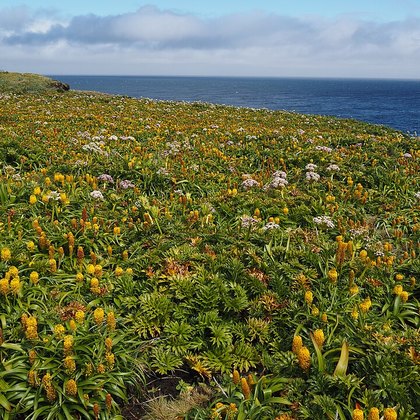
Shallow, cold subantarctic coastal water around the group, where it dives to the bottom for fish and invertebrates within a few kilometres of shore, often over kelp beds. It breeds in colonies on clifftops and rock ledges, building nests of weed, grass and guano; grassy tussock tops on the smaller islands are favoured. It hardly ventures further out to sea.
Where the bird is most often found, arranged by main group and formation.

Range and movements
The Auckland Islands only: Enderby, Rose, Ewing, Dundas, Disappointment, Adams and the coast of the main island. Away from the group it is a major rarity; there is no migration, and young birds too stay in island waters. It does not occur on mainland New Zealand.
- Resident
- dark = core range, pale = thinly spread
Where and when to look
On a subantarctic cruise Enderby Island is the surest place: the colonies sit on the clifftops along the north side and the birds shuttle low across Port Ross. On every perched bird check whether knobs stand above the bill — here there should be none — and look at the pale pink feet. From a zodiac in Sandy Bay they are often a few metres away.
Conservation
Vulnerable (VU), not because numbers are collapsing but because everything sits on one island group: a 2011 count on Enderby gave about 1366 active nests, and the whole group is put at some 4500 birds. Feral pigs wrecked the reachable colonies on the main island, so most birds have shifted to inaccessible cliffs; beyond that count feral cats, skua and gull predation on eggs and chicks, and storms that can strip whole ledges in a bad year.
Scientific name
Leucocarbo colensoi | (Buller, 1888)
Buller described the species in 1888 as Phalacrocorax colensoi; the move to Leucocarbo puts author and year in parentheses. The epithet honours William Colenso (1811–1899), missionary, printer of the Treaty of Waitangi and one of New Zealand's first botanists. The genus Leucocarbo was introduced by Bonaparte in 1857, from Greek leukos, 'white', and Latin carbo, 'charcoal', the old name for the cormorants — roughly 'white cormorant', after the white underparts of this group. The type locality is the Auckland Islands; the Maori name kawau o Motu Maha refers to Motu Maha, the Auckland Islands.