All species › Gannets and cormorants › Cormorants and shags › Stewart Island Shag
Stewart Island Shag | Leucocarbo chalconotus
Stewartaalscholver | Cormorán de Stewart
The Stewart Island Shag is the only blue-eyed shag that breeds on the New Zealand mainland: along the Otago coast of the South Island, from Oamaru to Otago Peninsula and Nugget Point, and further south around Foveaux Strait and Stewart Island. It is the only one of the group with two colour forms breeding side by side — a bronze one and a pied one — and that is not a species difference.

Voice
It is heard only at the colony. The male gives a dull borr while seeking a mate, and a soft eh-eh-eh on returning to the nest; the female is silent. From a week old the chicks beg with a squeaky ah-whee-ah that carries across the whole colony. At sea and at a roost it is mute.
No recording with a suitable Creative Commons licence has been found for this species yet; what to listen for is described below.
Identification
A heavy marine shag of nearly seventy centimetres and some two and a half kilos, with pink feet and a brown iris. There are two colour forms that interbreed freely. The bronze morph, seventy to eighty per cent of birds, is brownish black with green and blue sheens and no white below. The pied morph, twenty to thirty per cent, is black with a white belly and white wing patches. In breeding condition about half the birds of each morph develop small bright orange caruncles above the bill base; on the other half they stay dark orange papillae. Both forms have an orange or purple throat pouch. Young birds are dull brown and lack the caruncles.
Confusion species
On the mainland Otago coast it is the only blue-eyed shag, so in practice unmistakable; the bronze morph is now and then taken for a Great Cormorant (Phalacrocorax carbo), but that bird has a yellow throat patch and neither caruncles nor pink feet. The pied morph closely resembles Chatham Shag (Leucocarbo onslowi) and New Zealand King Shag (Leucocarbo carunculatus), but those two breed far away and show dark purple facial skin with orange-red caruncles and yellow caruncles with a cobalt-blue eye ring respectively. Auckland Shag (Leucocarbo colensoi), Campbell Shag (Leucocarbo campbelli) and Bounty Shag (Leucocarbo ranfurlyi) have no caruncles and sit on subantarctic islands; Imperial Shag (Leucocarbo atriceps) on Macquarie. Pitt Shag (Phalacrocorax featherstoni) is grey, slim and in another genus. Finally, mind the taxonomy: since 2016 some works split the birds of Stewart Island and Foveaux Strait off as Foveaux Shag (Leucocarbo stewarti), leaving the Otago coast birds as Otago Shag. This guide keeps the two together, so the names here follow the broader concept in all three languages: Stewart Island Shag, stewartaalscholver, cormorán de Stewart.
Habitat
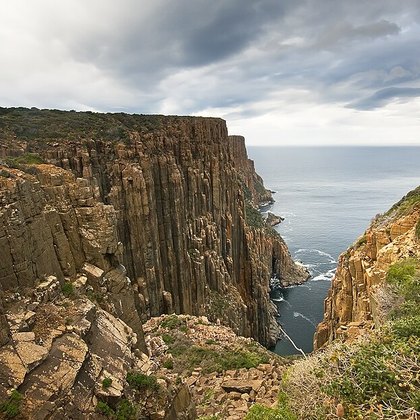
Shallow coastal water, bays and estuary mouths along a rocky coast, where it dives to the bottom for flatfish and invertebrates, often over kelp beds and rarely far offshore. It breeds in colonies on steep rock faces, stacks and the tops of sea cliffs, on solid pedestal nests of weed, sticks, grass and guano built up year after year.
Where the bird is most often found, arranged by main group and formation.


Range and movements
The Otago coast of the South Island, roughly from Oamaru in the north by way of Otago Peninsula — Taiaroa Head is the best known colony — to Nugget Point in the south, with a few more colonies on offshore stacks, and further south the colonies around Foveaux Strait and Stewart Island. It occurs nowhere else in New Zealand. Some works treat the Foveaux Strait and Stewart Island birds as a separate species; This guide includes them in this one.
- Resident
- dark = core range, pale = thinly spread
Where and when to look
Drive to Taiaroa Head on Otago Peninsula or to Nugget Point and look for the nests on the rock faces below the lookout; at Aramoana and in Otago Harbour the birds often dry off on the moles. Expect to see bronze and pied birds side by side — that is one species, and the mixture itself gives it away. The pink feet separate it from Great Cormorant at once.
Conservation
Vulnerable (VU) internationally, for its small range and small population, while the New Zealand national assessment rates it as Nationally Increasing; estimates run from sixteen hundred to eighteen hundred breeding pairs up to fewer than five thousand birds in all. The main losses are drowning in set nets, local illegal shooting by fishers, and disturbance of the colonies by boats, drones and walkers. Because nearly every nest sits on one of a few dozen rock faces, a single oil spill in Otago Harbour could reach a large part of the species.
Scientific name
Leucocarbo chalconotus | (Gray, 1845)
George Robert Gray described the species in 1845 as Graculus chalconotus; the move to Leucocarbo puts author and year in parentheses. chalconotus means 'bronze-backed', from Greek khalkos, 'bronze or copper', and -notos, 'backed' — a name aimed at the bronze form, the one Gray had before him. The genus Leucocarbo (Bonaparte, 1857) means 'white cormorant', from Greek leukos and Latin carbo. The type locality is Otago on the South Island; the Maori name is matapo.