All species › Gannets and cormorants › Cormorants and shags › New Zealand King Shag
New Zealand King Shag | Leucocarbo carunculatus
Wrattenaalscholver | Cormorán carunculado
The New Zealand King Shag breeds only on a handful of rocks in the outer Marlborough Sounds, at the top of the South Island — the smallest breeding range of any cormorant in the world. It is a big, thick-necked black-and-white bird with pink feet, cobalt-blue eye rings and yellow warty caruncles on each side of the bill base, which is what its Dutch name refers to.
Voice
At sea and at a roost it is not heard. At the colony come short bursts of low croaking and groaning, clearest in the early morning; at nest changeover the pair stretch their necks and clatter their bills. The female is all but mute.
No recording with a suitable Creative Commons licence has been found for this species yet; what to listen for is described below.
Identification
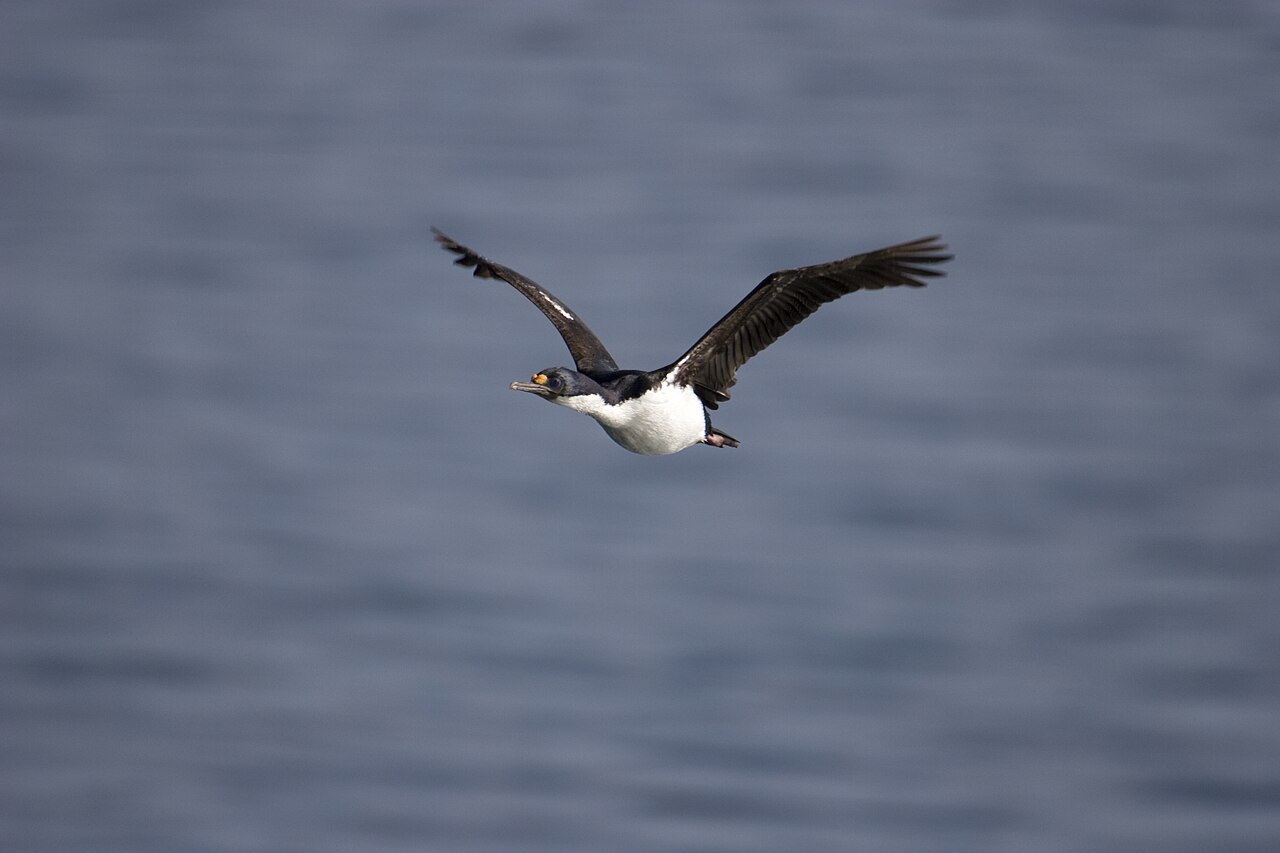
A large, heavy marine shag of over seventy-five centimetres and some two and a half kilos, with a strikingly thick neck. The upperwings and back are black, the throat, breast and belly white, and a white patch or stripe crosses the inner wing that catches the eye at once on a perched bird; many birds also carry a white patch on the back. The feet are pink, the eye rings cobalt blue, and yellow warty caruncles sit on each side above the bill base. Young birds are dull brown where the adults are black and lack the caruncles.
Confusion species
In the Marlborough Sounds it is the only blue-eyed shag, so the area settles the species. Great Cormorant (Phalacrocorax carbo) and Australian Pied Cormorant (Phalacrocorax varius) do occur there: the first has a yellow throat patch and black legs, the second orange-yellow skin before the eye and likewise no pink feet or yellow knobs. Of the relatives, Chatham Shag (Leucocarbo onslowi) is the closest look-alike but smaller, with orange-red rather than yellow caruncles and dark purple facial skin; the pied morph of Stewart Island Shag (Leucocarbo chalconotus) has small orange caruncles and sits on the Otago coast. Auckland Shag (Leucocarbo colensoi), Campbell Shag (Leucocarbo campbelli) and Bounty Shag (Leucocarbo ranfurlyi) have no caruncles at all and breed on subantarctic islands; Imperial Shag (Leucocarbo atriceps) has orange caruncles and sits on Macquarie. Pitt Shag (Phalacrocorax featherstoni) is grey, slim and in another genus.
Habitat
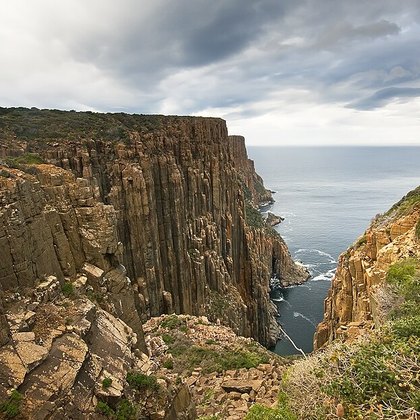
Sheltered, shallow arms and channels of the Marlborough Sounds and Cook Strait, where it dives to some tens of metres for bottom fish, usually within a few kilometres of the colony. It breeds on bare rocks, reefs and low treeless island tops, on solid nests of weed, grass and guano, and roosts on the same rocks and on buoys and piles.
Where the bird is most often found, arranged by main group and formation.

Range and movements
The outer Marlborough Sounds at the top of the South Island only. Nearly three-quarters of the nests lie in four colonies: Kuru Pongi (North Trio Island), Duffers Reef, White Rocks and Rahuinui. It does not migrate and almost always stays within a few tens of kilometres of those rocks; records elsewhere in New Zealand are exceptional.
- Resident
- dark = core range, pale = thinly spread
Where and when to look
Take a boat trip from Havelock or Picton through Pelorus Sound towards Duffers Reef or the Trio Islands; the birds sit low on the rocks, often with wings spread, and fly heavily and low over the water. Put the scope on the bill base: yellow knobs and a cobalt-blue eye ring settle it at once, and the pink feet separate it from every other cormorant in the Sounds.
Conservation
Vulnerable (VU) internationally and Nationally Endangered in New Zealand, with a population that is small on every measure: an aerial survey in 2015 gave 839 birds and 187 breeding pairs, and a year later active pairs were down thirty-seven per cent. The threats are an oil spill in the busy Sounds, coastal eutrophication from aquaculture and forestry, toxic algal blooms, severe storms and disturbance of the colonies by boats and drones — and with only five colonies, one disturbed morning can cost a whole breeding season.
Scientific name
Leucocarbo carunculatus | (Gmelin, 1789)
Gmelin described the species in 1789 as Pelecanus carunculatus, on the basis of Latham's 'Carunculated Shag' from material of Cook's second voyage; the move to Leucocarbo puts author and year in parentheses. carunculatus is Latin for 'having small fleshy lobes', after the yellow knobs above the bill, and the Dutch guide name translates that literally. The genus Leucocarbo (Bonaparte, 1857) means 'white cormorant', from Greek leukos and Latin carbo. The type locality is Queen Charlotte Sound on the South Island; the old 'Staten Island' given by Latham rests on a mix-up. The Maori name is kawau pateketeke.