All species › Gannets and cormorants › Cormorants and shags › Chatham Shag
Chatham Shag | Leucocarbo onslowi
Onslows aalscholver | Cormorán de las Chatham
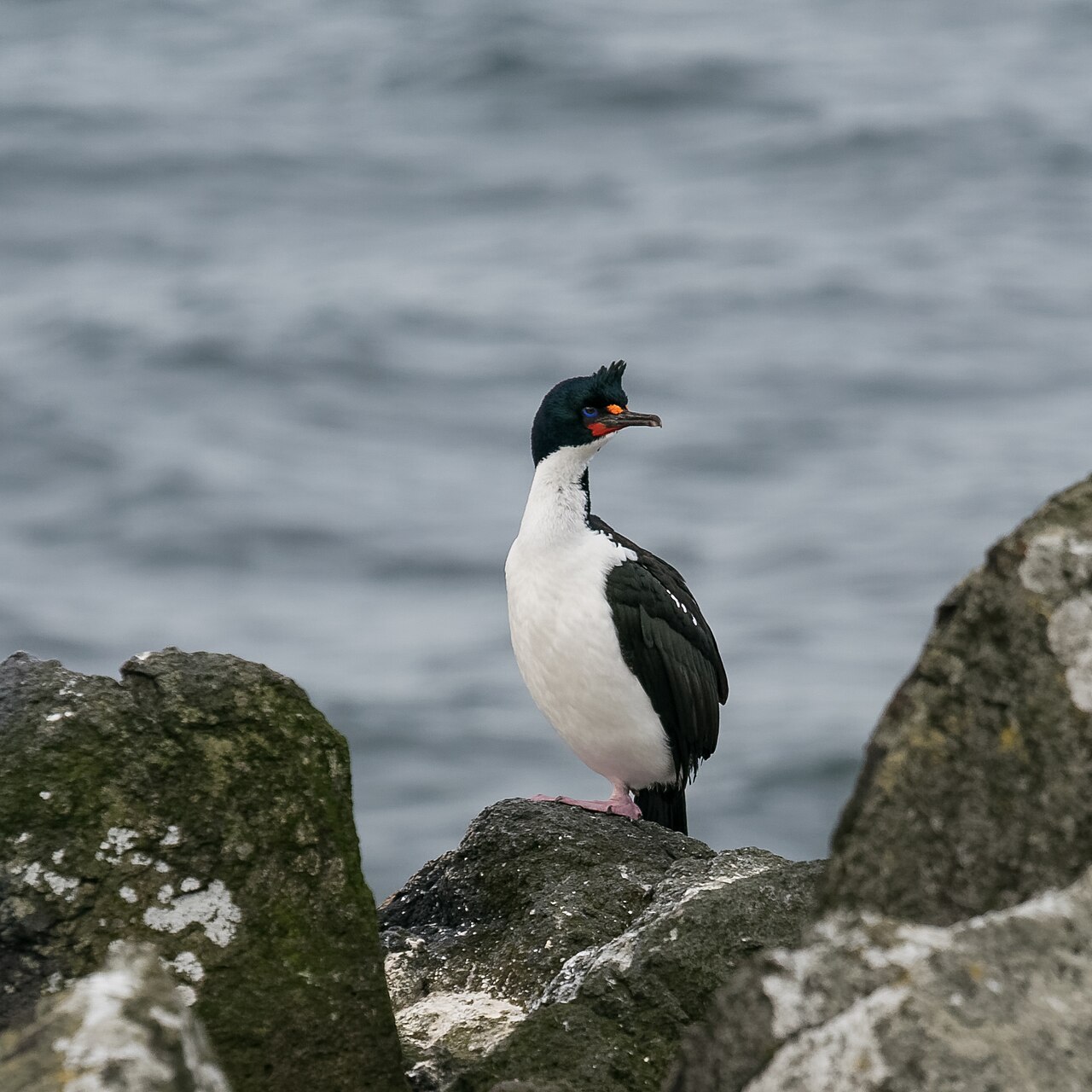
The Chatham Shag is the pied blue-eyed shag of the Chatham Islands and breeds nowhere else; it shares those islands with the much slimmer, grey Pitt Shag. A solid black-and-white bird with white wing patches, dark purple facial skin and bright orange-red caruncles above the bill base — and, with fewer than four hundred breeding pairs, one of the rarest cormorants in the world.
Voice
Away from the colony it is silent. At the nest the male gives a run of ticking, gargling and barking notes — a dry tk-tk-tk running into a harsh arr-arr — while the female does no more than puff softly. In a dense colony of sometimes three hundred nests that runs together into a low murmur.
Recording: David Boyle — CC BY-NC-SA 4.0 · Shag Rock, Te Whanga Lagoon, Chatham Island, New Zealand · xeno-canto
Identification
A stocky marine shag of a little over sixty centimetres and two to two and a half kilos, black on head, neck, back and wings with metallic blue and green gloss, and clean white on throat, breast, belly and in a panel across the wing that stands as a white bar on a perched bird. Breeding birds carry a prominent crest, white filoplumes over the neck, dark purple facial skin and orange-red caruncles above the bill base; out of season those colours fade hard. The iris is brown with a violet eye ring, the feet pink. Young birds are dark brown where the adults are black and have no caruncles.
Confusion species
On the Chathams only Pitt Shag (Phalacrocorax featherstoni) occurs alongside it, and that bird is different at once: grey instead of pied, half the weight, with yellow feet and a double crest, and in a wholly different genus. Note that the Dutch guide names mislead here — 'Onslows aalscholver' is this bird, the Chatham Shag, while 'Chatham-aalscholver' is the Pitt Shag. Among the blue-eyed shags it most resembles New Zealand King Shag (Leucocarbo carunculatus) of the Marlborough Sounds, which has yellow rather than orange-red caruncles and a cobalt-blue eye ring, and the pied morph of Stewart Island Shag (Leucocarbo chalconotus) on the Otago coast. Auckland Shag (Leucocarbo colensoi), Campbell Shag (Leucocarbo campbelli) and Bounty Shag (Leucocarbo ranfurlyi) lack caruncles altogether; Imperial Shag (Leucocarbo atriceps) sits on Macquarie. None of these reaches the Chathams, so in practice the island is the character.
Habitat
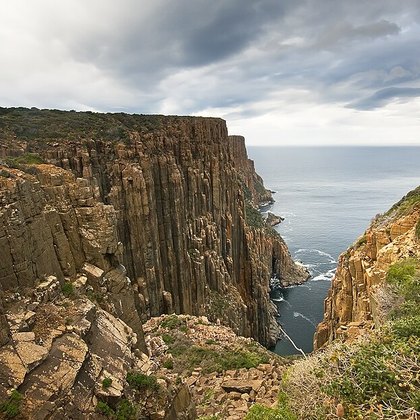
Sheltered, shallow coastal water around the group, and, unlike most relatives, the great inland lagoon Te Whanga on Chatham Island as well, where it fishes in brackish water. It breeds in compact colonies on rocky headlands, low clifftops and bare offshore islets, on nests of weed, grass and guano; some colonies hold three hundred nests packed together.
Where the bird is most often found, arranged by main group and formation.


Range and movements
The Chatham Islands only, seven hundred kilometres east of the South Island. In 2011 thirteen colonies were known, on Chatham Island itself, on Pitt Island, on the Star Keys, on Rabbit Island and on North East Reef. The species has not been recorded away from the group; there is no migration and even wandering stays in island waters.
- Resident
- dark = core range, pale = thinly spread
Where and when to look
From Chatham Island a boat trip to the Star Keys or along the northeast coast is the best chance; look for the black-and-white birds on low rocks in the surf and watch for the white wing bar. In Te Whanga Lagoon you can also find them resting on the shores. On every shag check the legs first: pink belongs to this species, yellow to Pitt Shag.
Conservation
Critically Endangered (CR), the gravest category in this group. Breeding pairs fell from 842 in 1997 to 355 in 2011, a halving in fourteen years, and nationally it rates as Vulnerable. Introduced predators on the inhabited islands — weka, feral cats and possums (climbing marsupials) — rob nests, stock trample mainland colonies on Chatham Island, and disturbance and direct persecution by people add to it. Because colonies on predator-free islets are falling too, causes at sea are suspected as well, among them food shortage and bycatch.
Scientific name
Leucocarbo onslowi | (Forbes, 1893)
Forbes described the species in 1893 as Phalacrocorax onslowi; the move to Leucocarbo puts author and year in parentheses. The epithet honours William Hillier Onslow, fourth Earl of Onslow, Governor of New Zealand from 1889 to 1892 — the same man who gave his Wellington-born son the Maori name Huia. The genus Leucocarbo (Bonaparte, 1857) means 'white cormorant', from Greek leukos and Latin carbo. The type locality is the Chatham Islands; the Maori name is papua.