All species › Gannets and cormorants › Cormorants and shags › Bounty Shag
Bounty Shag | Leucocarbo ranfurlyi
Bounty-aalscholver | Cormorán de las Bounty
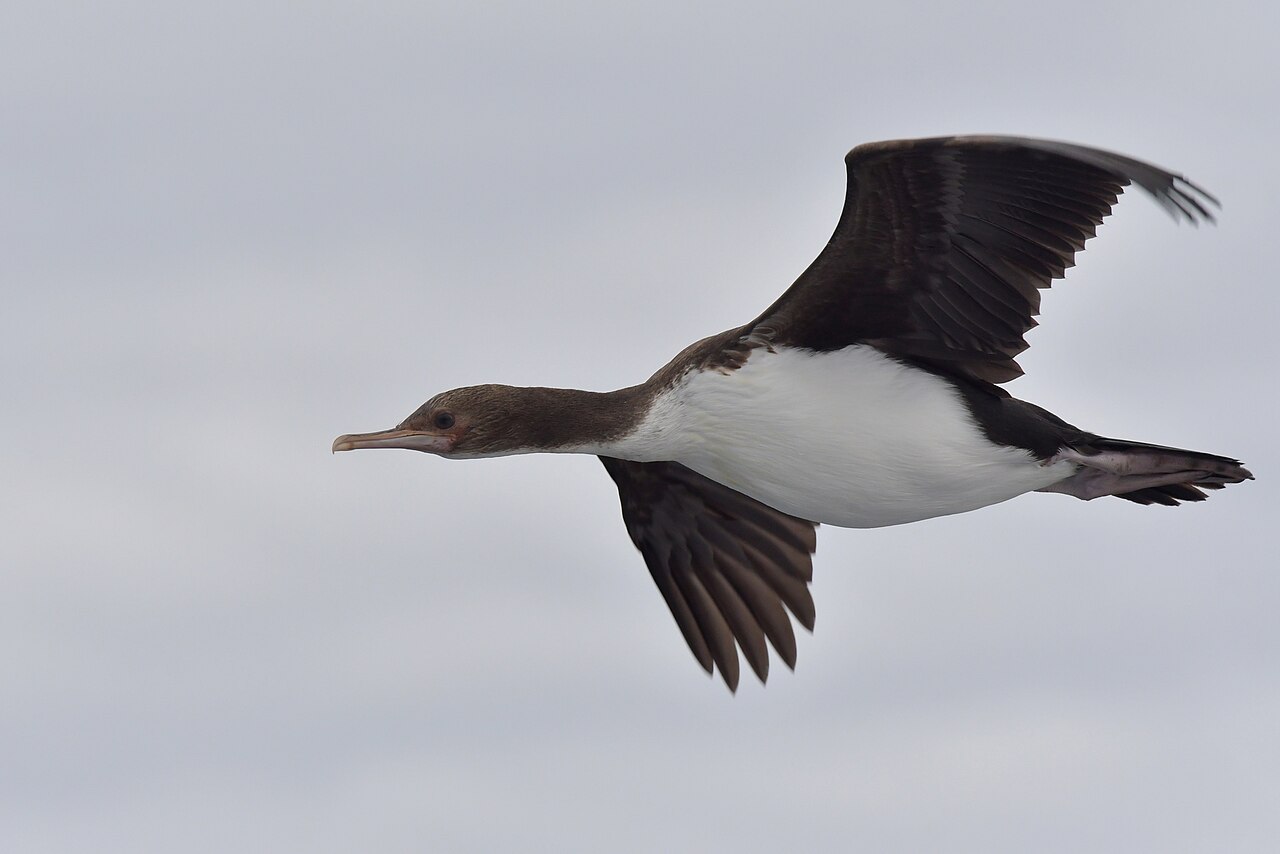
The Bounty Shag breeds only on the Bounty Islands, a handful of bare granite rocks seven hundred kilometres southeast of New Zealand with no soil, no plants and no introduced predator. It is a large black-and-white marine shag with a single crest, orange-yellow facial skin and pink feet, and no caruncles above the bill.
Voice
Away from the colony it is silent. Resting on the rocks the male gives a soft purring and a dry ticking, trrr … tk-tk-tk, which quickens in display; the female is almost always mute and purrs softly only at mating. Anyone landing off the Bounties hears that murmur swallowed by the din of penguins and fur seals.
No freely licensed recording has been found for this species yet; what to listen for is described below.
Identification
A large marine shag of over seventy centimetres and two to nearly three kilos. Head, neck, back and wings are black with a blue sheen, throat, breast and belly white; a white panel crosses the wing and shows as a clear white bar both in flight and at rest. Breeding birds carry a single crest on the forehead, orange-yellow facial skin, a red-orange to purple throat pouch and pink feet. There are no caruncles or knobs above the bill base. Young birds are brownish above, with pale facial skin and no crest.
Confusion species
The breeding island makes it unmistakable in practice: no other blue-eyed shag breeds on the Bounties. For birds at sea, watch for Auckland Shag (Leucocarbo colensoi) and Campbell Shag (Leucocarbo campbelli), both smaller at a little over sixty centimetres and with a magenta-pink eye region and a yellow-grading-to-red gape line respectively rather than orange-yellow facial skin. Imperial Shag (Leucocarbo atriceps) and New Zealand King Shag (Leucocarbo carunculatus) carry orange knobs above the bill base, entirely absent here; Otago Shag (Leucocarbo chalconotus) is besides often bronze rather than pied. Chatham Shag (Leucocarbo onslowi) also has bright caruncles. Pitt Shag (Phalacrocorax featherstoni) is grey, half the weight and in another genus.
Habitat
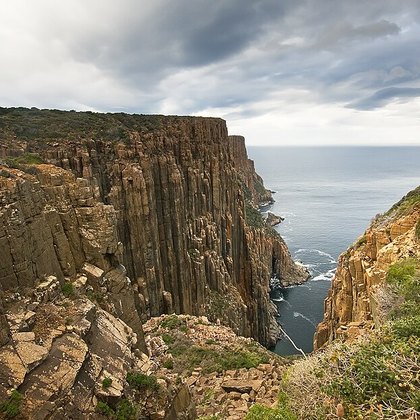
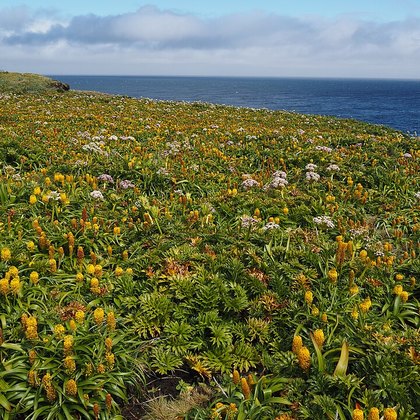
Cold subantarctic water right around the islets, where it dives to the bottom for fish and invertebrates; the seas off the Bounties are shallow and productive. It breeds on narrow ledges of the granite cliffs, on nests of weed and guano, in among the colonies of Erect-crested Penguins, Salvin's Albatrosses and fur seals — space is short and the contest for it constant.
Where the bird is most often found, arranged by main group and formation.

Range and movements
The Bounty Islands only, a group of thirteen bare rock islets totalling less than one and a half square kilometres, some 670 kilometres southeast of the South Island. It does not migrate and hardly wanders; records away from the group are exceptional. It does not occur on mainland New Zealand.
- Resident
- dark = core range, pale = thinly spread
Where and when to look
Only seen on a subantarctic cruise that calls at the Bounties — landing is not allowed, so scan the ledges above the surf from the ship or a zodiac. The white wing bar picks it out among the penguins; look for the birds that dive straight off the rock into the sea instead of waddling. October to January are the months, when the colonies are occupied.
Conservation
Vulnerable (VU), not from a collapsing trend but from the tiny population and the minute breeding range. Counts swing about: 1138 adults in 1978, 368 in 1997, 618 in 2005, and a 2022 drone survey came to 573 breeding pairs and about 1733 birds, suggesting numbers have been essentially stable across forty-five years. Introduced predators are absent altogether; the real risks are heavy storms that kill chicks through chilling, unrelenting competition for nest space with fur seals, albatrosses and penguins, skua and gull predation on eggs and chicks, and the fact that one oil spill or disease outbreak could reach the entire species.
Scientific name
Leucocarbo ranfurlyi | (Ogilvie-Grant, 1901)
Ogilvie-Grant described the species in 1901 as Phalacrocorax ranfurlyi; the move to Leucocarbo puts author and year in parentheses. The epithet honours Uchter John Mark Knox, fifth Earl of Ranfurly (1856–1933), Governor of New Zealand from 1897 to 1904, who collected New Zealand birds for the British Museum during his term — the type series of this species came from that collection. The genus Leucocarbo (Bonaparte, 1857) means roughly 'white cormorant', from Greek leukos and Latin carbo. The type locality is the Bounty Islands, named in 1788 by William Bligh after his ship HMS Bounty.