All species › Grebes › Grebes › Australasian Grebe
Australasian Grebe | Tachybaptus novaehollandiae
Australische dodaars | Zampullín australiano
The Australasian Grebe is the smallest grebe in the region and the bird of the stock dam: a dark, round ball that raises a whole family on a pond ten metres across. In breeding dress it has a jet-black head with a chestnut band along the cheek and a bright yellow spot at the gape. In New Zealand it is a newcomer that crossed under its own power.

Voice
The most striking sound is a loud, explosive rattling trill that comes out as laughter and bounces off a small sheet of water: bee-bee-bee-birrrrr, falling at the end and often given in duet by a pair. In alarm a short hard pit, repeated as long as the disturbance lasts. Young beg with a thin, penetrating peep that comes from the adult's back. Outside the breeding season the bird is all but silent.
No freely licensed recording has been found for this species yet; what to listen for is described below.
Identification
Twenty-five to twenty-seven centimetres, with a short pointed bill and a fluffy, tailless stern. In breeding dress the head is glossy black with a broad chestnut band running from behind the eye along the neck; the bare patch at the gape is then bright yellow and the best mark at range. The eye is yellow. Out of season it is grey-brown above and silver-grey below, with a pale throat and cheek and a duller bill base. The sexes are alike. Chicks are black with white lengthwise stripes on head and neck.
Confusion species
Hoary-headed Grebe (Poliocephalus poliocephalus) is slightly larger and out of season has a dark crown running down below the eye and a whiter face; in breeding dress its head is streaked white all over rather than black with a brown band. It also prefers to fly off where the Australasian Grebe always dives. In New Zealand the confusion species is New Zealand Dabchick (Poliocephalus rufopectus): larger, with a silvery streaked face, a rufous breast and a pale yellow iris.
Habitat
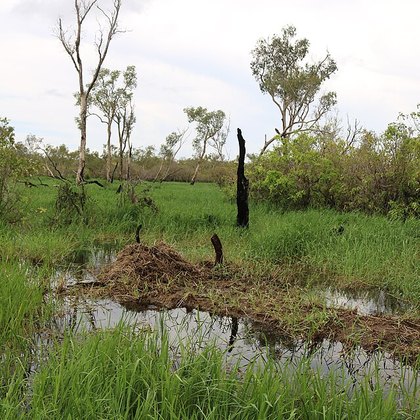
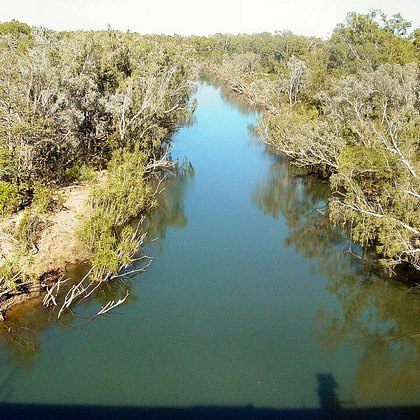
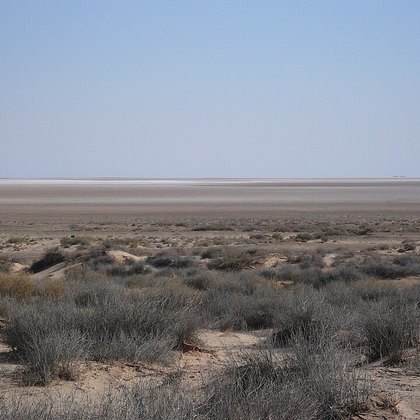
Small still fresh water with some fringing growth: stock dams, village ponds, clay pits, sewage ponds and the quiet backwaters of rivers and creeks. It needs floating or overhanging plants to anchor its floating nest to, and open water deeper than half a metre. Large bare lakes it leaves to the other grebes; after rain it settles newly filled claypans and ephemeral lakes inland within a few weeks.
Where the bird is most often found, arranged by main group and formation.


Range and movements
All of Australia where there is fresh water, and on through New Guinea, Timor and a string of islands in the southwest Pacific. New Zealand it colonised on its own: the first breeding was at Diamond Lake near Wanaka in 1977, and the centre of gravity since has been Northland, around Auckland and at the Rotorua lakes; since 2023 it has turned up more often on the South Island. On Norfolk it appears irregularly. It does not migrate to a fixed pattern but moves with the water, leaving a district as soon as the ponds dry out.
- Resident
- Breeding (summer)
- Winter
- dark = core range, pale = thinly spread
Where and when to look
Do not look at the big lake but at the smallest water nearby: a stock dam behind a fence or a settling pond yields a grebe more often than a reservoir does. Watch for the dive — it goes under without a splash and surfaces ten to twenty metres on. From October to March the adult carries the striped young on its back; that is also the time to get the yellow gape spot, with the bird sitting still on the nest.
Conservation
Not threatened (LC) and common and widespread in Australia; the building of stock dams and settling ponds has helped it rather than hurt it. In New Zealand it counts as a coloniser — a native bird that established itself unaided — with an estimate of about fifty birds in 1995 and a slow spread since. Locally, drainage, pollution and the clearing of fringing plants cost it nest sites.
Scientific name
Tachybaptus novaehollandiae | (Stephens, 1826)
Stephens described the bird in 1826 as Podiceps novaehollandiae; because it later moved to another genus, author and year stand in parentheses. Reichenbach introduced Tachybaptus in 1853, from Greek takhus, 'fast', and bapto, 'to dip': the bird that dives quickly. novaehollandiae means 'of New Holland', the old name for Australia. The type locality is New South Wales.