All species › Bustards › Bustards › Australian Bustard
Australian Bustard | Ardeotis australis
Australische trap | Avutarda australiana
The Australian Bustard is the largest flying land bird in Australia and the emblem of the open plain: a metre tall, with a grey neck and a heavy, deliberate walk. The displaying male lets a throat sac hang to the ground and booms a deep note across the grass. From the south of the country it has largely gone.

Voice
Mostly silent, and outside the display season rarely heard at all. On his display ground the male gives a deep, far-carrying roar, oo-woom, held for a couple of seconds and audible a kilometre off on a still evening; it suggests a beast or a distant engine rather than a bird. When disturbed he gives a short low bark, and young call a thin whistle. Display calling comes mostly at dusk and in the first hours of the night.
No freely licensed recording has been found for this species yet; what to listen for is described below.
Identification
Eighty to a hundred and twenty centimetres tall, with long grey legs, a long neck and a short flat head with a black crown and a fine crest. Neck and breast are pale grey with fine vermiculations, the upperparts grey-brown with black speckling, the belly white, and across the breast the male carries a black band. The folded wing shows a block of black and white coverts that lights up in flight as a sharp black-and-white panel. The male is much larger than the female. In flight the wings are broad and the primaries spread and upcurved at the tip.
Confusion species
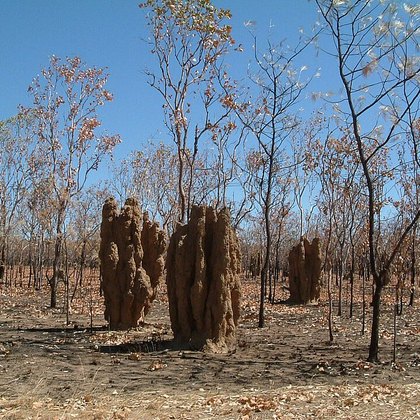
Brolga (Antigone rubicunda) and Sarus Crane stand taller, have a far longer neck, a long straight bill and a red head, and they fly with the neck extended; the bustard draws its neck in and has a short bill. The Emu is bigger, brown and shaggy, and does not fly. A bustard crouched in tall grass reads as a termite mound or a stump, and that is the commonest mistake; through binoculars the fine vermiculation on the neck gives it away. At range in heat haze it can pass for a grazing beast.
Habitat
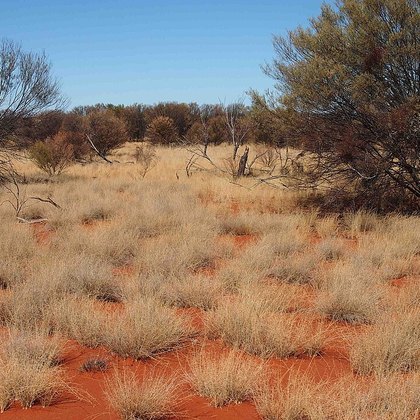
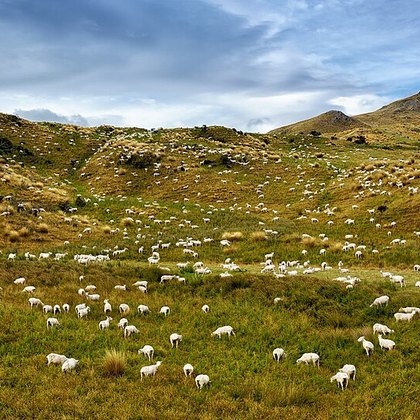
Mitchell grassland on black clay plains, savanna with scattered eucalypts, spinifex country and mulga with open ground beneath: anywhere it can see out over the grass. It also uses gibber plain and grazed rangeland, and after fire or rain birds gather on the fresh growth and on the grasshoppers that come with it. Dense shrub layers and closed forest it avoids, because it must see what is coming from a long way off.
Where the bird is most often found, arranged by main group and formation.



Range and movements
The interior and the tropical north of mainland Australia, plus southern New Guinea. In the nineteenth century the range ran unbroken into Victoria, southwestern Western Australia and the coastal districts of New South Wales; shooting — it was the plains turkey, killed by the thousand — and the conversion of grassland to cropping wiped it out there. In New South Wales it now stands as endangered and in Victoria it is all but gone. It wanders far and unpredictably: a district can be empty for years and then hold dozens of birds after a wet summer.
- Resident
- dark = core range, pale = thinly spread
Where and when to look
Drive a plains road through the Mitchell grassland of western Queensland or the Barkly Tableland at first light or in the last hour of the day and look out across the grass for a straight pale vertical: that is the neck. By day it lies up in shade and is next to impossible to find. Drive the same roads again after a wet summer, between December and March, when parties are about and the display grounds are occupied.
Conservation
Not threatened globally (LC), but that verdict rests on the northern half of the range. The fox, the feral cat and the loss of cover cost it its clutch — it lays a single egg on bare ground — and in the south it has largely gone as a result. Beyond that weigh poaching, road deaths and the conversion of grassland to cropping; through the north and centre it holds on at scale on grazed rangeland.
Scientific name
Ardeotis australis | (Gray, 1829)
Gray described the bird in 1829 as Otis Australis, among the European bustards; because it later moved to another genus, author and year stand in parentheses. Le Maout introduced Ardeotis in 1853, formed from Latin ardea, 'heron', and Greek otis, 'bustard': the bustard built like a heron. australis means 'southern'. The type locality is New South Wales, a state where the species now survives only in the far west.