All species › Cuckoos › Cuckoos › Chestnut-breasted Cuckoo
Chestnut-breasted Cuckoo | Cacomantis castaneiventris
Roestbuikkoekoek | Cuco ventricastaño
The handsomest of the Australian Cacomantis cuckoos and at the same time the hardest to find: slate blue-grey on head, back and wings, and below that deep rufous to chestnut, with a yellow eye-ring and a black-and-white barred tail. In Australia it is confined to the rainforests of Cape York Peninsula — for many birders the species the trip to Iron Range is made for.

Voice
A series of clear, descending whistles, usually three or four in succession, together with a mournful descending trill that recalls Fan-tailed Cuckoo but sounds shorter and thinner. In dense rainforest the voice is almost always the first contact and often the only one.
No freely licensed recording has been found for this species yet; what to listen for is described below.
Identification
Twenty-two to twenty-five centimetres, slim-built with a long tail, sitting in size between Sahul Brush Cuckoo and Fan-tailed Cuckoo. Head, back and wings are dark slate-blue to slate-grey, the breast and whole underparts deep rufous — a saturated chestnut, not the pale orange-buff of its relatives. A yellow ring surrounds the eye. The tail is barred black and white from below, though less strikingly than in Fan-tailed Cuckoo. Young birds are much duller, greyish cinnamon above with pale buff underparts, and then considerably harder.
Confusion species
Fan-tailed Cuckoo (Cacomantis flabelliformis) is the direct counterpart: larger (24–28 cm), pale orange-buff rather than deep chestnut below, with far bolder black-and-white barring on the undertail and a long, mournful descending trill; its stronghold lies in eastern and south-western Australia and Tasmania, with only a narrow overlap in the north-east. Sahul Brush Cuckoo (Cacomantis variolosus) is smaller (20–24 cm), has a grey rather than yellow eye-ring and pale buff underparts, and is regular on Cape York. The distinction therefore rests on three things at once: the saturation of the rufous, the colour of the eye-ring and the size. Young birds of all three are much alike; in that case wait for the call.
Habitat
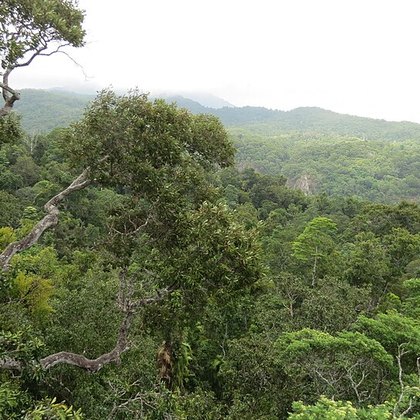
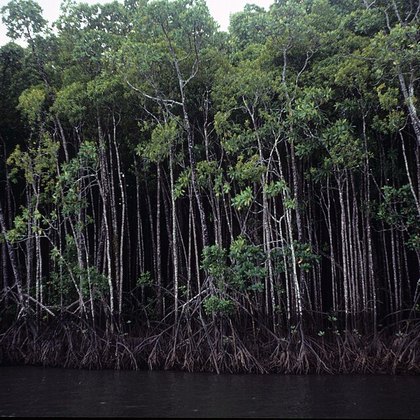
Tropical rainforest and its edges, monsoon forest and vine thicket, and locally mangrove. It usually keeps to the middle and upper canopy in dense foliage, taking caterpillars and other insects gleaned from leaves or seized in short sallies.
Where the bird is most often found, arranged by main group and formation.

Range and movements
Within the map window, only the northern part of Cape York Peninsula in Queensland, the best-known sites being the Iron Range and McIlwraith Range area and the Lockerbie Scrub near the tip. Southwards it stops quickly. Beyond the window the species occurs on the Aru Islands and throughout New Guinea, where two further subspecies are described. It is entirely absent from New Zealand.
- Resident
- dark = core range, pale = thinly spread
Where and when to look
Stand on a rainforest track in the Iron Range area early in the morning and let the bird announce itself: walking about helps less here than standing still and listening. Follow the descending whistled series upward and search the half-shaded middle canopy for a motionless, slender bird. Once you have it, go straight to the belly — that deep chestnut is the clincher, and against the light the yellow eye-ring helps.
Conservation
Least Concern (LC) globally, thanks to the large New Guinean range. Within Australia the species is very restricted, however: only the rainforests of northern Cape York, where the population is small and poorly counted. The Australian share of the range depends on keeping lowland rainforest unbroken; mining, road access and changing fire regimes at the forest edge are the real concerns there, rather than any direct persecution.
Scientific name
Cacomantis castaneiventris | (Gould, 1867)
Gould described the species in 1867 as Cuculus (Cacomantis) castaneiventris in the Annals and Magazine of Natural History, from material taken in the Cape York district of Queensland; with the later elevation of Cacomantis to full genus, author and year stand in parentheses. The epithet joins Latin castaneus, 'chestnut', to venter, 'belly'. The genus Cacomantis (Müller, 1843) is built on Greek kakos, 'bad', and mantis, 'soothsayer', after the old belief that a cuckoo's call foretells misfortune.