All species › Cuckoos › Cuckoos › Fan-tailed Cuckoo
Fan-tailed Cuckoo | Cacomantis flabelliformis
Waaierstaartkoekoek | Cuco flabeliforme
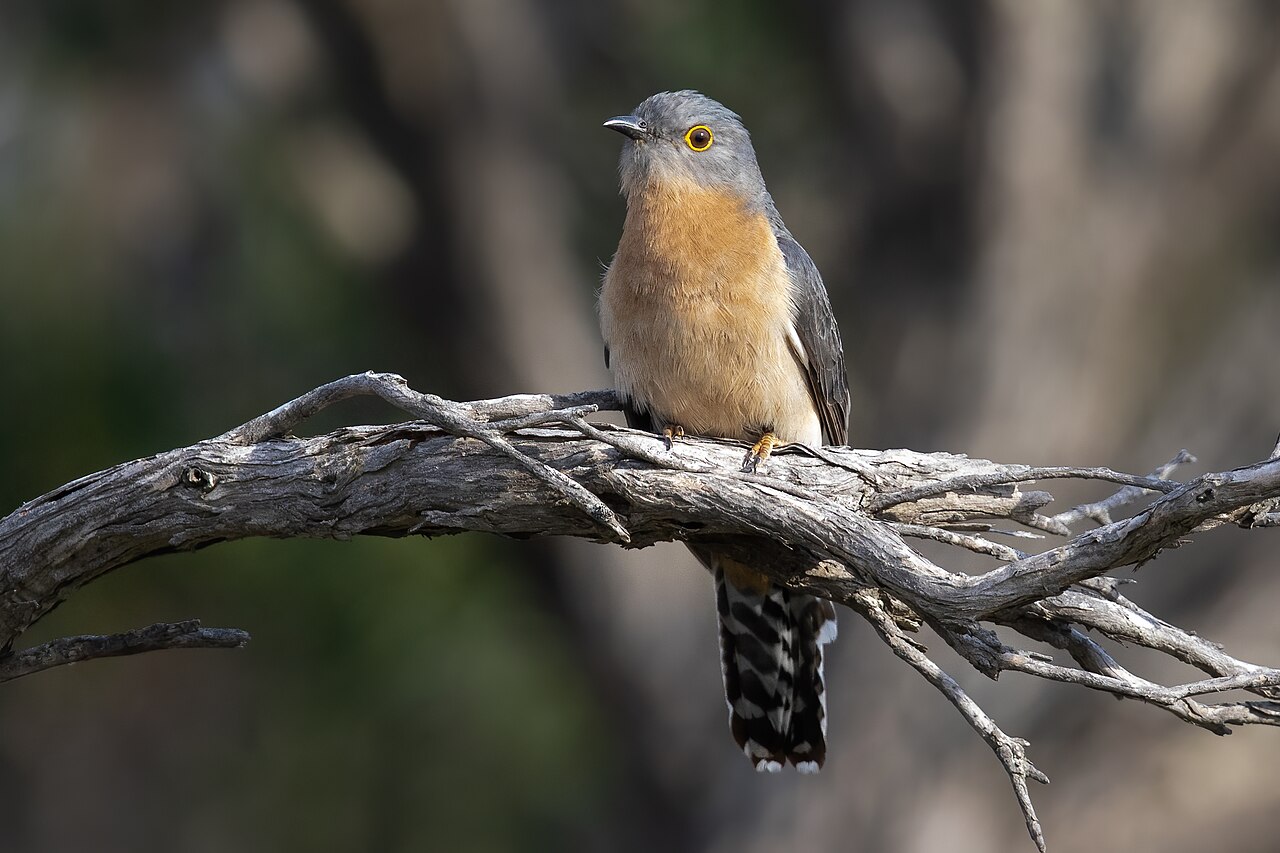
The Fan-tailed Cuckoo is the cuckoo of south-eastern Australia that you hear far more often than you see: a slate-grey bird with warm buff underparts, a bright yellow eye-ring and a long tail boldly barred black and white beneath, spread like a fan as it lands. The descending trill with which it fills the eucalypt forest in spring is one of the most characteristic sounds of the Australian east coast.
Voice
The signature sound is a rapid, high trill that falls away in pitch: tsee-rrrrrr, a few seconds long and then straight into the next one. It also gives a mournful drawn-out whistle and a dry, grasshopper-like chirp that is surprisingly soft at close range. It calls mainly between July and January, and then all day, even through a hot afternoon.
No freely licensed recording has been found for this species yet; what to listen for is described below.
Identification
A medium-sized cuckoo of 24 to 28 centimetres and about 58 grams. Head, back and wings are plain slate-grey, the underparts warm buff, with a pale orange throat. The best mark at close range is the broad, bright yellow eye-ring — slightly greenish in young birds. The tail is long and strikingly barred black and white beneath, and is spread when the bird lands or is uneasy. Juveniles are brown, mottled rufous above and barred below, but already have the long barred tail.
Confusion species
Chestnut-breasted Cuckoo (Cacomantis castaneiventris) is smaller, has deep chestnut rather than buff underparts, less crisp tail barring, and is confined to the rainforest of Cape York — off that peninsula confusion is impossible. Sahul Brush Cuckoo (Cacomantis variolosus) does overlap widely: it is smaller, paler buff below, has a grey rather than yellow eye-ring, and a shorter tail it does not fan. Pallid Cuckoo (Heteroscenes pallidus) is about the same size but grey without buff, with a dark eye-stripe and white spots on the upper tail coverts. Check the colour of the eye-ring first, then the belly.
Habitat
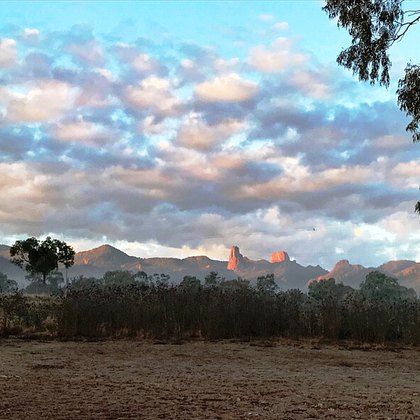
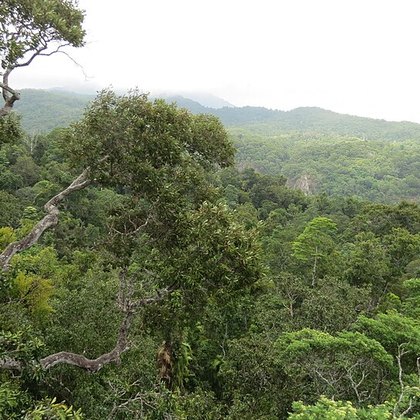
Wet and dry eucalypt forest, open woodland, rainforest edges, heath and the growth along creeks; also gardens and parks as long as bush is near. It hunts from an exposed branch at mid-height, dropping onto a hairy caterpillar on the ground or taking an insect in the air. As a brood parasite it depends on the domed nests of fairy-wrens (Malurus), thornbills (Acanthiza) and scrubwrens (Sericornis), laying one egg and removing one of the host's.
Where the bird is most often found, arranged by main group and formation.


Range and movements
In Australia all along the eastern side, from Cape York through Queensland, New South Wales and Victoria to south-eastern South Australia, plus the whole of Tasmania, with a separate population in the south-west of Western Australia. Tasmanian birds cross to the mainland for the winter. In New Zealand it is a vagrant only: a handful of accepted records since 1960, from Governor's Bay and Karikari to a road-killed bird in Northland in 2010 and a sighting on Stewart Island.
- Resident
- dark = core range, pale = thinly spread
Where and when to look
Learn the descending trill; it carries a long way and is the only thing that will find the bird in a big forest. Then search the forest edge for a silent grey bird sitting upright on a bare dead branch ten to fifteen metres up, slowly lowering its tail. August to November is the peak: it calls most then, and its hosts are on eggs.
Conservation
Least Concern (LC), and rated secure in every Australian state. It is widespread and numerous, and so are its hosts — fairy-wrens, thornbills and scrubwrens; because it builds no nest of its own, much of what hits other forest birds does not reach it directly. It drops out locally where forest is cleared or burnt too often and too hot, because that removes the shrub layer its hosts nest in.
Scientific name
Cacomantis flabelliformis | (Latham, 1801)
Latham described the bird in 1801 as Cuculus flabelliformis; because it later moved to another genus, author and year stand in parentheses. The genus Cacomantis was introduced in 1843 by Salomon Müller, from Greek kakos, 'bad', and mantis, 'seer' — 'prophet of doom'. Müller noted that people in the Moluccas took these mournfully calling cuckoos, often seen around burial grounds, for birds of ill omen. flabelliformis is Latin for 'fan-shaped', from flabellum, 'fan', for the tail. The type came from New South Wales.