All species › Cranes, rails and allies › Rails, gallinules and coots › Australian Crake
Australian Crake | Porzana fluminea
Australisch porseleinhoen | Polluela australiana
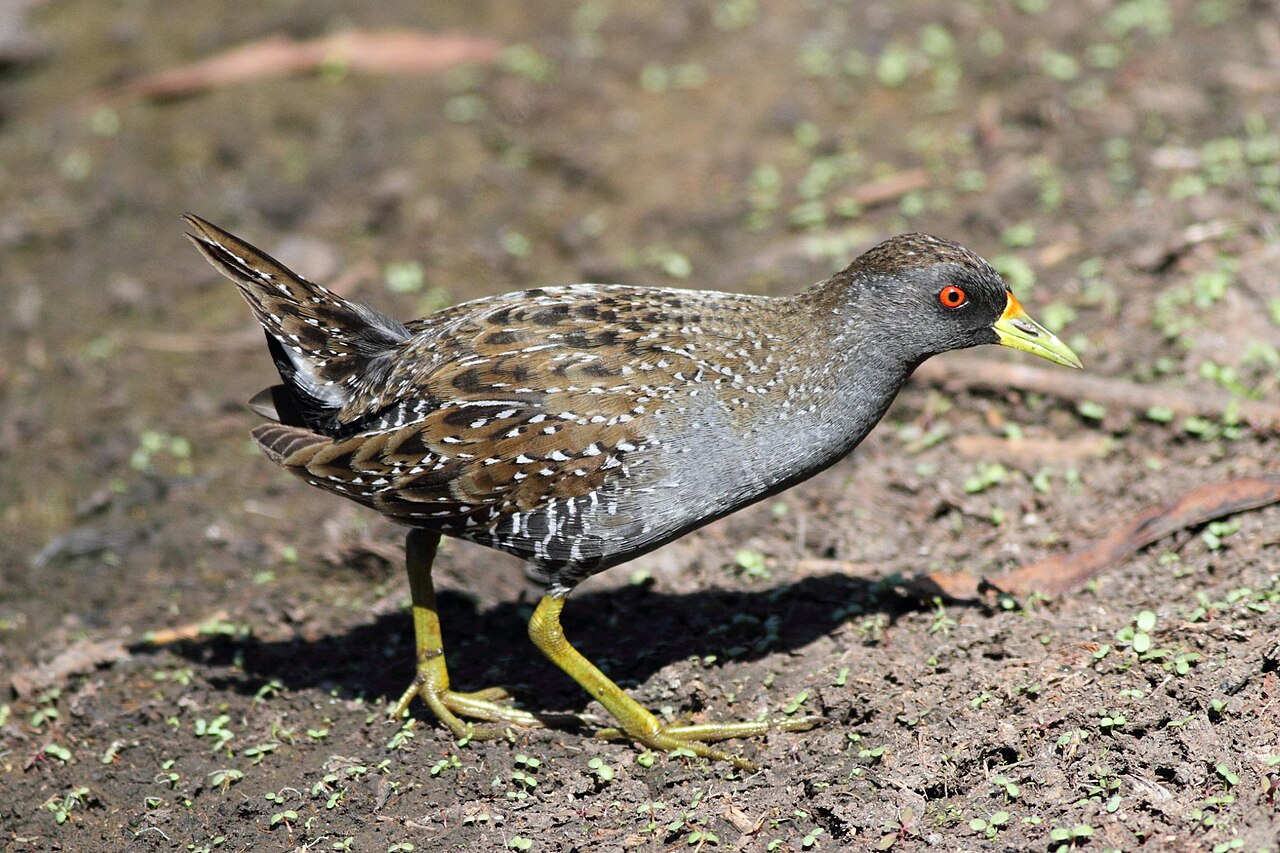
The Australian Crake is a small, compact marsh crake with slate-blue underparts, an olive-green bill with an orange-red patch at the base, and a red iris. It walks the mud at the edge of the reeds with its tail cocked, and slips back into cover at the least movement.
Voice
The commonest call is a sharp, metallic double note, chip-chip, which can run on into a fast, accelerating series. Beyond that come single clicks, a chattering rattle between partners, and a wheezing, panting note. It calls mainly at first light and at dusk, and on through the night.
No freely licensed recording has been found for this species yet; what to listen for is described below.
Identification
A crake of nineteen to twenty-three centimetres, about the bulk of a starling, weighing some sixty grams. Face, chin, throat and breast are dark slate-grey, the upperparts olive-brown with black streaks and fine white specks. Flanks and undertail coverts are barred black and white, with a strikingly broad white border below the tail. The bill is olive-green with an orange-red patch at the base, the legs greenish-yellow, the eye red. Females are duller than males; young birds lack the slate-blue on the underparts.
Confusion species
Baillon's Crake (Zapornia pusilla) is clearly smaller and a warmer cinnamon-brown above, has an all-green bill with no red at the base, and lacks the broad white border below the tail. Spotless Crake (Zapornia tabuensis) is uniform dark slate-grey without white specks, with red legs and a finely barred undertail. Lewin's Rail (Lewinia pectoralis) is bulkier, has a rufous crown and a long, slightly decurved pink bill. With a shape slipping along the reeds it is the bill that decides: short, green and red at the base belongs to this species.
Habitat
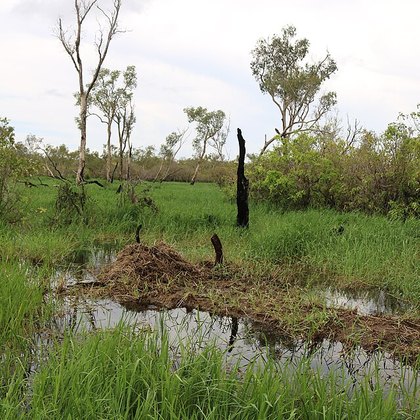
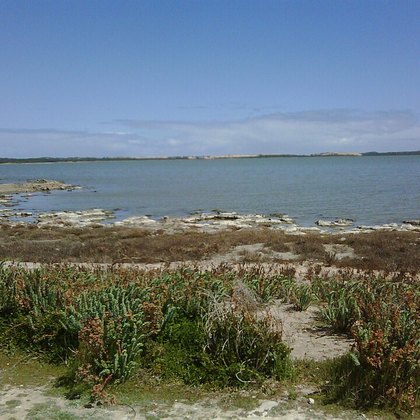
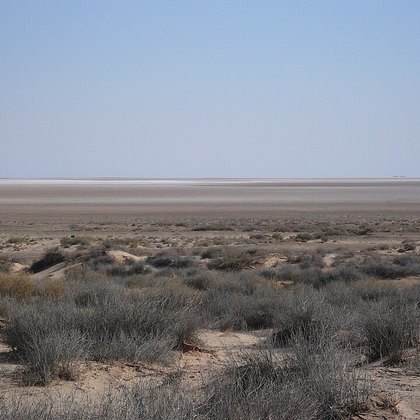
Densely vegetated margins of fresh and brackish wetlands, permanent or temporary: reeds, cumbungi, rushes and sedge, and on the coast also saltmarsh with samphire, saltbush and the fringe of mangrove. It feeds on exposed mud right in front of cover, usually within a metre or two of the vegetation. Inland it uses claypans and ephemeral lakes that fill after rain, and the vegetated margins of sewage works.
Where the bird is most often found, arranged by main group and formation.

Range and movements
Endemic to Australia. The stronghold lies in the southeast — Victoria, inland New South Wales and northeastern South Australia — and in southwestern Western Australia; it is thinly spread in Queensland and uncommon in Tasmania. After heavy rain it pushes far inland, as far as Alice Springs, and it has been recorded in the Kimberley as well. It does not occur in New Zealand or on the islands of the Tasman Sea.
- Resident
- Breeding (summer)
- dark = core range, pale = thinly spread
Where and when to look
Sit quietly before sunrise at a reed edge with a strip of bare mud in front of it, and give it half an hour; the crake usually comes out of cover and works a few metres along the margin. Watch for the cocked tail with its white border underneath — in a bird that shows for only a second, that is often the one usable mark. Vegetated settling ponds at sewage works give the best chance of all.
Conservation
Least Concern (LC): the range is large and numbers climb steeply after wet years. Its habitat nevertheless keeps shrinking. Drainage, regulation of river flows in the Murray-Darling basin, and the burning or grazing of reed fringes remove cover and nest sites, and foxes and cats find the bird on the very strip of mud where it feeds. Because the species is so hard to count, every trend estimate for it stays uncertain.
Scientific name
Porzana fluminea | Gould, 1843
Gould described the species in 1843 as Porzana fluminea, and it has stayed in that genus, so author and year carry no parentheses. Porzana goes back to a Venetian folk name for the small crakes and was introduced as a genus by Vieillot in 1816. fluminea means 'of the river', from Latin flumen. The type locality is New South Wales.