All species › Cranes, rails and allies › Rails, gallinules and coots › Purple Swamphen
Purple Swamphen | Porphyrio porphyrio
Purperkoet | Calamón común
The Purple Swamphen is the largest and most conspicuous rail in the region: deep blue and purple, with a heavy red bill running into a broad frontal shield, and long red legs that carry it across floating vegetation. In New Zealand it is the pukeko and stands beside almost every damp roadside; it breeds there in groups in which several males and sometimes two females fill a single nest.

Voice
The call is a loud, penetrating kee-ow that carries far across a swamp and which group members throw at one another all day long. Alongside it comes low clucking conversation from birds feeding together, and in a quarrel a series of sharp screeching yells. When a harrier passes over, a shrill sustained alarm goes up and the whole party vanishes into cover.
Recording: Joost van Bruggen — CC BY-SA 4.0 · Área Metropolitana de Sevilla (near Isla Mayor), Sevilla, Andalucía, Spain · xeno-canto
Identification
A large rail of 44 to 48 cm that looks bigger still on its high legs and enormous toes. Head, neck, breast and belly are deep blue to purple, the back and wing darker and blackish; the bill is big, red and heavy and runs into a broad red shield across the forehead. The legs are orange-red, the toes outsized. Under the tail sits a white patch that the bird flicks up constantly as it walks. Young birds are duller, grey-brown, with a dark bill.
Confusion species
South Island Takahe (Porphyrio hochstetteri) is much the same colour but far heavier, flightless, short and thick in the bill and confined to Fiordland and managed sanctuaries — anyone who sees a 'takahe' beside a New Zealand road is almost always looking at a pukeko. Dusky Moorhen (Gallinula tenebrosa) and Eurasian Coot (Fulica atra) are both far smaller and lack the blue. In flight the long red legs trail loosely behind the body, which fixes the swamphen at any range.
Habitat
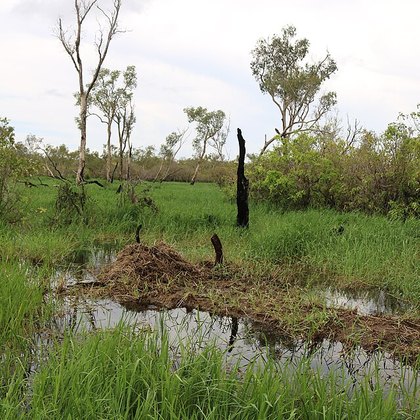
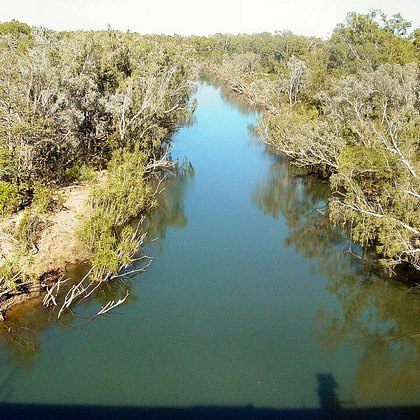
Freshwater swamp with reed, raupo and rush is the core, with lake edges, creeks, drains, wet pasture and damp road verges alongside. It walks over floating vegetation, climbs into the reeds and hauls a stem up with one foot to eat the sweet base — a posture that identifies it instantly. The nest is a platform of bent stems in dense marginal growth, often with several birds attending.
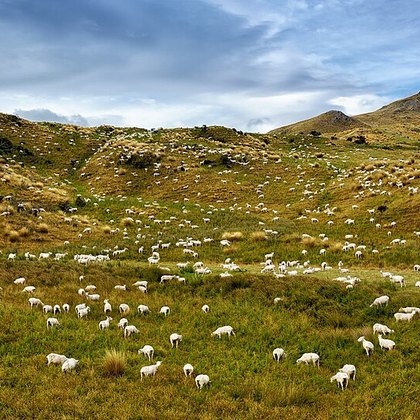
Where the bird is most often found, arranged by main group and formation.

Range and movements
Common in eastern and northern Australia, with a distinct subspecies in the southwest corner; in New Zealand across both main islands, out to the Chathams and the Kermadecs, and beyond that on Norfolk Island. It probably reached New Zealand only after Polynesian settlement, some five hundred years ago, and has gained from land clearance. Taken broadly, the species runs from the western Mediterranean across Africa and Asia into the Pacific. It does not migrate.
- Resident
- dark = core range, pale = thinly spread
Where and when to look
In New Zealand, drive a damp road verge and look into the roadside drains early in the morning; the birds stand out in the open grass, and the white tail signal of a whole family shows at once. Watch a feeding bird for the foot that holds the food — no other bird in the region eats like that. From September to December stand at a reed edge and count the adults at one nest: three to seven is normal.
Conservation
Least Concern (LC). The Purple Swamphen is one of the few wetland birds that clearing has suited: drained but still wet pasture, drain banks and road verges have widened its ground rather than narrowed it, and in New Zealand it is numerous enough to be legal game. Traffic kills many birds along wet verges, and where swamps dry out entirely it does disappear; against the balance of the species, that has so far weighed little.
Scientific name
Porphyrio porphyrio | (Linnaeus, 1758)
Linnaeus described the bird in 1758 as Fulica porphyrio; because it was later moved to another genus, author and year stand in parentheses. The genus Porphyrio was introduced by Brisson in 1760 and goes back to Greek porphyrion, the purple waterbird of the classical writers, from porphyra, 'purple dye'. The type locality lies on the western Mediterranean. AviList v2025b, which this guide follows, keeps the species broad; IOC and Clements split the birds of Australia and New Zealand off as Porphyrio melanotus, the pukeko.