All species › Cranes, rails and allies › Rails, gallinules and coots › South Island Takahe
South Island Takahe | Porphyrio hochstetteri
Zuidereilandtakahe | Calamón takahe
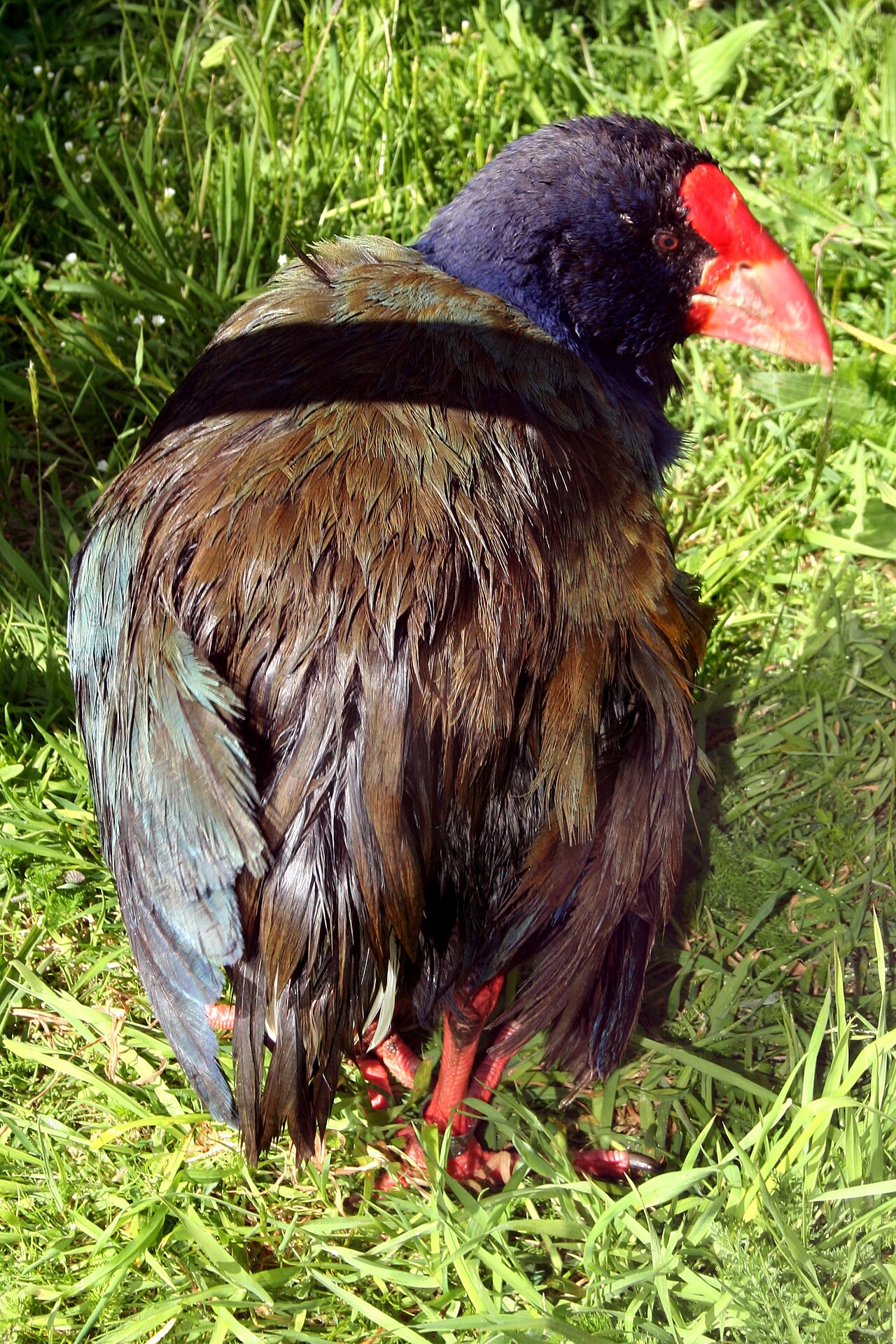
The South Island Takahe is the largest living rail in the world: a heavy, flightless bird of the South Island tussock grasslands, deep blue with an olive-green back, a massive scarlet bill and short, thick red legs. It was thought extinct for half a century and was found again in the Murchison Mountains in 1948 — since then it has been the face of New Zealand conservation.
Voice
The alarm call is a loud, piercing shriek; early observers compared the sound to someone whistling over an empty cartridge case. With it go a quiet hooting contact note between partners and a muted boom when the birds are uneasy. The voice resembles the Weka's but is fuller and deeper in tone — a difference that is obvious at once when listening at the edge of a tussock field.
No freely licensed recording has been found for this species yet; what to listen for is described below.
Identification
A stocky rail of about half a metre and two to nearly four kilos — two to three times the weight of a Purple Swamphen. Head, neck and underparts are deep dark blue with peacock gloss on the shoulder; back and wings are olive-green to teal, the undertail white. The bill is enormous, conical and carmine, with a red frontal shield running well up the crown; the legs are short, thick and scarlet. The wings are small and are spread only in courtship and in fights — it does not fly. Young birds are duller, with a blackish-orange bill and dull pink-brown legs; chicks are jet-black and downy with large brown legs.
Confusion species
Purple Swamphen (Porphyrio porphyrio), called pukeko in New Zealand, is the only real confusion and stands on every roadside. It is far slimmer and lighter, has a black rather than olive-green back, a much narrower bill, and long thin red legs that trail behind the body in flight. The Takahe is compact and heavy, does not fly, and carries a bill like a blunt knife. Anyone who sees a 'takahe' on a New Zealand roadside outside a reserve is almost certainly looking at a pukeko — and the difference is more than academic: Takahe have been shot during pukeko control, one in 2009 and four in 2015. Weka (Gallirallus australis) is equally solid and also flightless, but brown with no blue at all.
Habitat
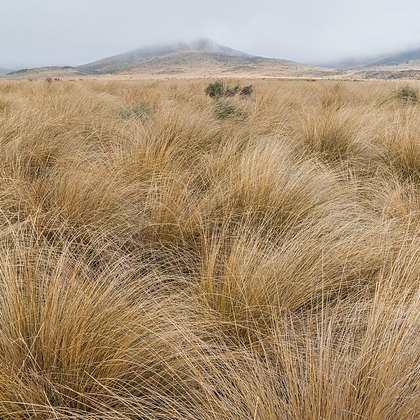
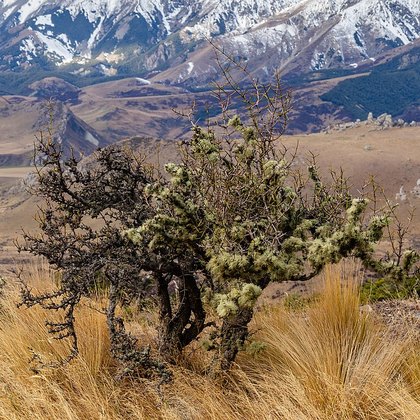
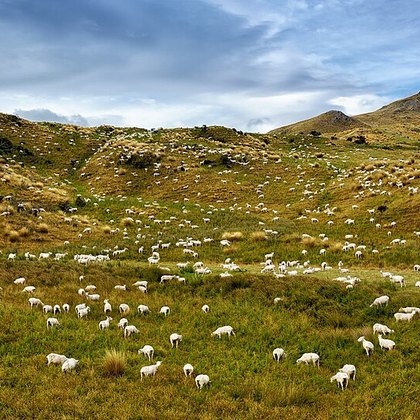
Alpine and subalpine tussock grassland, where it pulls the starchy leaf bases of Chionochloa tussocks and sedges from the clump, and red tussock flats on river terraces, with scrub for cover. Under heavy snow, when the food is out of reach, it drops into the southern beech forest and eats fern rhizomes there. On the island reserves and the new mainland sites it lives in regenerating farmland with scattered shrubs — a different picture from the alpine one, but the same grass.
Where the bird is most often found, arranged by main group and formation.


Range and movements
Once across the whole South Island; now Fiordland, with the Murchison Mountains west of Lake Te Anau as the wild core population, plus seven predator-free island reserves — Tiritiri Matangi, Kapiti, Mana, Maud, Motutapu and Rotoroa among them — and a growing number of managed mainland sites: Kahurangi (Gouland Downs) since 2018, the Greenstone/Whakatipu Waimaori valley since 2023 and the Rees Valley near Queenstown from February 2025. Birds also live in fenced sanctuaries such as Zealandia in Wellington, Maungatautari, Orokonui near Dunedin and Wairakei. The North Island held a species of its own, the moho (Porphyrio mantelli), which was gone before 1400.
- Resident
- dark = core range, pale = thinly spread
Where and when to look
The surest place is a reserve: on Tiritiri Matangi in the Hauraki Gulf, numbered birds walk the tracks, and at fenced Zealandia in Wellington and Orokonui near Dunedin it is all but guaranteed. In Fiordland the bird is practically out of reach, since the Murchison Mountains are closed country. On every blue rail check bill and legs: short, heavy and massive means Takahe, long and thin means pukeko — and watch for the olive-green back, which the pukeko lacks.
Conservation
Endangered (EN) on the world list, Threatened – Nationally Vulnerable in New Zealand, and one of the best-documented rescues anywhere. After the last certain record in 1898 the species was held to be extinct, until the physician Geoffrey Orbell found it again on 20 November 1948 by Lake Te Anau in the Murchison Mountains; two birds were caught, photographed and released. Recovery was slow. In 1985 the Burwood Takahe Centre opened near Te Anau, holding up to twenty-five breeding pairs; chicks there were at first raised with hand puppets and fibreglass models of adults to prevent imprinting on people, a method dropped in 2011. Through the 1980s and 1990s security populations were set up on predator-free islands, so that not everything depended on Fiordland any more. A stoat plague halved the population in 2007. After that it climbed: 263 birds in 2013, 306 in 2016 — which moved the national ranking from Nationally Critical to Nationally Vulnerable — 347 in 2017, 418 in 2019, and over five hundred since 2023, growing at five to eight per cent a year; more than half of the birds now live at wild sites rather than under close management. The main threats remain the stoat; red deer, which compete for the same tussock and whose helicopter culling in Fiordland has clearly let the vegetation recover; heavy snow that buries the food; and inbreeding with low fertility in a population descended from a few dozen birds. Because the Murchison Mountains and the Greenstone Valley are nearing capacity, the Rees Valley was opened as a third wild site, aiming at some eighty birds there by the end of 2025 and in time at one large self-sustaining population across the upper Whakatipu.
Scientific name
Porphyrio hochstetteri | (Meyer, 1883)
Meyer described the South Island bird in 1883 as Notornis hochstetteri, named for the Austrian geologist Ferdinand von Hochstetter, who worked in New Zealand in 1859; the species now sits in Porphyrio, so author and year stay in parentheses. Porphyrio is the Latin word for the swamphen, from Greek porphyra, 'purple dye, purple'. Richard Owen had already described North Island bones in 1848 as Notornis mantelli; the two island forms were long treated as subspecies of one species, but morphological and genetic work has restored them as separate species. The name takahe is Maori and goes back to takahi, 'to tread or stamp', after the way the bird walks.