All species › Cranes, rails and allies › Rails, gallinules and coots › White-browed Crake
White-browed Crake | Poliolimnas cinereus
Wenkbrauwral | Polluela cejiblanca
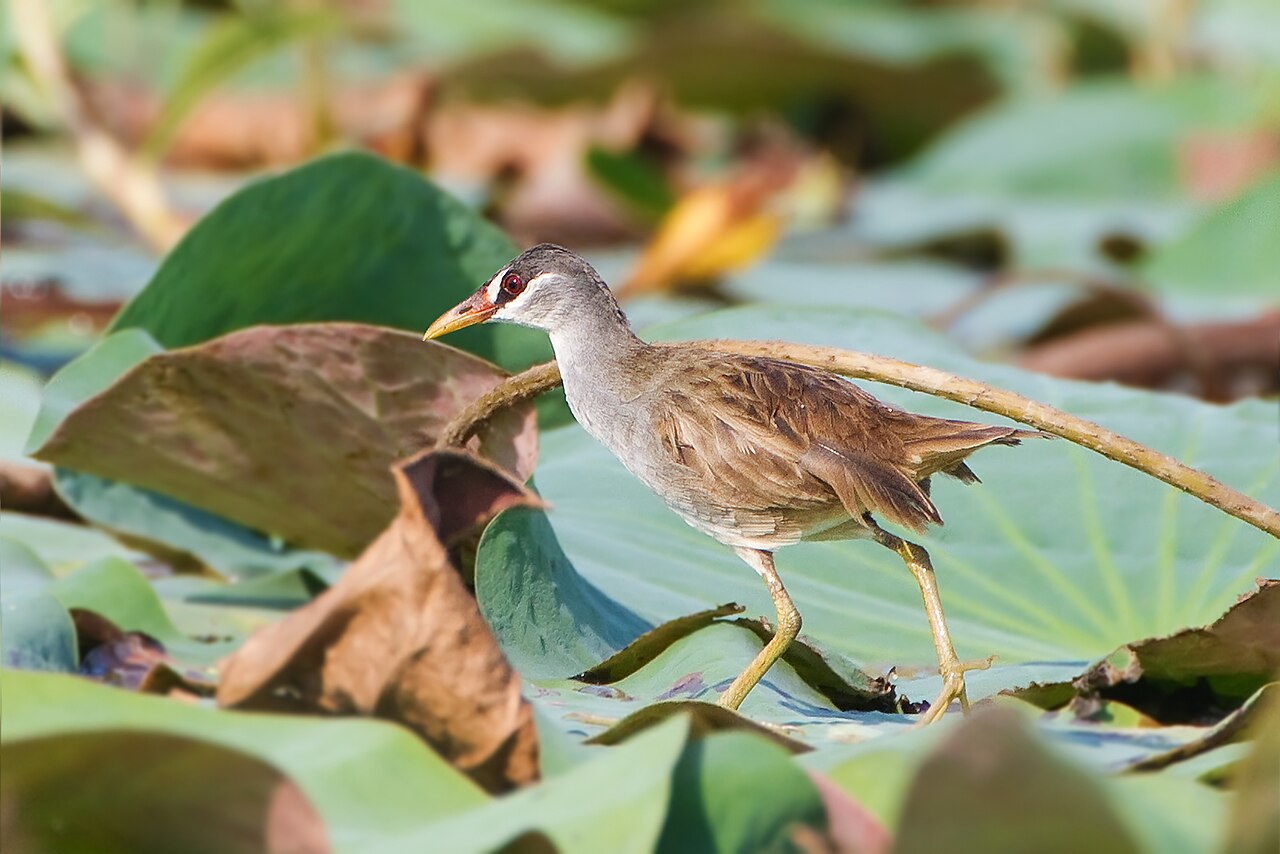
The White-browed Crake is the small, lightly built rail of floating vegetation in tropical northern Australia. The face pattern fixes it at once: a black mask around the eye, closed in above and below by a broad white stripe. On disproportionately long toes it walks out in the open across waterlily pads, where other crakes would be hiding.
Voice
The commonest sound is a loud, raspy kii-kah repeated rapidly, carrying right across a lagoon. Rarely there is a sudden, hard yelp or trill given seven or eight times in quick succession, probably territorial, and among the stems soft, low-held contact notes with which birds keep track of one another under the mat.
No freely licensed recording has been found for this species yet; what to listen for is described below.
Identification
A crake of eighteen to twenty centimetres, far more lightly built than it looks. Forehead and crown are grey with black markings; around the eye sits a black mask with a broad white supercilium above it and a second white stripe across the cheek below. Throat and breast are pale grey, the belly whitish, flanks and undertail warm rufous, the back olive-brown. The bill is yellow-green with an orange base, the legs yellow-green with strikingly long toes, and the iris red. Young birds are duller and browner with a less sharply drawn brow. It flies rarely and feebly, legs dangling.
Confusion species
Baillon's Crake (Zapornia pusilla) is just as small but has no face pattern at all: brown above with white streaking and black-and-white barred flanks. Spotless Crake (Zapornia tabuensis) is plain dark slate-grey with no head stripe, a black bill and red legs. Comb-crested Jacana (Irediparra gallinacea) walks the same floating leaves but is far larger, with a red comb on the forehead and even longer toes. In case of doubt the face settles it: two white stripes around a black mask belong, in this region, to this species alone.
Habitat
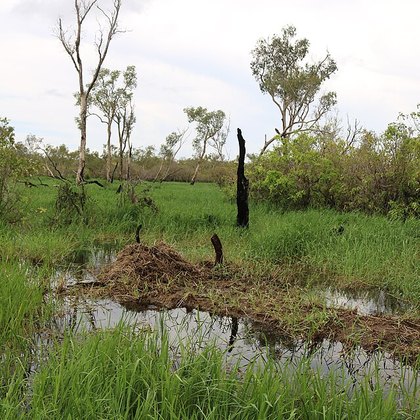
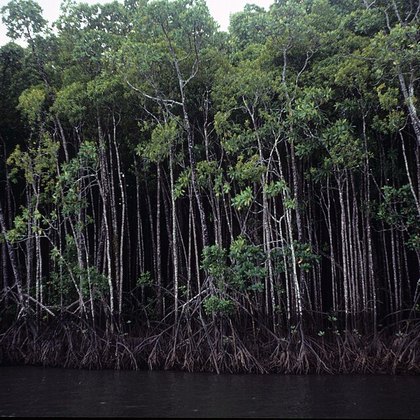
Well-vegetated freshwater swamps, lagoons, dams and slow creeks with a closed mat of floating vegetation — waterlily, azolla, floating grass — and a fringe of reed or sedge to vanish into. It also uses melaleuca swamp forest, rice fields and the freshwater side of mangrove. It feeds walking over the leaves and along mud margins, mostly at dawn and dusk.
Where the bird is most often found, arranged by main group and formation.


Range and movements
Tropical northern Australia only: from Broome in Western Australia through the Top End of the Northern Territory, with gaps in Arnhem Land, around the Gulf of Carpentaria, across Cape York and down the Queensland east coast to about the Burdekin. Outside this guide's map the range carries on through South-East Asia and the Pacific to Fiji, Samoa and New Caledonia. It does not occur in New Zealand.
- Resident
- dark = core range, pale = thinly spread
Where and when to look
Stand early in the morning on a dam wall, boardwalk or hide at a lagoon with waterlilies — Fogg Dam and the Mamukala wetlands near Kakadu, Hasties Swamp and the Mareeba wetlands in north Queensland are proven — and scan the floating leaves rather than the reedbed. It walks out in the open but dives into the reeds at the least alarm. Once you know the face pattern you pick it out at a distance.
Conservation
Least Concern (LC). The range is large and Australia's northern wetlands are still intact over great areas, so there is no sign of decline. Locally, altered water management and level regulation do play a part, along with trampling and turbidity from feral water buffalo and pigs, and the spread of introduced water plants such as water hyacinth, mimosa and para grass, which close over exactly the open floating leaf this bird feeds on.
Scientific name
Poliolimnas cinereus | (Vieillot, 1819)
Vieillot described the species in 1819 as Rallus cinereus, with Java as the type locality; it now sits in Poliolimnas, so author and year stay in parentheses. Sharpe introduced that genus in 1893, built from Greek polios, 'grey', and limnas, 'marsh-dweller'. cinereus means 'ash-grey' — a name for the grey underside, not for the white brow that the Dutch and English names point at.