All species › Cranes, rails and allies › Rails, gallinules and coots › Lewin's Rail
Lewin's Rail | Lewinia pectoralis
Grijsborstral | Rascón pectoral
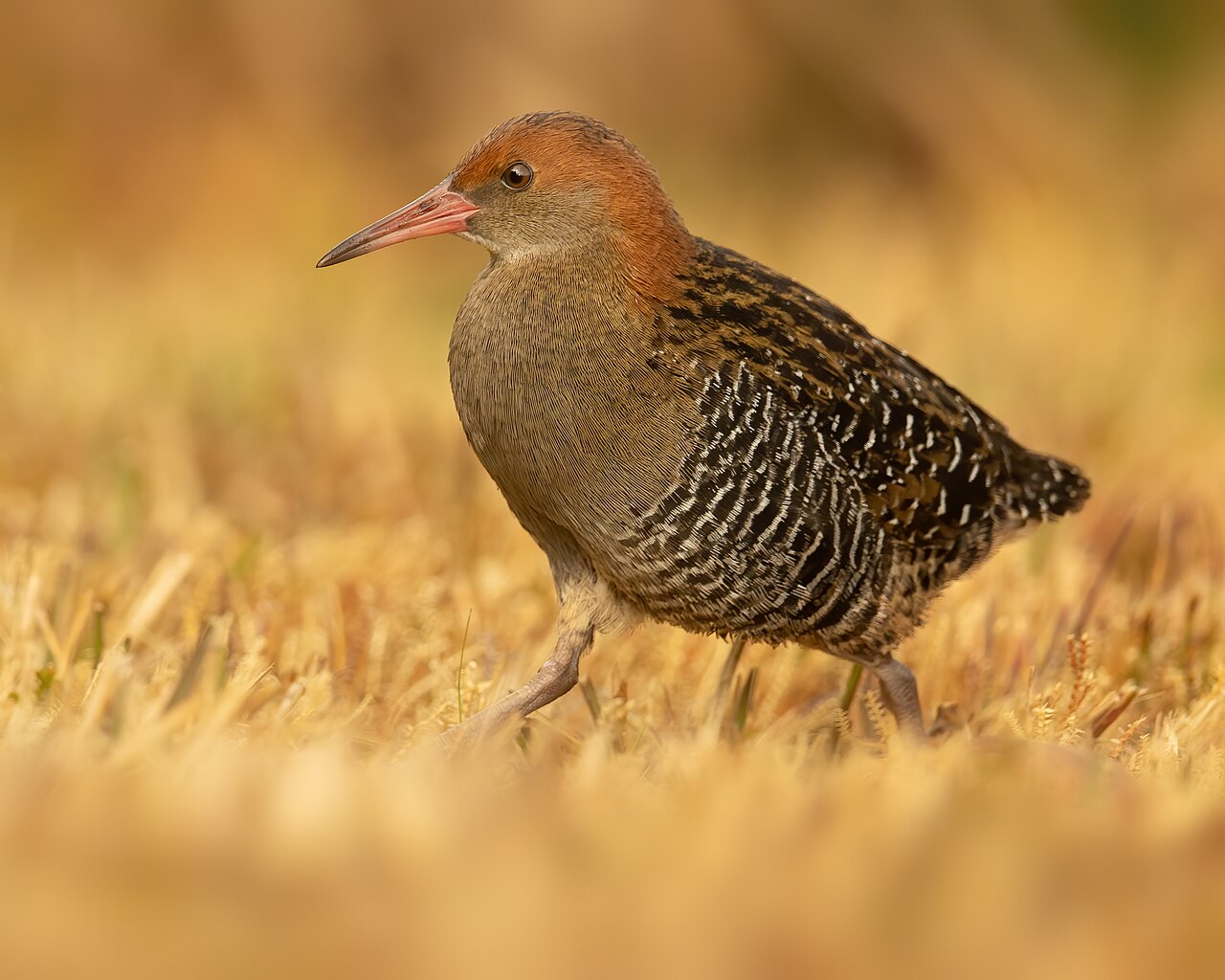
Lewin's Rail is a compact, short-tailed rail of dense swamp vegetation, with a long pink bill, a rufous crown and sharply barred black-and-white flanks. It is heard far more often than seen: most records amount to a voice from the reeds and a shape crossing a track.
Voice
The best-known sound is a hard, rattling kek-kek-kek-kek in series of ten or more, given above all at dusk and after rain. There are also low grunting and growling notes that at close range suggest a mammal rather than a bird, and a squealing note like a squeezed toy. An imitation of that squeal often brings the bird a few metres closer, after which it sinks back into cover at once.
No freely licensed recording has been found for this species yet; what to listen for is described below.
Identification
A rail of twenty-two to twenty-six centimetres with a heavy, long, slightly decurved bill in olive to dull pink, and a red iris. Crown and nape are rufous, face and breast slate grey, and flanks, belly and undertail are sharply barred black and white. The upperparts are blackish brown with cream streaking, which makes the bird vanish against dead reed. Young birds are duller, with a brownish breast and a dull crown. Tasmanian birds are larger and darker than those of the mainland.
Confusion species
The Buff-banded Rail (Hypotaenidia philippensis) lives in the same swamp and shows itself far more readily: it has a white brow, a rufous eye-stripe and an orange-buff breast band, and its bill is shorter and straighter. Baillon's Crake (Zapornia pusilla) is much smaller, has a short green bill and lacks the rufous crown. When a shape darts through the reeds the bill settles it: long, curved and pink belongs to this species.
Habitat
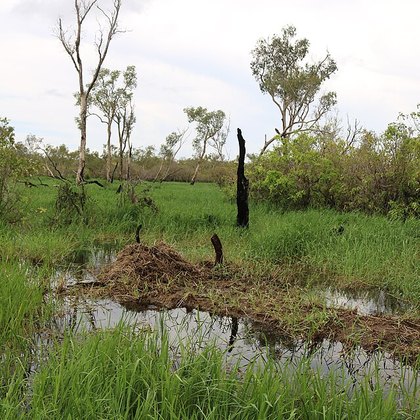
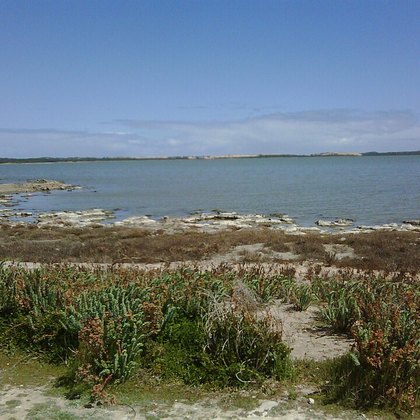
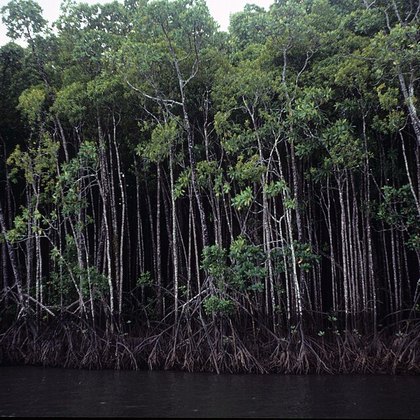
Dense tall growth in permanent fresh and brackish water: reeds, cumbungi, sedge, rushes and grass tussocks along swamps, drains and creeks. On Tasmania and in the Victorian ranges it also uses buttongrass moorland and wet herbfield, and along the coast the fringe of saltmarsh and mangrove. It avoids open banks and bare mud, preferring a tunnel through cover to any moment in the open.
Where the bird is most often found, arranged by main group and formation.

Range and movements
Eastern and southeastern Australia from southeastern Queensland into South Australia, with a population of its own on Tasmania, and beyond the region in New Guinea and Wallacea. The western form of southwestern Western Australia has not been seen since the 1930s and is regarded as gone. It does not migrate, but it turns up after rain in temporary swamps far from the known sites, which shows it wanders more than its shyness suggests.
- Resident
- dark = core range, pale = thinly spread
Where and when to look
Walk a reed edge or a vegetated drain early in the morning or just before dark and stand still; the voice usually comes within ten minutes. Watch the narrow runways through the sedge and the point where such a runway crosses a ditch or a track — that is where the bird steps across and is visible for a second.
Conservation
Least Concern (LC) globally, but a different story state by state: it is listed as vulnerable in Victoria and has become rare on the South Australian mainland. Drainage of wetlands, burning of reed beds and predation by foxes and cats cost it ground. Because the species is so hard to count, any trend for this bird stays uncertain.
Scientific name
Lewinia pectoralis | (Temminck, 1831)
Temminck described the species in 1831 as Rallus pectoralis; because it later moved to another genus, author and year stand in parentheses. The genus Lewinia was introduced by Gray in 1855 and honours John William Lewin, the first bird painter in Australia to live by the work. pectoralis means 'of the breast', after the grey breast shield. The description gives only Oceania as the source; Mathews fixed the type locality as New South Wales.