All species › Cranes, rails and allies › Rails, gallinules and coots › Red-necked Crake
Red-necked Crake | Rallina tricolor
Driekleurige ral | Polluela tricolor
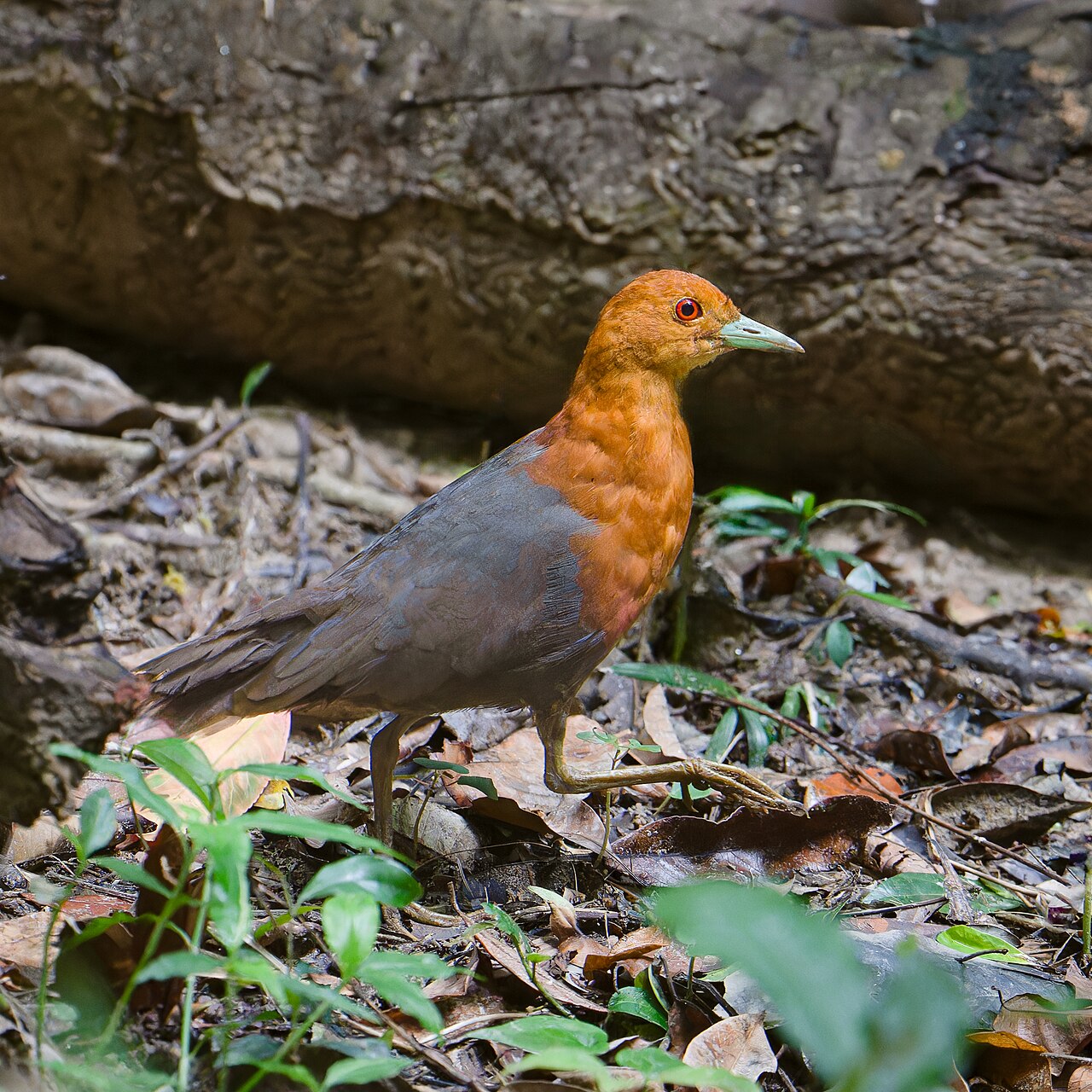
The Red-necked Crake is the rail of the tropical rainforest: head, neck and breast rufous, the rest dark olive-brown, with a red iris in a pale eye-ring and a black-and-white barred undertail. It keeps to dense scrub along creeks and pools and shows itself mainly in the last minutes before dark.
Voice
The best-known sound is an accelerating series of short, scraping squeaks that swells into a rattle, often at dusk and on through the night. Beyond that comes a slow, wooden tok … tok … tok and a low grunting that at close range sounds more mammal than bird. Pairs sometimes deliver the series in alternation.
No freely licensed recording has been found for this species yet; what to listen for is described below.
Identification
A crake of twenty-three to twenty-nine centimetres, some hundred and seventy to two hundred and ten grams, with a wingspan of about forty centimetres. Head, neck and breast are warm rufous, the throat paler; back, wings and belly dark olive- to grey-brown with faint pale barring below. Underwing and undertail are sharply barred black and white — the best mark on a bird flushing away. The bill is pale yellow-green, the legs grey-yellow to brown-olive, the iris red within a pale ring. Male and female cannot be told apart; young birds are mostly dark and dull.
Confusion species
Within this area confusion is limited, because no other rail pairs a rufous head with rainforest. Pale-vented Bush-hen (Amaurornis moluccana) shares the dense creekside cover of north Queensland but is plain olive-brown with a grey head and no rufous at all. Buff-banded Rail (Gallirallus philippensis) has a white eyebrow and an orange-brown breast band over sharply barred black-and-white underparts. White-browed Crake (Poliolimnas cinereus) is far smaller and paler, with a striking white face pattern.
Habitat
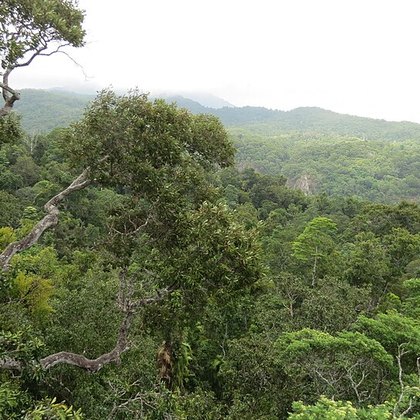
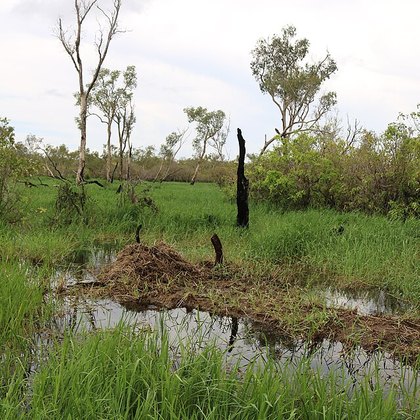
Tropical rainforest and dense forest around permanent water: creek banks with vines and ginger thickets, swampy hollows within the forest, and the tangled margins of pools and streams. Also in monsoon forest and vine thicket and in old gallery forest along creeks, up to about the upper limit of rainforest. It avoids open banks and keeps to the forest floor among leaf litter and roots.
Where the bird is most often found, arranged by main group and formation.


Range and movements
Within the map window only in the far northeast of Australia, and there in two separate areas: the eastern side of the tip of Cape York around Lockhart River, and the Wet Tropics coast between Cooktown and Townsville. It occurs nowhere else in Australia and not in New Zealand; most of its world range lies in New Guinea, the Bismarck Archipelago and eastern Indonesia.
- Resident
- dark = core range, pale = thinly spread
Where and when to look
Sit in the late afternoon by a forest bird bath or a rainforest creek around Julatten or Kuranda and wait until it is nearly dark — at Kingfisher Park, Julatten, it has come to drink and bathe for years. Do not move, and do not expect a whole bird: first a tick, then a rufous head between the stems. In torchlight the red iris is the first thing to catch.
Conservation
Least Concern (LC) globally, thanks to a large range outside Australia. The Australian population is small and wholly dependent on continuous rainforest with permanent water; historic clearing of the Wet Tropics shrank that ground, and what remains now lies largely within protected areas. Because the species is so shy and nocturnal, no reliable Australian trend exists.
Scientific name
Rallina tricolor | Gray, 1858
George Robert Gray described the species in 1858 as Rallina tricolor, in the Proceedings of the Zoological Society of London, from a bird taken in the Aru Islands; it remains in that genus, so author and year carry no parentheses. Rallina is a diminutive of Rallus, 'rail', introduced by the same Gray in 1846. tricolor means 'three-coloured', for the rufous, olive-brown and black-and-white of the plumage.