All species › Falcons › Falcons and caracaras › Australian Hobby
Australian Hobby | Falco longipennis
Australische boomvalk | Alcotán australiano
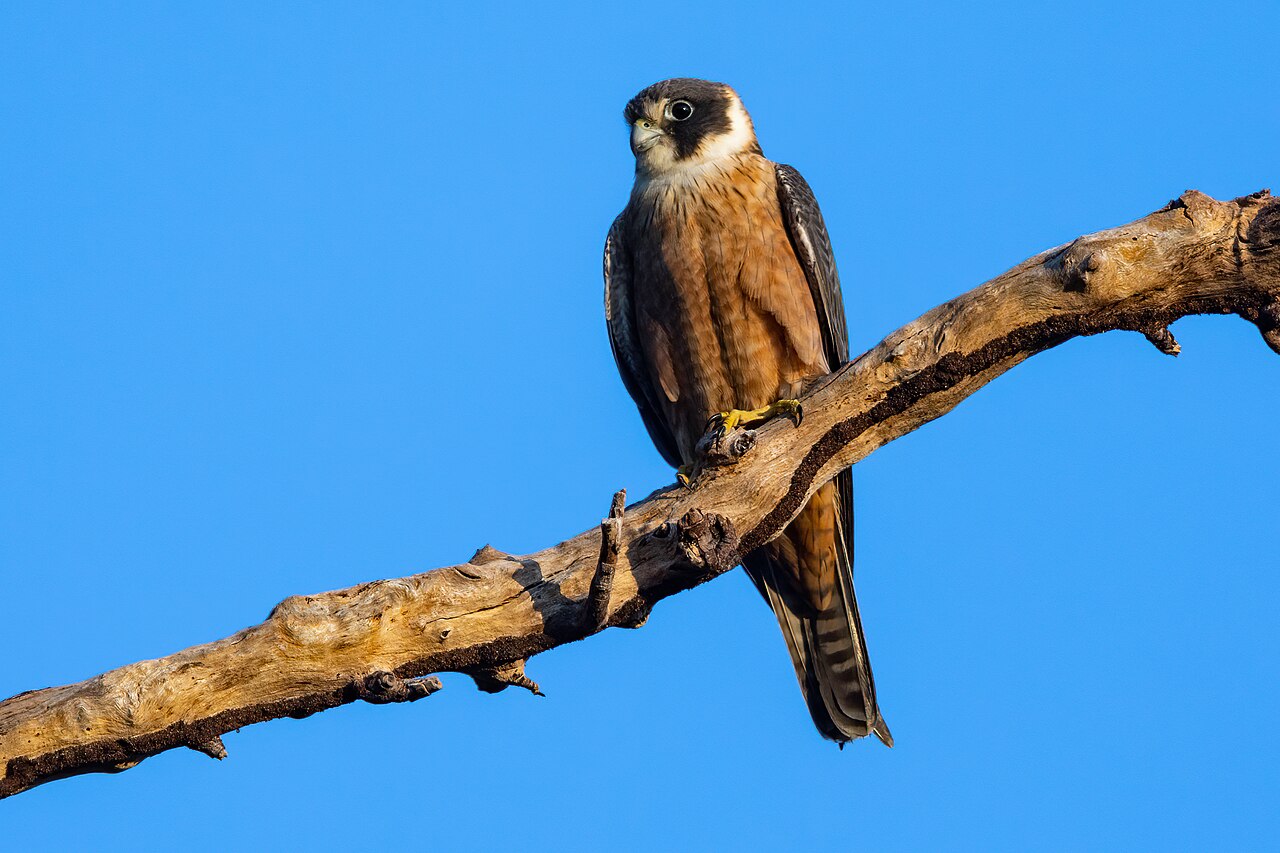
The Australian Hobby is the smallest true falcon on the mainland after the kestrel: a compact, dark bird with long scythe-shaped wings that hunts at dusk over street lights, waterholes and treetops. Anyone who sees a small falcon with a whirring wingbeat cutting in behind a swallow or a bat is almost certainly watching this species.
Voice
The call is a fast, high, chattering series almost always given in flight: kee-kee-kee, kee-kee-kee-kee, shriller and more hurried than the heavier hek-ek-ek of the Peregrine. At the nest it becomes more persistent and querulous; away from the nest the bird is usually silent, and a hunting hobby is more often betrayed by the alarm of swallows and starlings than by its own voice.
No freely licensed recording has been found for this species yet; what to listen for is described below.
Identification
A slim falcon of just over thirty centimetres with strikingly long, pointed wings and a short, square-cut tail. The upperparts are blue-grey to slate, the head carries a dark hood with a broad black moustache, and between them sit a pale brow and a cream half-collar that shows at range as a light patch on the nape. The underparts are warm rufous to buff with fine dark streaking — never clean white — and juveniles are browner and more heavily streaked. In flight the outline is that of a big swift: narrow, slightly bulging wings with a bluntish tip, and a beat that flickers rather than rows.
Confusion species
Peregrine Falcon (Falco peregrinus) is distinctly larger and heavier, with a full black helmet instead of a hood with a pale nape, and white underparts densely barred rather than rufous and streaked. Eurasian Hobby (Falco subbuteo), here only an extremely rare vagrant, is very similar but shows a bright white throat, a white cheek patch and a white breast with crisp black streaks standing out against the dark upperparts, plus sharply defined rufous thighs and vent. Nankeen Kestrel (Falco cenchroides) is rufous above, hovers, and has a black band at the tail tip. Collared Sparrowhawk (Tachyspiza cirrocephala) has rounded wings with spread fingers and a much longer tail.
Habitat
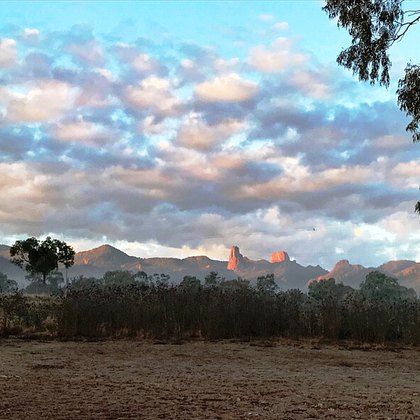
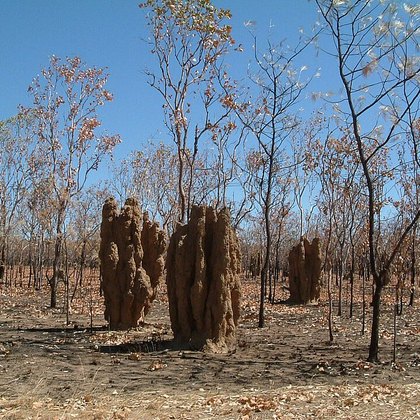
Lightly timbered country is its picture: dry eucalypt forest and woodland, eucalypt savanna, tree lines along creeks, but also orchards, grazing land with scattered trees and above all parks and streets in towns and cities. It avoids dense closed forest and truly treeless desert; open water with swallows, starlings and insects above it draws it in. Of all Australian falcons it is the most at home in town and the one most often hunting in the last light of the day.
Where the bird is most often found, arranged by main group and formation.


Range and movements
Spread over almost the whole Australian mainland, from the tropical north coast to the southern coast, and commonest in lightly timbered country with moderate to good rainfall. In the arid interior and on the Nullarbor it is scarce and irregular, although it appears there during mouse plagues. On Tasmania it is thinly spread and largely a summer bird: many cross Bass Strait in autumn. New Zealand lies outside its normal range.
- Resident
- dark = core range, pale = thinly spread
Where and when to look
Stand at dusk by a sports field, a car park or a lit bridge and look up: the Australian Hobby hunts insects and bats around the light beams until long after sunset, when most other raptors have gone to roost. By day a sudden collective panic among starlings or martins often places it before you see it.
Conservation
Least Concern (LC), and rated secure federally and in every Australian state. The species profits from the half-open landscape that farming has made and from towns full of starlings, sparrows and martins; it breeds in the old nests of ravens and magpies and so needs no tree hollow. Loss of large nest trees in cleared farmland and collisions with vehicles cause local losses, but the overall picture is stable.
Scientific name
Falco longipennis | Swainson, 1838
Swainson described the species in 1838 as Falco longipennis, and it has stayed in that genus, so author and year carry no parentheses. Falco is the ordinary Latin word for falcon, probably from falx, 'sickle', after the shape of the wing. longipennis combines longus, 'long', with penna, 'flight feather', hence 'long-winged' — exactly the feature that fixes it in the air. The type locality is Tasmania; the Dutch and English names both point to the similar Eurasian Hobby.