All species › Falcons › Falcons and caracaras › Grey Falcon
Grey Falcon | Falco hypoleucos
Grijze valk | Halcón gris de Australia
The Grey Falcon is Australia's rarest falcon and one of the rarest raptors in the world: a pale, thickset bird of the arid interior, with black wingtips in an otherwise wholly grey plumage and with bright orange cere, orbital ring and legs. With perhaps a thousand breeding pairs spread across a continent, every sighting is an event.
Voice
A hoarse, clucking and whining chatter that recalls the Peregrine but runs slower and deeper: a loud, unhurried kek-kek-kek or kak-ak-ak-ak, mainly at the nest and in territorial defence. Away from breeding the bird is silent. Unlike Brown Falcon, which is constantly noisy, voice rarely helps here — a silent pale falcon is itself a reason to look harder.
No freely licensed recording has been found for this species yet; what to listen for is described below.
Identification
A robust, rather thickset falcon with broad-based wings that taper to a point without being acutely so, and a comparatively short tail. The whole plumage is made of greys, from near-white on the underwing to near-black on the outer primaries: there is no brown or rufous anywhere. From below the bird looks very pale against the sky, with black wingtips prominent from above but barely visible from beneath; the tail is pale grey with dark barring and an off-white tip. The decisive features are the bare parts: in the adult the orbital ring, cere and legs are bright orange-yellow, and the white 'trousers' cover half the bare lower leg. Juveniles lack the orange — their legs are mid-yellow — and are darker above with black marks on the flanks and underwing. It soars for long periods without a wingbeat and never hovers.
Confusion species
The palest Brown Falcons (Falco berigora) are the main confusion species and live in the same interior: they have shorter trousers that leave the long leg bare, blue-grey or dull legs rather than orange, a tear-stripe and a variable plumage with brown in it, and they are constantly noisy. Peregrine Falcon (Falco peregrinus) is far darker slate above, with longer, more acutely pointed wings, a longer tail and a black helmet. Grey Goshawk (Tachyspiza novaehollandiae) and the other accipiters have rounded wingtips with spread fingers, long uncovered legs and no yellow orbital skin. Black-shouldered Kite (Elanus axillaris) shows a pure white inner wing against sharply cut black, where the Grey Falcon grades gradually from white to grey.
Habitat
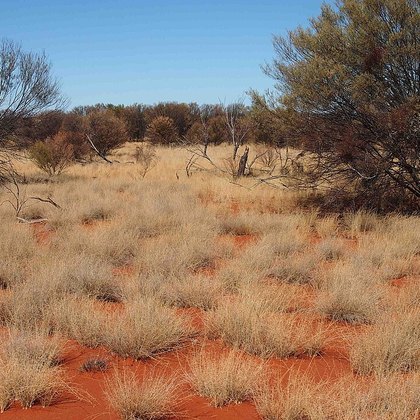
The arid and semi-arid interior below about 500 millimetres of annual rainfall, and nowadays mainly the part below 250 millimetres: spinifex plains, mulga and acacia scrub, lightly timbered desert woodland, Mitchell grass plains and gibber. It breeds only in large trees along inland creeks and river beds — river red gum and coolibah — using abandoned stick nests of ravens and other raptors. The combination of treeless hunting plain and a single line of nest trees is exactly what makes it so vulnerable.
Where the bird is most often found, arranged by main group and formation.



Range and movements
Endemic to Australia and spread across almost the whole dry mainland except Cape York, but everywhere at extremely low density. The centre of gravity lies in the arid centre and north: the channel country of south-west Queensland, the inland Northern Territory, the Pilbara and Gascoyne, and far western New South Wales, chiefly west of the Darling. The breeding range has clearly contracted: formerly it reached within the 500-millimetre isohyet, now only the true arid zone. Tasmania and New Zealand lie outside the range.
- Resident
- Winter
- dark = core range, pale = thinly spread
Where and when to look
Look for it along the big inland creeks of the arid centre, and on every pale falcon check the bare parts first: an orange orbital ring, cere and legs rule out a pale Brown Falcon at once. If you are unsure at range, look at the legs — on Grey Falcon half the lower leg disappears under the white trousers, on Brown Falcon the long bare legs stick well out. Report every sighting to the state database; with this species almost every bird counts.
Conservation
Vulnerable (VU) on the global list, and recorded as endangered or rare in several Australian states. The world total is put at some thousand breeding pairs, roughly two thousand mature birds, of which New South Wales holds fewer than a quarter — fifty to two hundred mature birds are reckoned there, and a whole atlas period produced no breeding records. The heaviest pressure comes from degradation of arid rangeland by overgrazing and from clearing in the semi-arid zone, which hits both prey density and the number of usable nest trees; prolonged drought empties territories, and poisoning is named as a further risk.
Scientific name
Falco hypoleucos | Gould, 1841
Gould described the species in 1841 as Falco hypoleucos, and it has stayed in that genus, so author and year carry no parentheses. The epithet is Greek: hupo-, 'beneath, below', and leukos, 'white', hence 'white beneath' — precisely the impression a bird passing overhead gives against the sky. The type locality is Western Australia. The Dutch and English names point to the grey upperparts; the Spanish name adds the country to avoid confusion with other grey falcons.