All species › Falcons › Falcons and caracaras › Nankeen Kestrel
Nankeen Kestrel | Falco cenchroides
Australische torenvalk | Cernícalo australiano
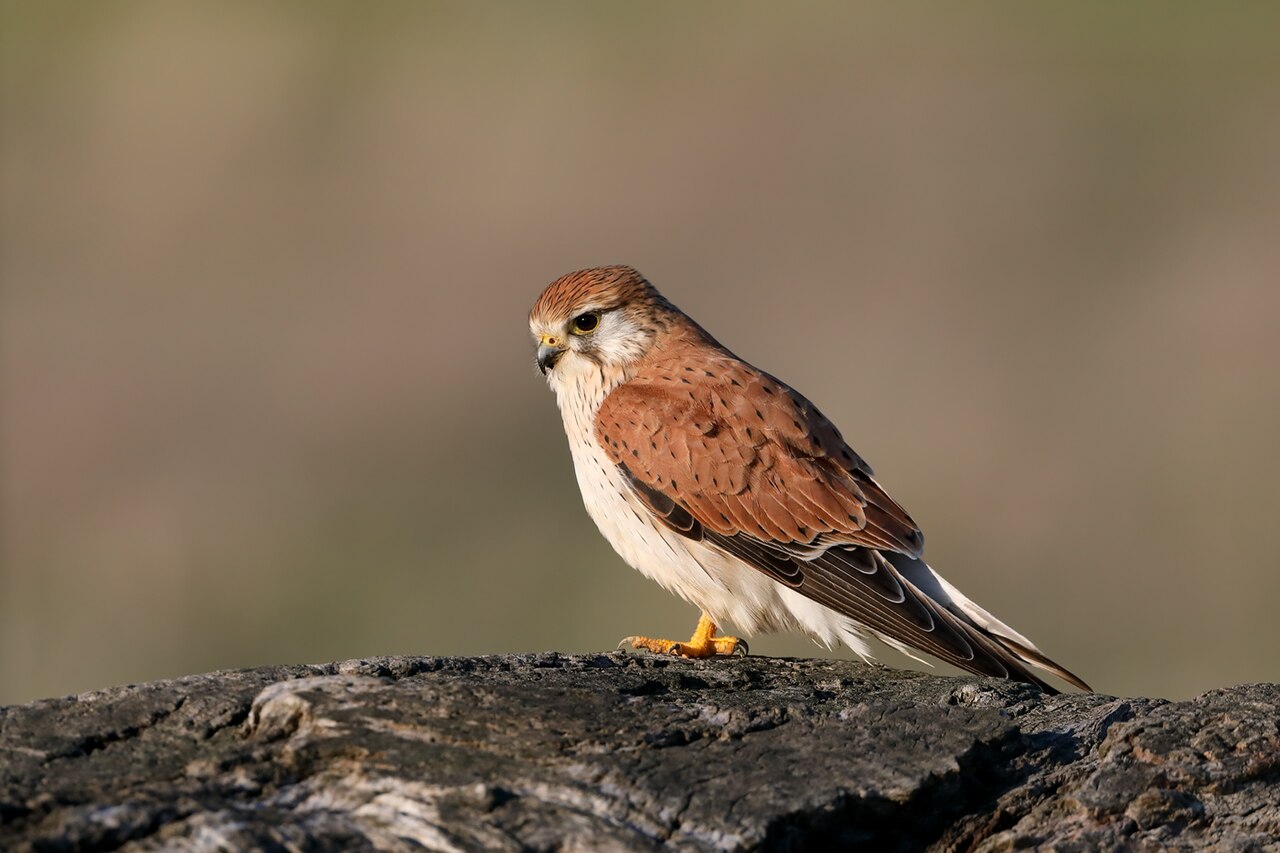
The Nankeen Kestrel is the falcon that hangs still above the roadside: lightly built, rufous above and pale below, with black wingtips and a black band at the end of the tail. It is the commonest raptor of open country and the only one to be found almost everywhere in the region. Its numbers move with the mice: after a good wet year inland there are suddenly dozens along a single road.
Voice
At the nest and against its own kind comes a high, rapidly repeated kee-kee-kee-kee, shriller and thinner than the voice of the larger falcons. It is heard mostly in the breeding season, when the pair chase one another around a cliff ledge or a building. Begging young give a sustained, plaintive whistling that betrays an occupied nest site from a kilometre away. Hunting birds are silent.
No freely licensed recording has been found for this species yet; what to listen for is described below.
Identification
A slim, long-winged falcon with a long tail spread into a fan while hovering. The upperparts are light rufous with fine dark streaks, the wingtips black, the underparts cream-white with fine streaking on the breast and a black band just short of the tail tip. The male has a grey crown and grey tail, to a degree that varies from bird to bird; the female is larger, more heavily marked and keeps rufous on crown and tail, barred across. Young birds resemble the female but are more coarsely streaked. The flight is light and sailing, with short quick beats and long motionless pauses in which the head is held perfectly still.
Confusion species
Australian Hobby (Falco longipennis) is as long but dark, with a black cap, rufous underparts and scythe-shaped wings, and hunts in fast straight attacks without ever hovering. Brown Falcon (Falco berigora) is larger, extremely variable in colour, with a dark moustache and a slow, sleepy wingbeat. Black-shouldered Kite (Elanus axillaris) also hangs still over the roadside, but is white with a grey back, a black shoulder patch and a red eye, and holds its wings high in a V while doing so. In doubt the colour of the upperparts settles it: only the kestrel is rufous there.
Habitat
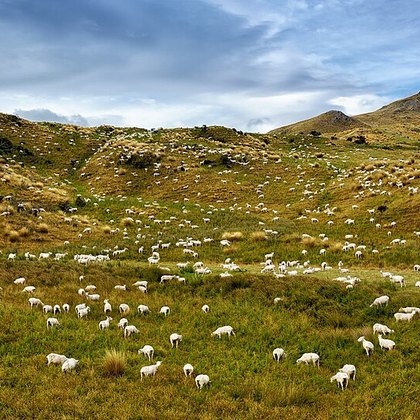
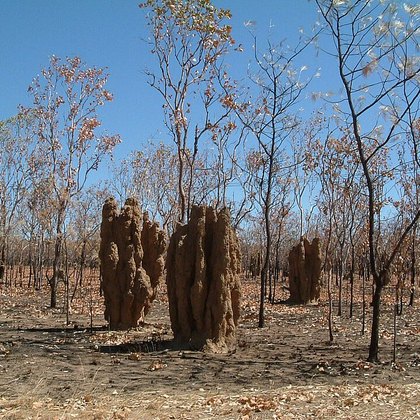
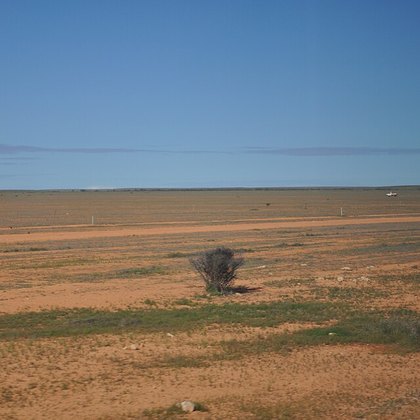
Open country in the widest sense: pasture and grazed rangeland, cereal paddocks, savanna with scattered eucalypts, saltbush plain, road verges and the edges of towns and cities. To hunt it needs open ground under short cover, and to breed a hollow, a cliff ledge, a disused corvid nest or a ledge on a building. Dense forest goes unused, and the core of the sand deserts only after rain.
Where the bird is most often found, arranged by main group and formation.



Range and movements
Across almost all of Australia, from the coast to deep inland, and annually on Norfolk as well; in New Zealand it is a rare but regular visitor. Outside the area of this guide it breeds in New Guinea and parts of Indonesia. Some birds are resident, some move short distances, and a large share simply follow the food: after a wet spell inland the birds follow the mice and leave again as it dries. In the southeast birds move north out of the coldest districts in winter.
- Resident
- dark = core range, pale = thinly spread
Where and when to look
Drive a country road with posts and wires and watch for the bird standing still in the air above the verge; only this falcon does that at length and with the tail spread. Then look at the back: rufous closes the case. In spring, search cliff edges and the ledges of tall buildings for a pair chasing each other and calling.
Conservation
Not threatened (LC) and the commonest raptor in Australia, with a distribution that clearing and grazing have if anything widened. Numbers swing strongly with the supply of mice and grasshoppers, which makes one year hard to compare with the next. Poisoning through controlled rodents and the loss of old trees with hollows press locally, but the species takes to buildings and to nest boxes readily.
Scientific name
Falco cenchroides | Vigors & Horsfield, 1827
Vigors and Horsfield described the species in 1827 as Falco cenchroides, and it stands in that genus still, so author and year carry no parentheses. The genus Falco goes back to the Latin falx, sickle, after the sickle shape of the wing. The epithet is formed from cenchris, the old name of the Lesser Kestrel of the Old World, with the ending -oides, 'resembling'; the name therefore says that this falcon looks like that species. The type locality is Australia, later fixed to New South Wales. The English name Nankeen comes from nankeen, a yellow-brown cotton cloth from Nanjing, after the colour of the upperparts.