All species › Falcons › Falcons and caracaras › New Zealand Falcon
New Zealand Falcon | Falco novaeseelandiae
Nieuw-Zeelandse valk | Halcón maorí
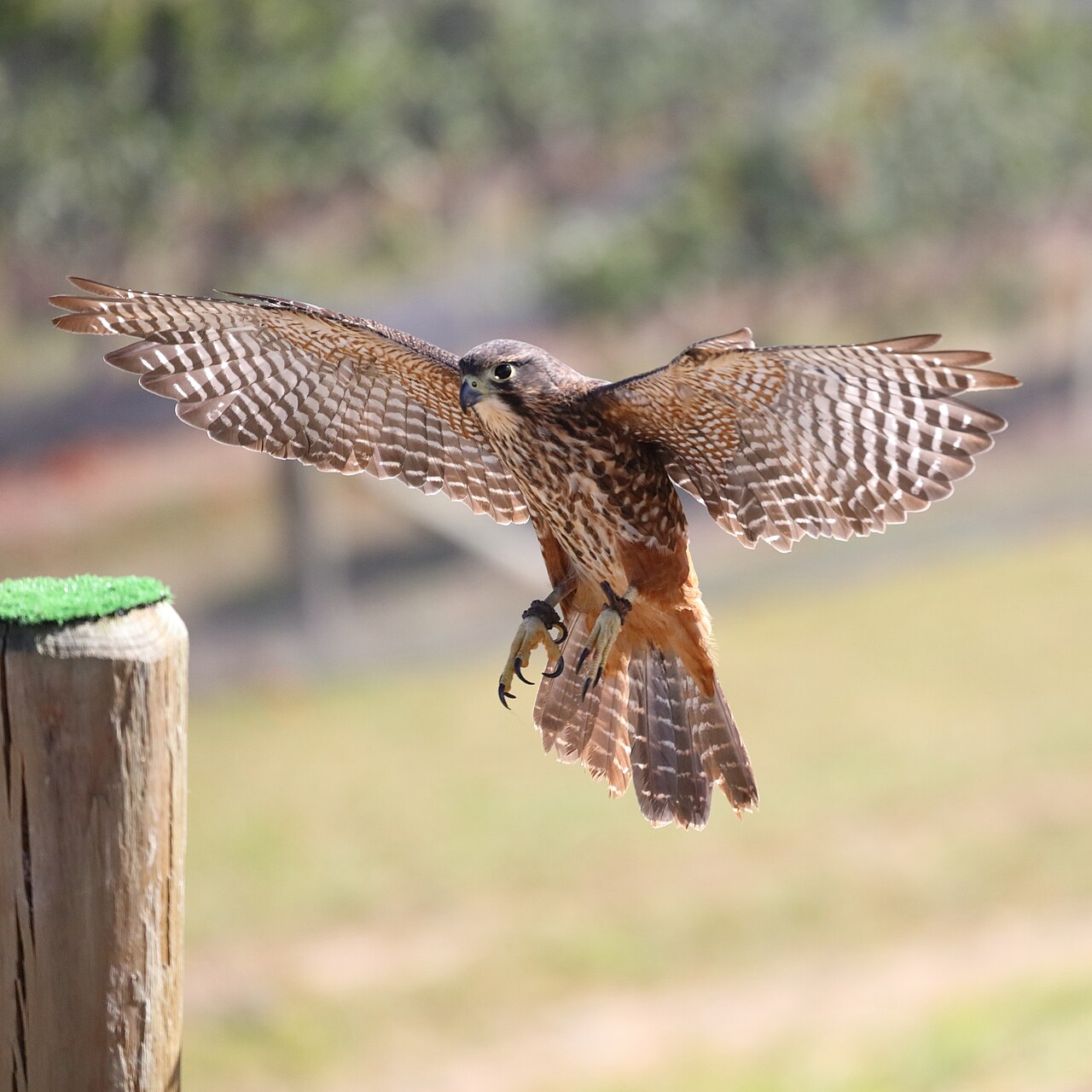
The New Zealand Falcon or karearea is the only falcon in the country and, alongside the Swamp Harrier, the only native diurnal raptor still breeding there: a dark, short-winged falcon that hunts in agile pursuit flights straight through the forest and takes prey larger than itself. It appears on the twenty-dollar note and is one of the few birds that will actually strike a walker near the nest.
Voice
Voice is usually the first sign and almost always means a nest is close: a loud, rapidly repeated, penetrating series of kek-kek-kek-kek, given by both parents in defence of the territory, the female's call noticeably deeper than the male's higher one. There are also softer, plaintive contact notes between partners and at food passes. Anyone who hears this above a forest edge or a tussock (grassland of loose, tall clump-forming grasses, especially in New Zealand) slope is almost certainly already being watched.
Recording: David Lloyd-Jones — CC BY-NC-SA 4.0 · Motuara Island, Marlborough, New Zealand · xeno-canto
Identification
A solid falcon of about forty-five centimetres with strikingly broad, fairly short wings and a long tail — an outline closer to a goshawk than to a Peregrine, and one that lets it steer between tree trunks. The upperparts are dark brown, the breast cream with heavy dark streaking, and the thighs and undertail coverts rufous. In all plumages a dark moustache runs down the cheek from the hooked bill. Juveniles are more uniformly dark brown with blue-grey legs and eye-ring, while adults have bright yellow legs, cere and orbital ring. The female is considerably larger and heavier than the male.
Confusion species
Swamp Harrier (Circus approximans) is the bird it is most often confused with in New Zealand: much larger, with a pale rump, long narrow wings held in an obvious V, and a slow, low quartering flight — the falcon by contrast flies with fast, shallow beats and hunts in straight pursuit. Long-tailed Koel (Urodynamis taitensis) misleads with its long tail and streaked underparts, but has a loose, straight flight and no hooked bill. Nankeen Kestrel (Falco cenchroides), which reaches New Zealand occasionally, is smaller, rufous above and hovers. The rare Australian vagrant falcons, such as Black Falcon (Falco subniger), are larger and longer-winged.
Habitat
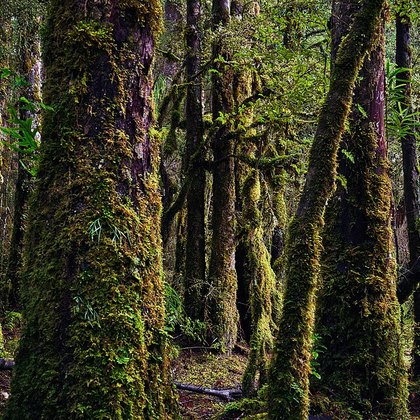
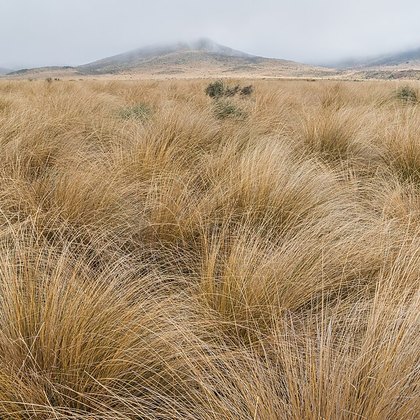
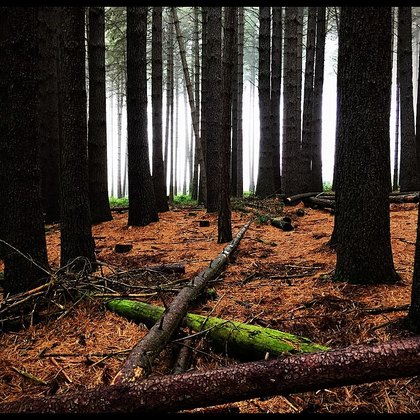
Three kinds of country carry the species: southern beech and podocarp-broadleaf forest in the hills, open tussock grassland and hill country with rock outcrops, and planted forests of Monterey pine. In forested country it nests in epiphytes or on a branch, in open country on the ground under an overhanging rock or in a scrape among tussocks. Since the turn of the century it has also bred in vineyards and farmland in Marlborough, where birds have been put to work protecting the grapes from songbirds.
Where the bird is most often found, arranged by main group and formation.



Range and movements
Endemic to New Zealand and spread across both main islands wherever suitable habitat exists, extending to Stewart Island and the Auckland Islands. It is absent from Northland and scarce north of a Taranaki–Rotorua line; the highest densities are in the forested interior of the North Island, the north-west of the South Island and the dry east of the South Island. Three forms are recognised: the small, dark bush falcon of the North Island and north-west South Island, the large, pale eastern falcon of the central and eastern South Island, and the southern falcon of Fiordland, Stewart and the Auckland Islands. Australia lies outside its range.
- Resident
- dark = core range, pale = thinly spread
Where and when to look
Walk a forest edge or a tussock slope in the breeding season and listen for the kek-kek-kek: if you hear it, do not keep walking towards the sound, because a breeding pair will come at people and dogs and will genuinely connect. On the South Island plains it likes a roadside fence post or a transmission pylon. In the Marlborough vineyards a purposeful summer walk stands a good chance.
Conservation
Globally the species is listed as Least Concern (LC), but the New Zealand assessment is stricter and splits by form: the southern falcon counts as Nationally Endangered, the eastern falcon as Nationally Vulnerable and the bush falcon as Nationally Increasing. The total is uncertain and put at five to eight thousand birds. The heaviest pressures are predation by cats, stoats and ferrets at the often ground-level nests, loss of nest trees to selective logging, conversion of tussock grassland to pasture, illegal shooting around livestock, electrocution on power poles and collisions with wind turbines. The Department of Conservation runs predator control and genetic research on the three forms, and works with the Karearea Falcon Trust and the Wingspan Birds of Prey Trust, which care for injured birds and breed them in captivity.
Scientific name
Falco novaeseelandiae | Gmelin, 1788
Gmelin described the species in 1788 as Falco novae-Seelandiae, after a description by Latham; the genus has not changed since, so author and year carry no parentheses. novaeseelandiae simply means 'of New Zealand'. The type locality is Queen Charlotte Sound on the South Island, where the bird was collected on one of Cook's voyages. The Maori name karearea is the everyday name in New Zealand itself and is used in official language too; the bird is pictured on the back of the twenty-dollar note, together with Mount Tapuae-o-Uenuku and the Marlborough rock daisy.